The Essential ETOH Meaning: Your Complete Guide to Medical Use, Safety, and Lab Results
You saw “ETOH” on a hospital form or lab report and felt lost. Misreading that abbreviation can delay treatment or hide a serious drinking problem. This guide unpacks the complete etoh meaning so you can interpret charts, recognize red flags, and have smarter conversations with healthcare providers.
The Origin of ETOH: Why Medical Professionals Use This Abbreviation
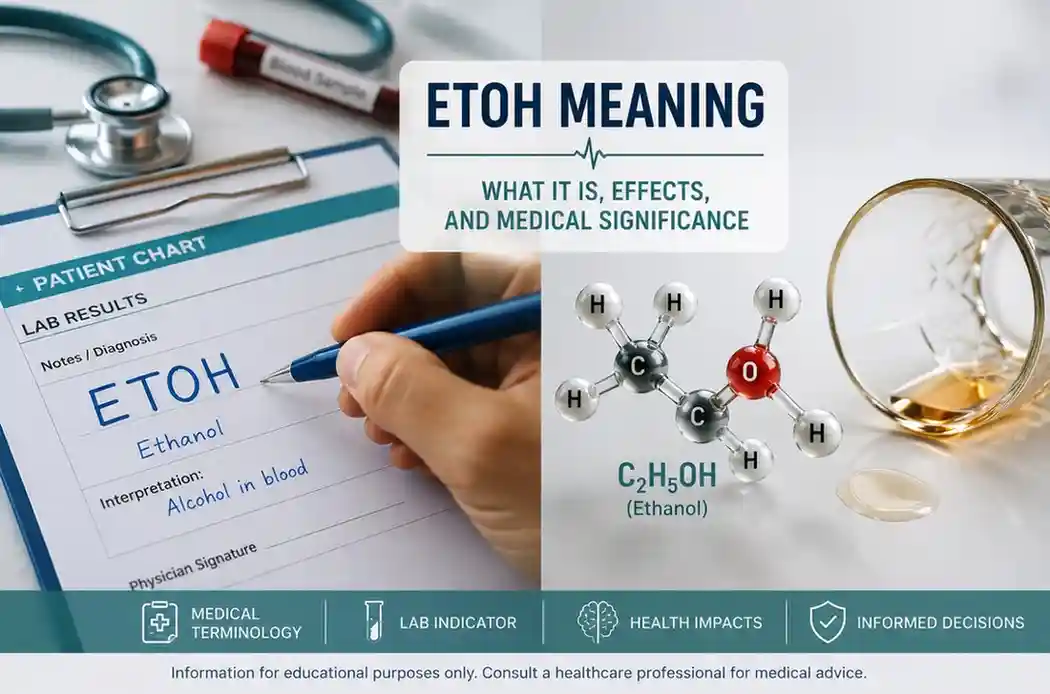
Doctors and nurses write “ETOH” to represent ethyl alcohol, the type of alcohol found in beer, wine, and spirits. The term comes from the chemical structure: “Et” stands for the ethyl group (C₂H₅), and “OH” stands for the hydroxyl group. In busy emergency rooms, shorthand saves precious seconds. Understanding the etoh meaning helps you decode everything from triage notes to surgical clearances. The abbreviation first appeared in early 20th-century medical textbooks and stuck because it instantly communicates a substance that can complicate almost any diagnosis.
ETOH Meaning in Blood Tests and Lab Results
When a lab report lists “ETOH” with a number, it measures the concentration of alcohol in your blood. This test directly reflects recent drinking. A result of 0.08% (80 mg/dL) is the legal driving limit in most U.S. states. Critical values above 300 mg/dL can lead to coma or respiratory failure. Lab systems also use “ETOH” to flag a blood alcohol level (BAL) that requires immediate attention. Grasping the etoh meaning here means recognizing that even a “normal” reading might not rule out chronic alcohol use — it only rules out acute intoxication at the time of the draw.
| Blood ETOH Level (mg/dL) | Clinical Symptoms & Impairment |
| 10–50 | Mild relaxation, slight warmth, minimal impairment |
| 50–100 | Impaired judgment, reduced coordination, legal intoxication in many regions |
| 100–200 | Slurred speech, unsteady gait, significant motor impairment |
| 200–300 | Marked confusion, vomiting, possible blackouts |
| 300–400 | Stupor, severely depressed vital signs, risk of coma |
| Above 400 | Respiratory arrest, life-threatening overdose, death possible |
ETOH Slang Meaning: The Street Interpretation
Outside the clinic, people sometimes use “ETOH” as a coded way to talk about alcohol without others catching on. In text messages or social media, “ETOH” can mean any alcoholic drink, often in discussions about partying or addiction recovery. Online support groups for alcohol use disorder even tag posts with #ETOH to share sober milestones. The slang version of the etoh meaning keeps the conversation discreet. If you see “ETOH” in a non-medical chat, it almost always points to alcohol — rarely, it’s a misspelled “et cetera,” but context clears that up fast.
How ETOH Is Measured: mg/dL and BAC Explained
Blood alcohol content (BAC) measures milligrams of ethanol per deciliter of blood. A BAC of 0.05% means 50 mg of ethanol in 100 mL of blood. Breathalyzers estimate BAC indirectly, but serum ETOH testing remains the gold standard in hospitals. Metabolism breaks down alcohol at a fixed rate — roughly 15 mg/dL per hour for an average adult. This biological fact explains why “sleeping it off” takes time and why a high ETOH level can still be dangerous hours after the last drink. Emergency teams calculate backward to estimate peak intoxication, making the etoh meaning a timeline tool, not just a number.
ETOH Abuse vs. Dependence: Clinical Distinctions
The American Society of Addiction Medicine separates “ETOH abuse” from “ETOH dependence.” Abuse means drinking despite recurrent legal, social, or occupational problems. Tolerance, withdrawal, and a need to drink are all components of dependence. Knowing the precise etoh meaning in these contexts shapes the treatment plan. A person who abuses alcohol may benefit from brief counseling, while someone dependent often needs medically supervised detox. The DSM-5 now folds both under “alcohol use disorder” with mild, moderate, and severe sub-classifications, but the term “ETOH” still anchors the chart.
Signs of ETOH Withdrawal and Medical Management
ETOH withdrawal can start 6–12 hours after the last drink and peaks at 24–72 hours. Symptoms escalate in stages:
- Tremors, anxiety, sweating
- Nausea, increased heart rate
- Hallucinations (visual, tactile)
- Seizures
- Delirium tremens (DTs) with confusion and high fever
The Clinical Institute Withdrawal Assessment for Alcohol (CIWA-Ar) scores severity and guides benzodiazepine dosing. Recognizing the etoh meaning early in withdrawal symptoms allows nurses to intervene before DTs become life-threatening. Never attempt home detox if you’ve had DTs or seizures before — inpatient care saves lives.
ETOH in Nursing Documentation: A Nurse’s Perspective
Nursing notes frequently document “ETOH on breath” or “ETOH positive” during admission assessments. This shorthand shapes the entire care plan. A positive ETOH screen means the team must monitor for withdrawal, implement fall precautions, and adjust anesthesia dosing. Once you understand the etoh meaning in this workflow, you see why nurses advocate so strongly for honest patient reporting. Concealing alcohol intake leads to preventable surgical complications or dangerous drug interactions. Nurses also use the term to teach patients about the effects of ethanol on healing and medication metabolism.
Legal Implications of High ETOH Levels
Courts rely on serum or breath ETOH to prove intoxication in DUI cases. A blood draw showing 0.08% or higher triggers automatic license suspension in many jurisdictions. For commercial drivers, the limit drops to 0.04%. Ignoring the etoh meaning in legal settings can cost you your job, your driver’s license, and your freedom. Chain of custody forms explicitly record “ETOH” to eliminate ambiguity. Defense attorneys scrutinize the time between the alleged offense and the blood draw, since metabolism continuously reduces the level.
How to Talk to Your Doctor About ETOH Findings
Patients often panic when they see “ETOH” flagged on their lab results. Frame the conversation with direct questions: “What was my exact ETOH level?” “Could occasional social drinking cause this result?” “How does this affect the procedure I’m scheduled for?” The etoh meaning extends beyond a single number — it opens a dialogue about lifestyle, liver health, and mental well-being. Primary care providers can use the result to screen for hidden alcohol problems and order follow-up tests like GGT, AST, and ALT.
Difference Between ETOH and Ethanol
Ethanol is the scientific name for the chemical compound C₂H₅OH. ETOH is simply the medical abbreviation. They are identical substances. No hidden nuance exists — the etoh meaning equals pure ethyl alcohol. This matters because some patients confuse ETOH with methanol or isopropyl alcohol, which are toxic. When you see “ETOH” on a label, understand it refers exclusively to the drinkable (potable) alcohol, not industrial solvents.
ETOH Meaning in Pregnancy and Fetal Alcohol Syndrome
An ETOH reading in a pregnant patient’s chart demands immediate action. No safe level of alcohol exists during pregnancy. Prenatal exposure to ethanol can cause fetal alcohol spectrum disorders (FASDs), leading to lifelong physical and cognitive disabilities. The CDC highlights that the etoh meaning in obstetrics is a red-alert signal. Screening tools like T-ACE and TWEAK help providers ask sensitively about drinking while pregnant, and early intervention reduces harm.
Why ETOH Screening Matters in Emergency Settings
Trauma surgeons order an ETOH level on almost every serious injury patient because intoxication masks symptoms of head trauma and internal bleeding. A disoriented patient with a high ETOH level might have a brain bleed that gets missed without a CT scan. This is why the etoh meaning in the ER goes far beyond “drunk.” It forces clinicians to dig deeper and keep the patient under observation longer. Screening also uncovers risky drinking patterns that brought the patient to the ER — a golden opportunity for a brief intervention.
Is ETOH Always About Alcohol? (Other Possible Meanings)
Almost always, yes. In extremely rare cases, “ETOH” could appear as a typo for “E.T. on H” (a sci-fi reference) or in a chemistry discussion referring to the ethyl radical without the hydroxyl. But in any human-health context, the etoh meaning points straight to ethyl alcohol. If you stumble upon the term in a non-medical document, check the surrounding text; there is no widely accepted alternative definition that would cause confusion.
How Much Time Does Etoh Remain in Your Body?
Urine tests detect ETOH metabolites up to 80 hours after heavy drinking, but blood clearance follows a predictable curve. Approximately one standard drink is eliminated by the liver every hour. A person with a BAC of 0.16% will need about 10–12 hours to reach zero. Hair testing can show ETOH use for months. This timeline explains why employment alcohol testing and post-accident investigations demand an exact etoh meaning, not a guess.
Frequently Asked Questions (FAQs)
1. In terms of medicine, what does ETOH stand for?
Short Answer: ETOH stands for ethyl alcohol, the chemical name for the alcohol in beverages.
Details: Healthcare workers use the abbreviation to denote any ethanol-containing substance. The notation saves time on handwritten notes and electronic health records, instantly alerting the care team to potential intoxication, withdrawal risk, or medication interactions.
2. Is ETOH the same as ethanol?
Short Answer: Yes, ETOH and ethanol are exactly the same thing.
Details: “Et” represents the ethyl group; “OH” represents the hydroxyl group. Ethanol is the systematic chemical name, while ETOH is the shorthand version. Both refer to drinkable alcohol, not rubbing alcohol or methanol.
3. Why do hospitals use ETOH instead of just writing “alcohol”?
Short Answer: ETOH is a precise, universal abbreviation that eliminates confusion with other alcohols.
Details: “Alcohol” can mean isopropyl, methanol, or cetyl alcohol in medical settings. Writing “ETOH” confirms ethyl alcohol specifically. This precision prevents medication errors and ensures accurate lab orders.
4. Can ETOH be used to refer to other substances?
Short Answer: No, in medical and clinical contexts, ETOH always means ethyl alcohol.
Details: While organic chemistry uses “Et” and “OH” in other compounds (like ethyl acetate), the standalone term “ETOH” in a patient chart, lab report, or nursing note is unambiguous. No other substance shares this abbreviation in healthcare.
5. What is considered a high ETOH level?
Short Answer: A level above 300 mg/dL is critically high and can be life-threatening.
Details: Mild impairment starts at 50 mg/dL. Levels above 250 mg/dL can cause stupor. When ETOH reaches 400 mg/dL or higher, respiratory arrest becomes a real risk. Chronic heavy drinkers may tolerate higher levels, but the danger remains severe.
6. How long does ETOH stay in your system?
Short Answer: Blood ETOH drops at about 15 mg/dL per hour, but urine and hair tests can detect use for days to months.
Details: Most adults clear alcohol from the bloodstream within 10–12 hours after moderate drinking. Heavy use extends that timeline. Urine ethyl glucuronide (EtG) tests remain positive for up to 80 hours, and scalp hair analysis can reveal a pattern of ETOH consumption for three months or longer.
Now that you understand the etoh meaning from every angle — lab results, slang, pregnancy, and legal risks — act on it. Share this guide with a friend who might be confused by a recent ETOH test result.Contact SAMHSA’s National Helpline (1-800-662-4357) or consult a primary care physician right immediately if you or someone you know suffers from alcoholism. Bookmark this page as a quick-reference resource for your next health conversation.
Medically reviewed by Jennifer Morris, RN, BSN. Fact-checked against current guidelines from the National Institute on Alcohol Abuse and Alcoholism (NIAAA), Centers for Disease Control and Prevention (CDC), American Society of Addiction Medicine (ASAM), and Merck Manual Professional Version.