What Is Irony? Uncover the True Irony Meaning and 3 Types
You hear “irony” tossed around in conversation, social captions, and news headlines. Yet most people mistake a random coincidence or a sting of bad luck for genuine irony. That mix-up blurs your meaning and weakens your credibility. Stop guessing. Here you will lock in the exact irony meaning, break down three distinct types step by step, and walk away with real‑world examples that stick.
What Is Irony? The Core Irony Meaning
Irony is a figure of speech and a narrative device where the intended meaning clashes with the literal words or the expected outcome. The core irony meaning lives in that sharp contrast—between what we say and what we mean, between what we anticipate and what actually happens, or between what a character believes and what the audience already knows. Merriam‑Webster defines irony as “the use of words to express something other than and especially the opposite of the literal meaning.” That gap is what makes irony so powerful, and so frequently misunderstood.
The irony meaning isn’t just “something funny” or “bad luck.” It requires a deliberate opposition between appearance and reality. Once you isolate that opposition, you start seeing irony everywhere—in classic novels, everyday chats, political speeches, and even your favorite sitcom.
Why the Irony Meaning Trips Up So Many People
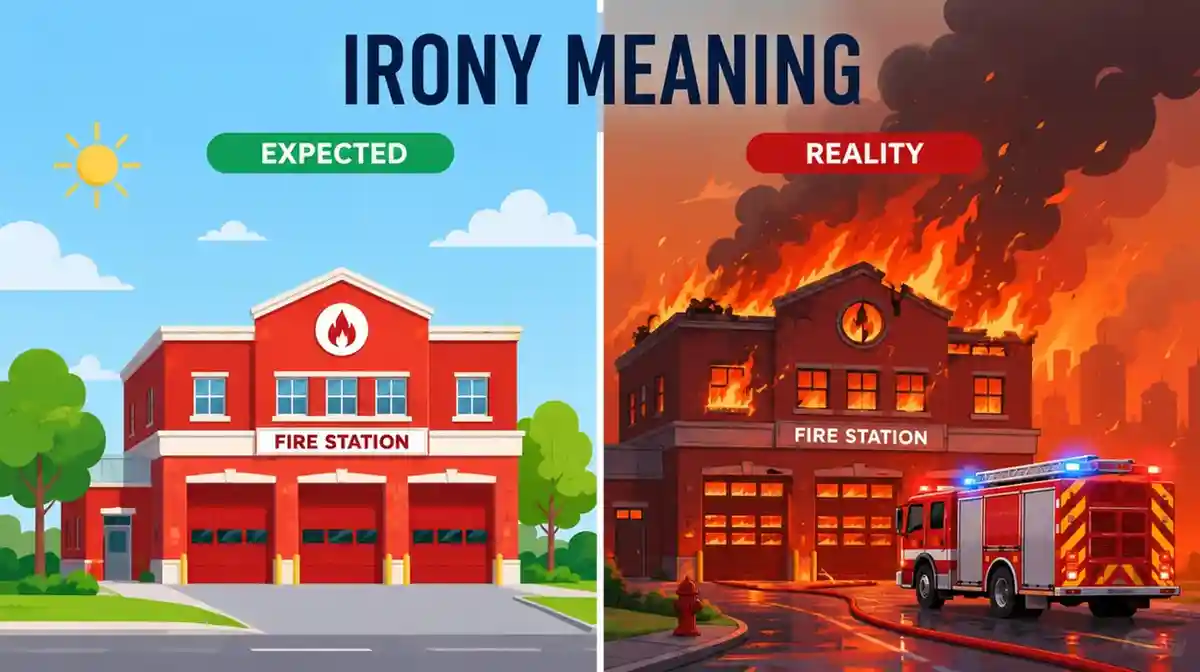
Three reasons keep the irony meaning fuzzy. First, pop culture uses “ironic” as a catch‑all for anything odd, which dilutes the definition. Second, irony often overlaps with sarcasm, coincidence, and misfortune, but those aren’t the same thing. Third, situational irony can feel like cosmic bad luck—yet luck lacks the intellectual snap of true irony. When a fire station burns down, that’s situational irony. When you wash your car and it rains, that’s just bad timing.
Understanding what irony isn’t sharpens your grasp of the genuine irony meaning. Once you lock that in, you stop mislabeling everyday events and start using the term with precision that others notice.
The 3 Types of Irony: A Quick Overview
Keep this table handy. It captures the irony meaning in its three major forms, giving you a cheat sheet to return to anytime.
| Type | What Happens | Real‑World Example |
| Verbal Irony | Saying the opposite of what you mean, often to emphasize a point | Stepping into a storm and muttering, “Lovely weather we’re having.” |
| Situational Irony | An outcome that is the reverse of what was expected | A pilot who has a fear of heights |
| Dramatic Irony | The audience knows a truth hidden from the character | In Romeo and Juliet, the audience knows Juliet is alive while Romeo believes she’s dead |
These three buckets contain all irony you will encounter. Memorize them and the irony meaning becomes second nature.
Verbal Irony Definition and Everyday Examples
Verbal irony happens when a speaker intentionally says one thing but signals a different, often opposite, meaning. Tone, facial expression, and context separate verbal irony from a lie. When your friend stares at a mountain of unfinished dishes and says, “Well, this is going to be fun,” she is using verbal irony.
Sarcasm is verbal irony’s sharper cousin—its goal is usually to mock or wound. Not all verbal irony is sarcasm, but all sarcasm is a form of verbal irony. The irony meaning here depends entirely on the gap between words and intent. You deploy it daily: “Great job!” after a teammate fumbles, or “I could do this all day” while slogging through a tedious report.
Classic literature overflows with verbal irony. In Jane Austen’s Pride and Prejudice, Mr. Bennet’s dry remarks constantly undercut surface politeness. Recognizing this layer sharpens your reading and your own communication.
Situational Irony: Expectation vs. Reality
Situational irony is the wrecking ball of the irony meaning: you expect one result, and the exact opposite unfolds. The surprise must be logically connected to the situation—not just random. A marriage counselor filing for divorce is ironic because the profession builds on relationship mastery. A lifeguard drowning in a kiddie pool would be tragic yet ironic for the same reason.
O. Henry’s short story “The Gift of the Magi” remains the textbook example. A wife sells her long hair to buy a chain for her husband’s watch; the husband sells the watch to buy ornamental combs for her hair. Each sacrifice nullifies the gift, creating a perfect ironic twist. That’s the irony meaning in narrative action—the actions themselves produce the opposite of the desired outcome.
Real life delivers it too. The Titanic was deemed “unsinkable,” yet it sank on its maiden voyage. A traffic jam on a day you leave an hour early to avoid traffic. These aren’t just bad luck; the very efforts to avoid a fate cause it.
Dramatic Irony in Movies, Plays, and Books
Dramatic irony places the audience in a privileged position. We hold crucial information that a character lacks, and that gap charges every scene with tension, dread, or dark comedy. The irony meaning shifts from verbal contradiction to dramatic suspense.
Shakespeare wielded dramatic irony masterfully. In Romeo and Juliet, we watch Romeo poison himself beside Juliet, knowing she merely sleeps. Every second of that scene is agony because the irony makes us complicit. Alfred Hitchcock explained suspense with a bomb under a table: the audience sees it ticking, but the characters chat obliviously. That’s dramatic irony at work.
Horror films thrive on it. The audience knows the killer waits behind the door; the protagonist reaches for the handle. The irony amplifies emotion. Recognizing this device elevates your appreciation of storytelling and helps you deploy it in your own creative work.
Irony vs. Coincidence: What’s the Real Difference?
People often say “How ironic!” when they mean “What a coincidence!” The irony meaning involves a reversal of expectation, while a coincidence is a random alignment of circumstances with no deep conflicting logic. Bumping into your ex at a grocery store in another country? Coincidence—unless you had specifically flown there to heal a broken heart and avoid all memory of them. That twist would inject irony.
- Irony: A professional organizer whose own home is permanently cluttered.
- Coincidence: You and your coworker wearing the same shirt on the same day.
- Bad luck: Your flight gets canceled because of a storm.
The test: Does the outcome deliberately undercut a stated belief, effort, or expectation? If yes, irony. If not, you’re witnessing chance. Sharpening this distinction makes your speech more accurate and your writing more credible.
How to Spot Irony in Conversations and Writing
Spotting irony starts with asking two questions: Is there a gap between surface and substance? Did the outcome reverse a justifiable expectation? For verbal irony, listen for tone shifts, overstatement, or understatement that contradict literal meaning. A colleague who says “This deadline is exactly what I needed” in a monotone voice while rubbing tired eyes is dripping in irony.
In texts, look for contradictions between a character’s knowledge and the reader’s. In non‑fiction, notice when an author describes an event that mocks the intended plan. Train your ear by reading satirical news headlines; The Onion thrives on verbal and situational irony. As you practice, the irony meaning emerges faster, and you’ll start separating genuine irony from lazy labeling.
How to Use Irony Meaningfully in Your Own Writing
Using irony with intent strengthens your voice. In fiction, dramatic irony builds empathy and urgency. Let your reader know the secret and watch the tension tighten. In essays or speeches, well‑placed verbal irony engages your audience and makes your argument memorable.
Avoid drowning your piece in irony—too much muddies sincerity. Anchor it to one clear contradiction. If you’re drafting a personal narrative, highlight a moment where your best effort backfired beautifully. That’s situational irony that resonates because readers relate to plans gone sideways.
A quick checklist for writers:
- Pinpoint the expectation you’re reversing.
- Ensure the reversal springs logically from the action.
- Signal verbal irony through context, tone, or word choice.
- Trust your reader to catch it; don’t over‑explain.
Famous Examples of Irony That Will Surprise You
History and pop culture offer iconic irony that illuminates the irony meaning beyond textbooks. Here are a few that stick:
- The Cobra Effect: Colonial India offered a bounty for dead cobras to reduce the snake population. People began breeding cobras for the reward. When the government canceled the program, breeders released the snakes, multiplying the problem. The solution created the opposite outcome.
- Alanis Morissette’s “Ironic”: The song famously lists situations that aren’t truly ironic (rain on your wedding day is bad luck, not irony). The genuine irony is that a song titled “Ironic” contains almost no irony—a meta‑irony that sparks debate decades later.
- The Segway: Billed as a world‑changing transport revolution, it became a niche tourist curiosity. The hype vs. reality gap is pure situational irony.
- A sign spelling “illiteracy” incorrectly: If a campaign poster promoting literacy contains a misspelling, the message’s delivery undercuts its intent.
These examples anchor the irony meaning in memorable, talk‑about‑worthy stories.
The Psychology Behind Why We Enjoy Irony
Our brains love pattern disruption. Irony delivers a satisfying mental click when we detect the hidden opposition. That click triggers a small dopamine release, which makes irony feel pleasurable. Studies on humor comprehension show that recognizing incongruity—the mismatch between expectation and reality—is central to why we laugh or feel a sense of cleverness.
Moreover, irony builds social bonds. When you share an ironic comment and someone catches it, you’ve signaled shared understanding and intelligence. This is why irony meaning matters in communication: it’s not just a literary device, it’s a social tool that filters in‑group belonging. Mastering irony, then, deepens both your thinking and your relationships.
Irony in the Age of Social Media and Memes
Digital culture has reshaped the irony meaning for a new generation. Memes use layered irony: a top caption sets an expectation, the image mocks it, and the bottom caption subverts the subversion. Posts dripping with “/s” (sarcasm tags) signal verbal irony explicitly because tone is lost in text.
Yet the oversaturation of ironic detachment can exhaust and alienate. Some internet communities speak almost exclusively in layers of irony, making sincere discussion difficult. Understanding the mechanics of irony helps you navigate this landscape—you can participate knowingly without drowning in hollow cynicism. Use irony, but know when to drop the mask and be direct.
Frequently Asked Questions About Irony Meaning
What is the simple irony meaning?
Irony means a contrast between what is expected or said and what actually happens or is meant. It hinges on a clear reversal that you can point to.
What are the three main types of irony?
Verbal irony (words oppose meaning), situational irony (outcomes oppose expectations), and dramatic irony (the audience knows what a character doesn’t) make up the full irony meaning spectrum.
How is verbal irony different from sarcasm?
Sarcasm is verbal irony with a sharp edge intended to mock or insult. All sarcasm is verbal irony, but verbal irony can be gentle, humorous, or emphatic without cruelty.
Can you give a clear example of situational irony?
A fire station burning down. The place dedicated to extinguishing fires becomes the victim of one—the expectation of safety reverses completely.
Why do writers love dramatic irony?
Dramatic irony loads scenes with tension, dread, or humor because the audience holds secret knowledge. It makes readers feel actively engaged and emotionally invested.
Is irony the same as bad luck?
No. Bad luck is an unfortunate random event. Irony requires a logical reversal: your action or belief directly sets up the opposite outcome.
Own the Irony Meaning and Use It with Confidence
You now hold a clear, actionable understanding of the irony meaning—not a vague notion, but a sharp tool. Verbal, situational, and dramatic irony each offer a unique way to express the gap between appearance and reality. When you label something as ironic, you are making a claim about an intentional or structural reversal, not just describing a quirky coincidence.
Start small. Catch one ironic moment in your next conversation. Drop a well‑aimed verbal irony and watch the reaction. When you watch a thriller, note the dramatic irony and feel the suspense intensify. Then share your favorite ironic discovery in the comments or with a friend. Mastery begins the moment you stop guessing and start spotting—now go spot some irony.