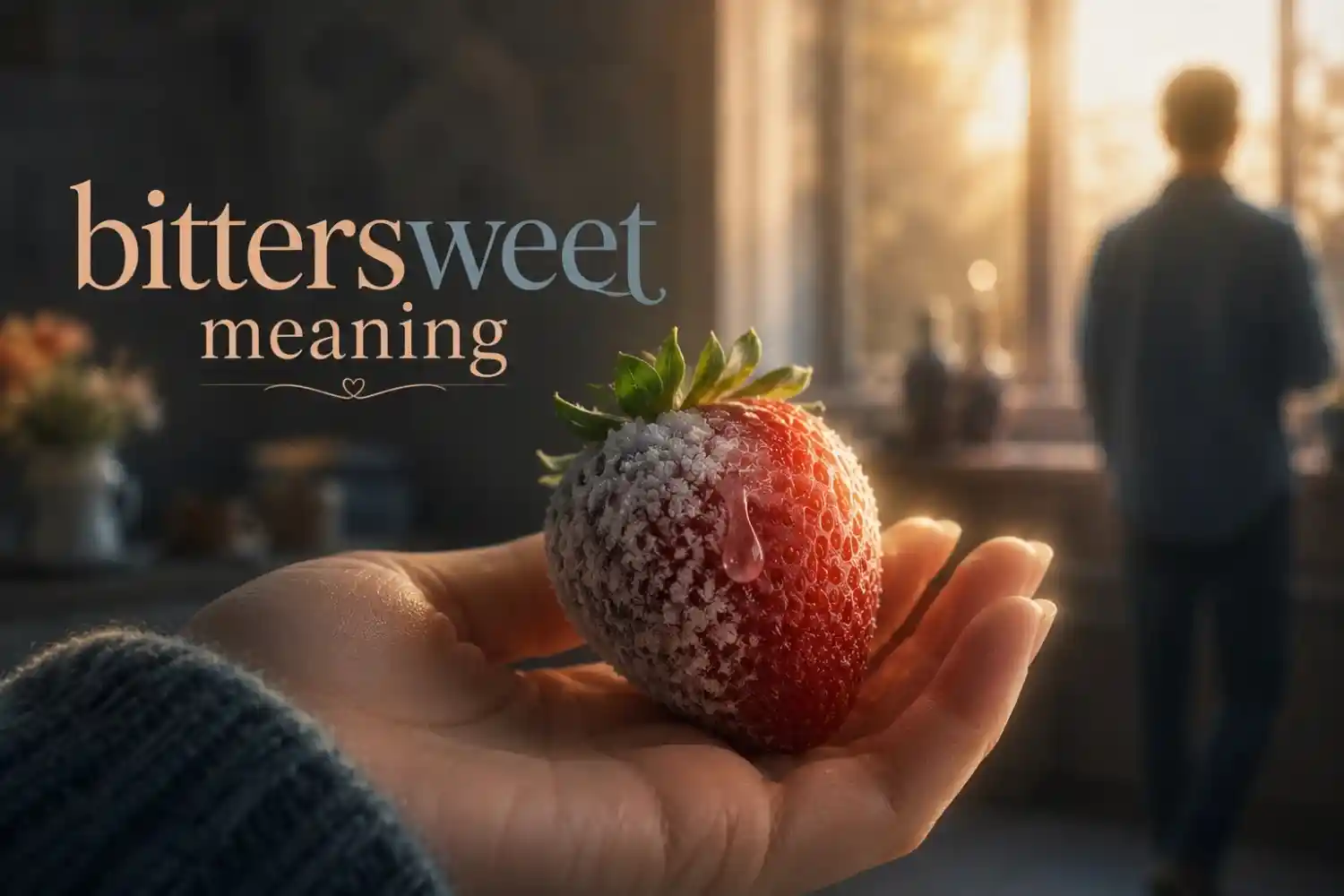
Bittersweet Meaning: Mixed Emotions & Life’s Poignant Joy
You hear “bittersweet” tossed around, yet its full emotional weight often slips through your fingers. Without that clarity, you miss the richness of moments that define you. This guide sharpens your grasp of the bittersweet meaning so you can name, feel, and grow through life’s most layered experiences.
What Is the Bittersweet Meaning? A Clear Definition
The bittersweet meaning describes an emotional blend where joy and sorrow occupy the same moment. Psychologists classify it as a mixed emotion—pleasure tinged with pain, or sadness wrapped in gratitude. Unlike simple happiness or pure grief, bittersweet feelings carry two contradictory currents at once.
Oxford English Dictionary anchors the term in “pleasure alloyed with pain.” That alloy matters. You taste sweetness on the surface but sense a bitter undertow. A graduation ceremony, for instance, hums with pride and the ache of leaving friends behind. Both truths coexist without canceling each other.
The word itself traces back to the 14th century, originally naming a plant with a sweet taste and poisonous root. By the 16th century, writers adopted it as a metaphor for emotion.Susan Cain’s work Bittersweet (2022) pushed the concept into mainstream conversation, framing it as a force for connection and creativity. Her research confirms that longing and joy feed each other in art, leadership, and love.
The Psychology Behind Bittersweet Emotions
Research shows that mixed emotions emerge from distinct neural pathways. A 2015 study in Emotion revealed that people experience happiness and sadness simultaneously during poignant film scenes—not as a rapid flip but as a genuine blend. Your brain can hold both, especially when events signal a transition or an ending.
Bittersweet meaning gains depth from what psychologists call “poignancy.” Poignancy arises when you recognize the fleeting nature of a good thing. The delight of a child’s hug sharpens when you realize they outgrow it. This awareness triggers both the reward system (sweet) and the stress-response system (bitter), producing a unique emotional signature.
Carstensen’s socioemotional selectivity theory explains why bittersweet moments intensify with age. Older adults prioritize emotionally meaningful goals, making endings richer. A retirement party erupts with laughter and tears because the future feels open but the past pulls hard. The bittersweet meaning, then, signals that something mattered deeply.
Bittersweet Meaning in Everyday Life
You meet bittersweet meaning in small, unexpected pockets. Packing away baby clothes stirs nostalgia and relief. A final dinner with a friend moving abroad crackles with closeness and impending absence. Your first sip of coffee on a grey morning comforts you while the sky mirrors an inner heaviness.
These ordinary scenes teach emotional fluency. Naming the blend reduces the urge to force a single feeling. Researchers at the University of North Carolina found that people who acknowledge mixed emotions cope better with loss and transition. You stop pretending it’s only happy or only sad.
Look at graduation again. You celebrate a diploma and mourn the daily rhythm of campus life. The bittersweet meaning lets you toast the achievement and honor the goodbye in the same breath. That permission strengthens your emotional resilience.
How Literature and Art Capture the Bittersweet Meaning
Artists have long understood that sorrow seasons beauty. The Romantic poets—Keats, Shelley, Wordsworth—imbued their verses with the ache of transient perfection. Keats’ “Ode to a Nightingale” spills over with “the weariness, the fever, and the fret” even as the bird’s song lifts him. The bittersweet meaning becomes the poem’s engine.
Visual art, too, leans into the tension. Edward Hopper’s paintings of solitary figures in sunlit rooms hum with isolation and serenity. The light warms but cannot quite reach the soul. Viewers report feeling exactly the bittersweet chord—an emotional recognition that stills them.
Contemporary film harnesses this power relentlessly. Pixar’s Up opens with a montage of lifelong love and loss in under five minutes. Audiences laugh and weep within seconds because the bittersweet meaning is not a flaw; it’s the story’s heartbeat.
The Difference Between Bittersweet and Ambivalence
People often confuse bittersweet with ambivalence. Ambivalence means having opposing evaluations—you both want and fear a job change, or you admire and resent a colleague. The pull is cognitive, a mental tug-of-war. Bittersweet meaning, by contrast, is an emotional texture where the sweet and bitter fuse into one felt experience.
Think of holding a lover’s hand before a long separation. You don’t evaluate the situation as good and bad in separate mental columns; you feel a single aching sweetness. That fusion defines the bittersweet. Ambivalence can keep you stuck; bittersweet moments often bring clarity about what you cherish.
Psychologist Iris Mauss notes that ambivalence correlates with discomfort, whereas poignancy (a close cousin of bittersweet meaning) correlates with life satisfaction. Welcoming the blend reframes loss as proof of deep attachment.
Why We Crave Bittersweet Experiences
You might wonder why anyone would seek an emotion that hurts. The answer lives in connection. The bittersweet meaning bonds you to other people, to memory, and to what’s real. A funeral service devastates you, but the shared stories and laughter forge an unbreakable thread.
Neuroscientist Jaak Panksepp’s work on the SEEKING system hints that longing itself is rewarding. The ache for reunion, for a lost place, or for a version of yourself activates brain opioids. That ache feels productive—it moves you toward meaning-making. The sweetness inside the bitter keeps you reaching.
Susan Cain’s research with thousands of participants confirmed that people who lean into longing report higher creativity and empathy. The bittersweet meaning becomes fuel. Songwriters, poets, and innovators regularly mine this vein. It gives raw material for beauty that straightforward happiness cannot.
Bittersweet Meaning in Music and Lyrics
Songs that drill into your chest almost always carry a bittersweet meaning. Adele’s “Someone Like You” marries a soaring melody to lyrics about acceptance and heartbreak. You sing loudest during the chorus because the pain and the release lock together. That marriage makes the song unforgettable.
The minor iv chord—often called the “bittersweet chord”—has a neurological fingerprint. Composers from Bach to Radiohead use it to inject longing into resolution. It tells your brain that something is finished yet still resonates. The bittersweet meaning in music teaches you that endings don’t erase beauty; they distill it.
Country music builds its foundation on this blend. A steel guitar weeps under a narrator smiling through a memory. You hear life simultaneously breaking and mending, and you feel less alone.
Cultural Perspectives on Bittersweet Feelings
Different cultures honor the bittersweet meaning through specific words and rituals. Japan’s mono no aware translates roughly to “the pathos of things”—a gentle sadness at impermanence. Cherry blossoms explode in pink glory and fall within a week. The Japanese celebration of hanami cherishes both the bloom and its brevity.
Portugal’s saudade captures a melancholic longing for a person, place, or feeling that may never return. Unlike pure sadness, saudade carries an undercurrent of pleasure in the remembering. The bittersweet meaning finds a home in that national soul.
In Latin America, la pena dulce (the sweet sorrow) appears in boleros and tangos. The music aches, yet dancers smile. These cultural traditions normalize the idea that grief and joy share a table.
How to Embrace the Bittersweet Meaning for Personal Growth
Reframe the pang as a compass. When a moment stings with sweetness, it points to what you love. Write it down. A journal entry capturing a graduation, a moved-out child’s room, or a finished project turns that ache into a landmark.
Practice savoring the whole flavor. Pause for 30 seconds during a bittersweet moment and name what’s sweet and what’s bitter”I will miss my team, but I am excited for this new job.” That tiny verbal act strengthens emotions and stops denial. Therapists call this “affect labeling,” and it reduces amygdala reactivity.
Share the feeling aloud. Telling a friend “I’m so proud and I’m also gutted” opens a genuine connection. You give the other person permission to drop a brave face. The bittersweet meaning transforms from a private ache into a shared bridge.
Common Misconceptions About Bittersweet Meaning
Misconception: Bittersweet means hidden sadness behind a fake smile. Reality: The bittersweet meaning involves authentic co-occurring emotions. There’s no mask. The joy and sorrow are equally true, and both deserve air.
Misconception: Bittersweet is just a polite word for depression. Reality: Depression flattens affect and steals motivation. Bittersweet feelings energize and connect you. You cry, but you also feel gratitude, love, or hope in the same breath.
Misconception: Only artists and sentimental people feel it. Reality: Every human brain processes mixed emotions. If you’ve ever laughed during a stressful farewell or felt a lump in your throat at a wedding, you know it firsthand.
Misconception: The bittersweet meaning is culturally specific.Numerous languages encode it, as the cultural survey above demonstrates. The expression differs, but the emotional signature is universal.
The Bittersweet Meaning of Nostalgia and Memory
Nostalgia functions as bittersweet meaning’s favorite carrier. When you thumb through old photographs, warmth floods in for the scene and a sting surfaces because it’s gone. That combination reinforces identity. Studies by Constantine Sedikides find that nostalgia bolsters self-continuity and reduces existential anxiety.
The bittersweet meaning in nostalgia doesn’t simply trap you in the past. It propels you forward with a renewed sense of what matters. A fond memory of a grandparent’s kitchen may inspire you to cook for your own family. The bitterness of loss fuels the sweetness of legacy.
Topic Cluster Overview: Emotional Vocabulary Hub
This pillar page anchors a broader cluster. Dive into each subtopic to refine your emotional literacy and understanding of related mixed states.
| Subtopic Cluster Page | Core Focus | Why It Matters |
| Poignant Definition and Real-Life Examples | Sharp clarity on poignant emotion and how it differs from pure sadness | Helps you label the feeling that something precious is slipping away |
| Saudade Meaning: The Longing That Shapes Us | Deep cultural and psychological roots of Portuguese saudade | Expands your emotional range with a word English lacks |
| Nostalgia vs. Reminiscing: A Neuroscience Look | How nostalgia activates the brain and builds resilience | Separates helpful reflection from unproductive rumination |
| Ambivalence in Decision-Making | The mental conflict of holding two attitudes and how to resolve it | Distinguishes cognitive tension from emotional blend |
| How Mixed Emotions Improve Creativity | Research relating problem-solving and art to concurrent joy and melancholy | Turns emotional complexity into a professional advantage |
| Mono No Aware: Japanese Art of Impermanence | Philosophy and practice of appreciating transient beauty | Offers daily rituals for peace and presence |
Frequently Asked Questions About Bittersweet Meaning
What does bittersweet mean exactly?
Bittersweet means experiencing pleasure and pain, or happiness and sorrow, at the same time. The two feelings don’t alternate—they merge into a single, layered emotion.
Is bittersweet a positive or negative emotion?
It’s neither purely positive nor negative. Psychologists classify it as a mixed emotion. The sweetness carries a beneficial quality, while the bitterness signals attachment and loss.
How can bittersweet be used in a sentence?
You can say, “Leaving my hometown for the new job brought a bittersweet meaning I wasn’t ready for—excited for the future and grieving the goodbyes.” It describes any moment where joy and pain coexist.
What does a bittersweet moment look like?
A classic example is a parent watching their child board a school bus for the first time. Pride floods in, but at the same time, the pain of letting go tightens the chest. Can bittersweet feelings be healthy?
Absolutely. Research links embracing bittersweet moments to higher emotional resilience, deeper empathy, and greater life satisfaction. It confirms that you love something enough to feel its absence.
What’s the origin of the word bittersweet?
It enters English from the Old English plant name bitterswēte, referring to a vine with a sweet-tasting root that could also cause poisoning. The metaphorical sense for emotions appeared by the 1500s.
The Bittersweet Meaning Opens a Door
You now hold a clear map to the bittersweet meaning—from its definition and psychological roots to its echo in art, music, and your own quiet moments. This emotion doesn’t weaken you. It proves you’re paying attention. Let the next pang of sweet sorrow remind you that you’re living deeply.
Share your experience. Describe a recent bittersweet moment in the comments or forward this article to a friend who just crossed a threshold. Your story will help someone else name what they feel.
Sources (Primary):
- Cain, S. (2022). Bittersweet: How Sorrow and Longing Make Us Whole. Crown.
- Larsen, J. T., & McGraw, A. P. (2014). The case for mixed emotions. Social and Personality Psychology Compass, 8(6), 263–274.
- Carstensen, L. L. (2006). The influence of a sense of time on human development. Science, 312(5782), 1913–1915.
- OED Online. (2024). “bittersweet, adj. and n.” Oxford University Press.
- Sedikides, C., et al. (2015). To nostalgize: Mixing memory with affect and desire. Advances in Experimental Social Psychology, 51, 189–273.