Ineffable Meaning: 7 Powerful Examples & Why It Matters
By Alex Morgan, M.A. Linguistics | Fact-checked against Merriam-Webster, Oxford English Dictionary, and Stanford Encyclopedia of Philosophy
You feel something vast—peace, love, or awe—but no word fits. That gap has a name: ineffable meaning. Most people stop at a dry dictionary line, yet real understanding stays fuzzy. This guide unpacks this powerful word through seven clear examples, synonyms, history, and daily use, so you can finally grasp what lies beyond language.
What Is the Ineffable Meaning?
The ineffable meaning refers to an experience, feeling, or quality that refuses to fit into ordinary language. Merriam-Webster’s ineffable definition is “too great, powerful, beautiful, etc., to be described or expressed.” When you call something ineffable, you admit that words fall short.
The ineffable meaning also carries a quiet power: it names the edge of language. You can feel the edge when you try to explain a perfect moment and produce only silence.
The Latin Root and History of Ineffable
The word ineffable comes from Latin ineffabilis. It combines *in-* (not) and effabilis (speakable). Effabilis itself comes from effari, meaning “to utter.” So ineffable literally means “unutterable.” The Oxford English Dictionary records early English use in the 15th century, often tied to divine names.
Knowing the root makes ineffable meaning easier to remember: not + speakable.
7 Powerful Examples of Ineffable Meaning in Real Life
Examples make the word concrete without flattening it.
- Watching a newborn sleep. The love feels too large for a sentence. The ineffable meaning here is awe mixed with protectiveness.
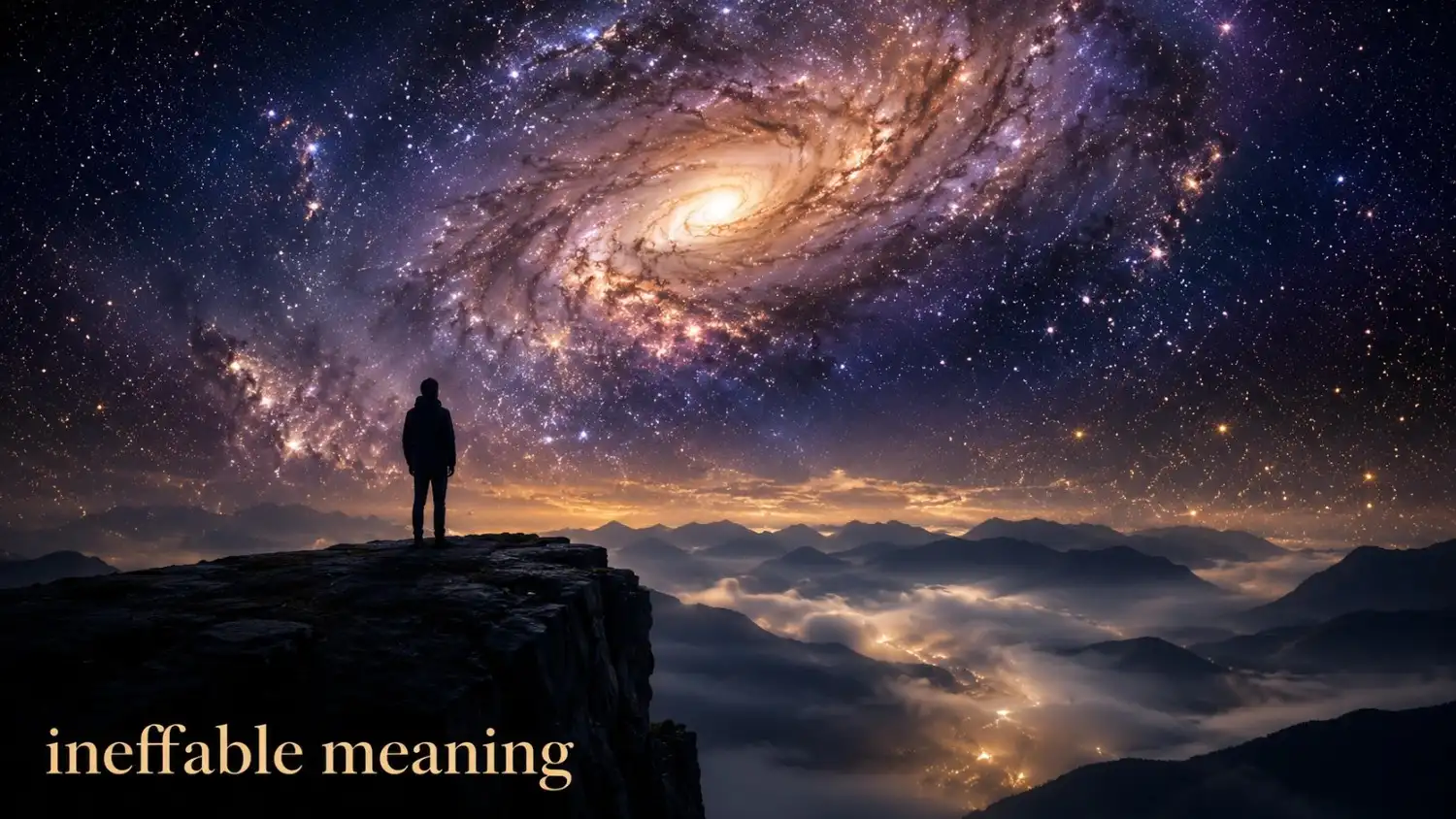
- Standing under the Milky Way. The scale of the sky triggers silence. That silence is ineffable.
- Hearing music that gives you chills. No lyric explains the body’s reaction. The wordless vibration is ineffable.
- A moment of profound grief. Sorrow can be so heavy that language fails. Here, ineffable meaning points to the weight of loss.
- Deep meditation or prayer. Some inner states feel vast and wordless. That interior stillness is often called ineffable.
- Falling in love at first sight. The sudden knowing feels beyond logic. That is ineffable.
- Finishing a great novel and staring at the wall. The book rearranged you. You cannot say exactly how—that is the ineffable meaning.
Ineffable Synonyms: Words That Come Close
No single synonym captures the full force of this word, but several circle the same territory.
- Inexpressible: cannot be expressed
- Indescribable: defies description
- Unutterable: too sacred or deep to speak
- Unspeakable: often used for horror, but can overlap
- Beyond words: common, less formal
- Transcendent: goes beyond ordinary limits
Ineffable vs. Unspeakable: Key Differences
People often confuse these two. Unspeakable usually leans negative—unspeakable violence, unspeakable loss. Ineffable leans positive or sacred—ineffable beauty, ineffable peace. The ineffable meaning carries awe more than dread.
Why Do Humans Experience the Ineffable?
Language evolved for survival and social coordination, not for every inner state. When an experience exceeds everyday categories, the brain still registers it, but the vocabulary lags. That gap creates the ineffable meaning.
Psychology Today notes that peak experiences often produce a temporary drop in verbal processing. The feeling floods the body, but the language center stays quiet.
Ineffable in Religion, Philosophy, and Mysticism
Many traditions insist the highest truths cannot be spoken. The Stanford Encyclopedia of Philosophy documents ineffability as a core theme in mystical language. The ineffable meaning in this context points to divine mystery.
- Christianity: “the peace that surpasses all understanding”
- Judaism: the divine name treated as unpronounceable
- Buddhism: nirvana described through negation
- Sufism: divine love beyond doctrine
Ineffable in Psychology and Emotional Language
Psychologists describe alexithymia as difficulty identifying feelings. But even emotionally fluent people hit a wall with awe, grief, or love. The ineffable meaning appears when emotional intensity exceeds linguistic precision. Labeling the feeling as ineffable helps; it validates the experience instead of forcing a false word.
How to Use Ineffable Meaning Correctly in Sentences
Use ineffable as an adjective before nouns like beauty, joy, peace, or mystery. For the noun phrase ineffable meaning, place it after verbs like grasp, capture, point to, or express.
- “The ineffable meaning of the ceremony left the room silent.”
- “She tried to explain her dream, but the feeling slipped away.”
- “That movie’s quiet power cannot be adequately described in a review.”
Cambridge Dictionary lists “ineffable beauty” and “ineffable joy” as common collocations.
Common Mistakes and Misuses of Ineffable
Writers sometimes use ineffable for anything slightly hard to describe. A messy desk is not ineffable; it is just messy. Save the word for experiences that truly silence speech.
- Using it for ordinary confusion
- The word “extremely ineffable” is absolute.
- Pairing it with noise — silence is ineffable, noise is not
- Confusing it with unspeakable horror
Ineffable in Literature and Art
Poets and painters have always chased the ineffable. Emily Dickinson wrote about “that White Sustenance / Despair.” Abstract art, instrumental music, and lyric poetry try to communicate what prose cannot. When art leaves you speechless, you are brushing against the ineffable.
The Limits of Language: Why Ineffable Matters Today
Digital communication prizes clarity and speed. Yet the most important human moments—birth, death, love, awe—still outrun language. Recognizing the ineffable keeps you humble. It also makes you a better listener, because you stop demanding perfect words from others.
Quick Reference Table: Ineffable at a Glance
| Aspect | Detail |
| Definition | Too great, powerful, or beautiful to be expressed in words |
| Part of speech | Adjective (ineffable); noun phrase (ineffable meaning) |
| Etymology | Latin ineffabilis, from *in-* (not) + effabilis (speakable) |
| First recorded use | 15th century, per Oxford English Dictionary |
| Synonyms | Inexpressible, indescribable, unutterable, beyond words |
| Antonyms | Expressible, describable, speakable |
| Common contexts | Beauty, joy, peace, awe, grief, divine mystery |
| Tone | Positive or sacred; not usually negative |
Frequently Asked Questions About Ineffable
What does ineffable meaning mean in simple words?
The ineffable meaning is a feeling or experience too big, beautiful, or deep for ordinary words. Think of standing under a star-filled sky and losing all sentences. That wordless wonder is ineffable.
How do you use ineffable in a sentence?
Use it before a noun: “The ineffable beauty of the ocean left us quiet.” Or use the phrase: “She captured the ineffable in one photograph.” Keep it for moments that truly stop language.
Is ineffable meaning always religious?
No. Ineffable moments appear in religious and non-religious settings alike. A secular awe—like hearing a perfect symphony—can be as ineffable as prayer.
What is the difference between ineffable and indescribable?
Indescribable means hard to describe. Ineffable adds a sense of overwhelming power or sacredness. A complicated tax form is indescribable; a silent mountain sunrise is ineffable.
Can joy be ineffable?
Yes. Joy can be so sudden and full that it leaves you breathless and silent. People often call this ineffable joy. It marks a peak emotional state.
Why do people use ineffable to describe love?
Love mixes biology, memory, and mystery. When the feeling floods the body, simple words like happy or excited fail. Calling love ineffable honors that depth without oversimplifying it.
Language draws a map, but the territory is larger. You now have the tools to name the nameless, use ineffable with precision, and appreciate the moments that leave you speechless. Which experience has left you without words? Share it in the comments or save this guide for your next vocabulary deep dive.
Primary Sources: Merriam-Webster Dictionary, Oxford English Dictionary, Cambridge Dictionary, Stanford Encyclopedia of Philosophy, Psychology Today.