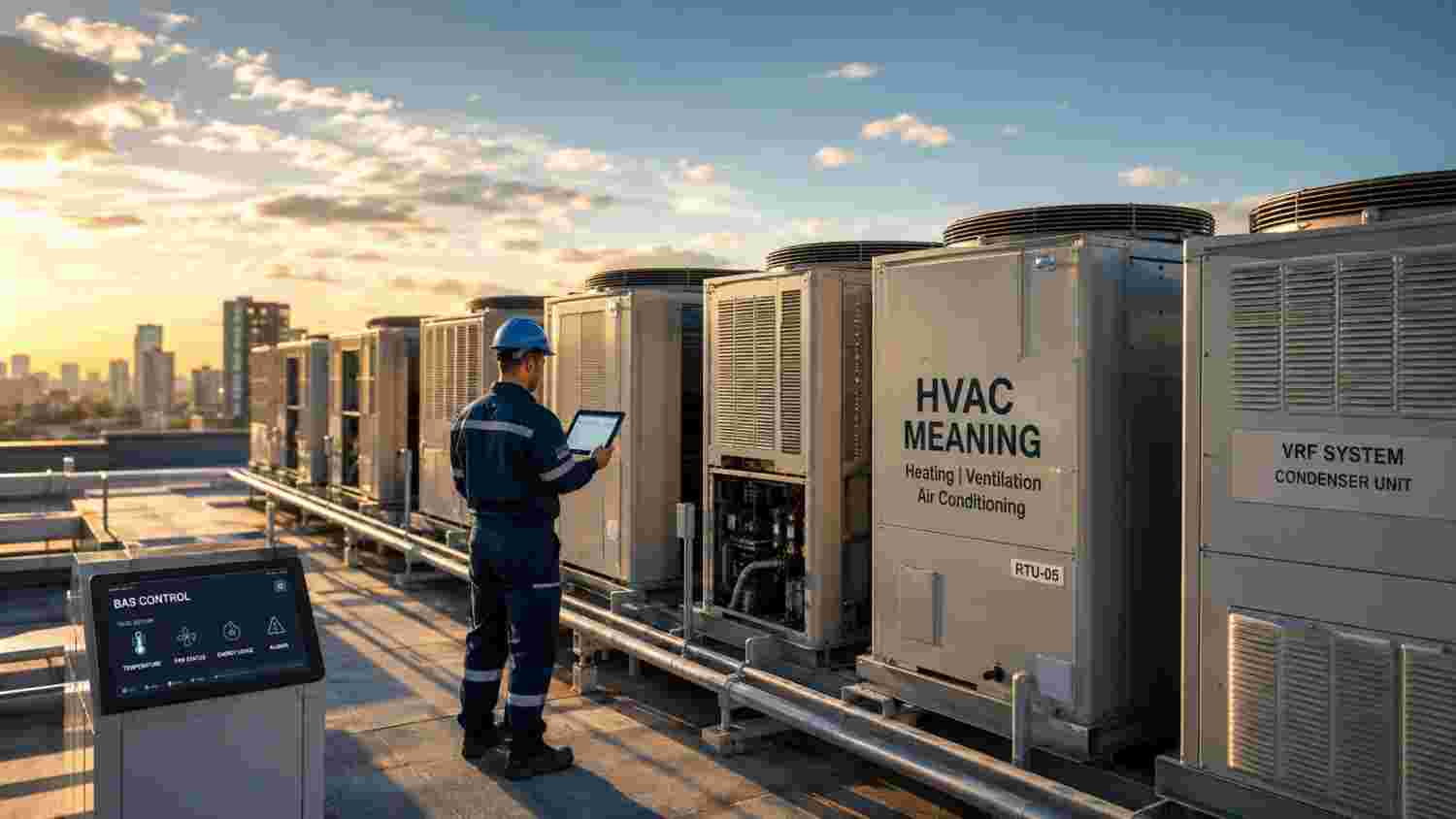
HVAC Meaning: The Complete Breakdown of 9 Terms That Control Your Comfort and Your Wallet
You walk into a hardware store, overhear two technicians arguing about VRF systems and CFM ratings, and realize you have absolutely no idea what they are talking about. That single moment of confusion can cost you real money when you blindly sign a repair contract you do not fully understand.
The uncomfortable truth is that most homeowners and even fresh engineering graduates stumble over basic HVAC terminology on a regular basis. Contractors count on that confusion to upsell equipment you may not actually need.
This guide strips away every layer of jargon and hands you a crystal-clear breakdown of the nine acronyms that genuinely matter. By the time you finish reading, you will decode an HVAC quote like a seasoned pro and catch overcharges before they ever hit your bank account.
What Does HVAC Meaning Actually Cover?
Heating, ventilation, and air conditioning are referred to as HVAC. Those three simple words describe the entire climate-control ecosystem hiding inside your walls, ceilings, and mechanical rooms.
The heating component includes furnaces, boilers, and heat pumps that keep indoor spaces livable during freezing winter months. Without it, pipes burst and families huddle under blankets by January.
Ventilation quietly moves fresh outdoor air inside while pushing stale, polluted, moisture-laden air back out through ductwork and exhaust fans. Most people never think about ventilation until mold shows up on their bathroom ceiling.
Air conditioning cools and dehumidifies indoor air using refrigerant cycles that absorb heat from your rooms and dump it outside through a condenser unit. Understanding the hvac meaning goes far beyond memorizing a three-letter acronym you see on a van parked in your neighbor’s driveway.
It means recognizing how each subsystem constantly interacts with the others to create the indoor environment you breathe, sleep, and work inside every single day of your life.
HVAC Meaning in Engineering: The Technical Layer
When professionals discuss the hvac meaning in engineering, the conversation shifts dramatically from basic home comfort to precise thermodynamic calculations and strict building code compliance.
Mechanical engineers design HVAC systems using detailed load calculations that account for solar heat gain, occupancy levels, insulation R-values, and hyper-local climate data. A single miscalculation on a high-rise project can leave an entire floor of office workers sweating through their shirts in mid-July.
Engineering-grade HVAC design also factors in energy efficiency ratings, refrigerant environmental impact scores, and full lifecycle cost analysis spanning twenty to thirty years of operation. The goal extends well beyond simple comfort into long-term sustainability and regulatory approval.
In practical terms, the hvac meaning in engineering represents a demanding multidisciplinary field that blends fluid dynamics, heat transfer science, electrical systems, and advanced control theory into one cohesive building solution.
Decoding the Alphabet Soup: CFM, ERV, VFD, RTU, and VRF
HVAC technicians love acronyms almost as much as they love strong coffee on a Monday morning. Each abbreviation packs a specific technical meaning that directly affects system performance and your monthly energy bill.
Let us break down the five most common acronyms you will encounter on equipment spec sheets, service invoices, and contractor proposals this year.
CFM HVAC Meaning
The cfm hvac meaning refers to Cubic Feet per Minute, which measures the exact volume of air flowing through your ductwork every sixty seconds.
Higher CFM numbers translate to more air movement and faster temperature changes throughout your living spaces. A typical residential bedroom needs roughly 1 CFM per square foot of floor area for adequate cooling performance.
If your technician mentions low CFM during a service call, you likely have leaky ductwork, a severely clogged filter, or an undersized blower motor that demands immediate attention before your compressor burns out.
ERV HVAC Meaning
The erv hvac meaning stands for Energy Recovery Ventilator, a clever device that transfers heat and moisture between outgoing stale air and incoming fresh air without mixing the two streams.
During winter, an ERV captures residual warmth from exhaust air and uses it to preheat the freezing outdoor air entering your home. In summer, it reverses the process by pre-cooling incoming air using the chilled exhaust stream.
This elegant heat-exchange trick can slash your ventilation energy costs by up to 40 percent without sacrificing a single breath of indoor air quality.
VFD HVAC Meaning
The vfd hvac meaning refers to a Variable Frequency Drive, an electronic controller that continuously adjusts the rotational speed of motors powering fans, pumps, and compressors.
Instead of running a motor at full blast around the clock, a VFD intelligently ramps speed up or down based on real-time cooling or heating demand. This eliminates the massive energy waste caused by constant full-speed operation in older buildings.
Commercial facilities equipped with VFDs typically report 20 to 50 percent reductions in motor electricity consumption within the very first year of installation.
RTU HVAC Meaning
The rtu hvac meaning stands for Rooftop Unit, a self-contained heating and cooling package installed on the flat roofs of commercial and retail buildings.
RTUs house the compressor, condenser coil, evaporator, and air handler inside a single weatherproof metal cabinet. This compact design saves valuable indoor floor space and simplifies maintenance access for service crews working above the occupied areas.
You will spot rows of RTUs on grocery stores, warehouses, and big-box retail buildings across the country because they deliver reliable climate control with minimal interior disruption during installation.
VRF HVAC Meaning
The vrf hvac meaning refers to Variable Refrigerant Flow, an advanced technology that precisely modulates refrigerant volume to match the exact cooling or heating demand of each individual zone.
Unlike traditional systems that blast one fixed temperature everywhere, VRF lets a sun-facing conference room stay cool while the server room next door stays warm using the same outdoor condenser unit.
VRF systems dominate modern high-rise construction because they deliver unmatched zoning flexibility with dramatically lower energy consumption than conventional rooftop or split setups.
BAS vs BMS in HVAC: Clearing Up the Confusion
Two acronyms confuse even experienced facility managers on a regular basis, so let us clear up the bas hvac meaning and the bms hvac meaning once and for all.
BAS stands for Building Automation System, a networked web of sensors, actuators, and controllers that automatically manages HVAC equipment, lighting schedules, and security hardware inside a structure.
BMS stands for Building Management System, which functions as a broader umbrella term that includes full BAS functionality plus additional oversight of fire alarms, elevator systems, and electrical power distribution panels.
In everyday HVAC conversations, most professionals use the two terms interchangeably without batting an eye. The practical difference only becomes significant when you are specifying a full-building technology stack for a large commercial or institutional project.
HVAC Meaning Salary: What Do Professionals Actually Earn?
Curiosity about the hvac meaning salary is exploding right now as skilled trades face massive labor shortages across North America and Western Europe.
Entry-level HVAC technicians typically start between $38,000 and $48,000 per year depending on geographic location, certification level, and union membership status. Mid-career professionals with five to ten years of hands-on field experience command $55,000 to $72,000 annually.
Senior engineers and project managers overseeing large commercial installations regularly earn well over $95,000, with top-tier roles in data center cooling and cleanroom design exceeding $120,000.
| Experience Level | Average Annual Salary | Industry Demand |
| Entry-Level (0–2 yrs) | $38,000 – $48,000 | High |
| Mid-Career (5–10 yrs) | $55,000 – $72,000 | Very High |
| Senior / Manager | $85,000 – $120,000+ | Critical Shortage |
The numbers paint a clear picture: HVAC careers offer above-average compensation with recession-resistant job security and rapid advancement paths for motivated individuals.
Frequently Asked Questions
What is the basic hvac meaning for complete beginners?
HVAC simply means Heating, Ventilation, and Air Conditioning. It covers every mechanical system responsible for controlling indoor temperature, humidity levels, and air quality in both residential and commercial buildings.
Why does the hvac meaning in engineering differ from everyday use?
Engineers use the term to describe complex thermodynamic systems involving detailed load calculations, fluid dynamics modeling, and energy simulations. Homeowners typically just think of their furnace and air conditioner as one combined unit.
How does understanding cfm hvac meaning help me save money?
Knowing your required CFM lets you spot undersized or oversized equipment before you make a purchase. Correct airflow sizing prevents wasted energy, uneven room temperatures, and premature compressor failure that leads to expensive emergency repairs.
Is VRF technology better than a traditional split system?
VRF systems offer superior zoning control and energy efficiency for multi-room commercial buildings. However, a standard split system remains more cost-effective for small single-family homes with straightforward heating and cooling needs.
What is the real difference between BAS and BMS in HVAC?
BAS focuses specifically on automating HVAC and lighting controls within a building. BMS covers the entire building infrastructure including fire safety systems, elevators, and electrical distribution. Most small projects only require a BAS setup.
How much does a residential ERV system cost to install?
A typical residential ERV installation runs between $1,500 and $3,500 depending on ductwork complexity. The energy savings from reduced heating and cooling loads usually pay back the full investment within three to five years.
Does the hvac meaning salary justify the training investment?
Absolutely. HVAC certification programs take six months to two years to complete, and starting salaries already exceed those of many four-year college graduates. The trade also offers generous overtime potential and recession-proof demand.
Final Thoughts
Mastering HVAC terminology is not just about sounding smart during conversations with your contractor. It directly protects your wallet every single time someone hands you a quote filled with acronyms you now fully understand.
Start by checking your current system’s CFM rating and asking your technician about VFD upgrade options during your next service visit. Those two conversations alone could cut your annual energy bills by hundreds of dollars starting this season.
Knowledge is leverage, and in the HVAC world, leverage translates directly into real, measurable savings on every utility bill that arrives in your mailbox.