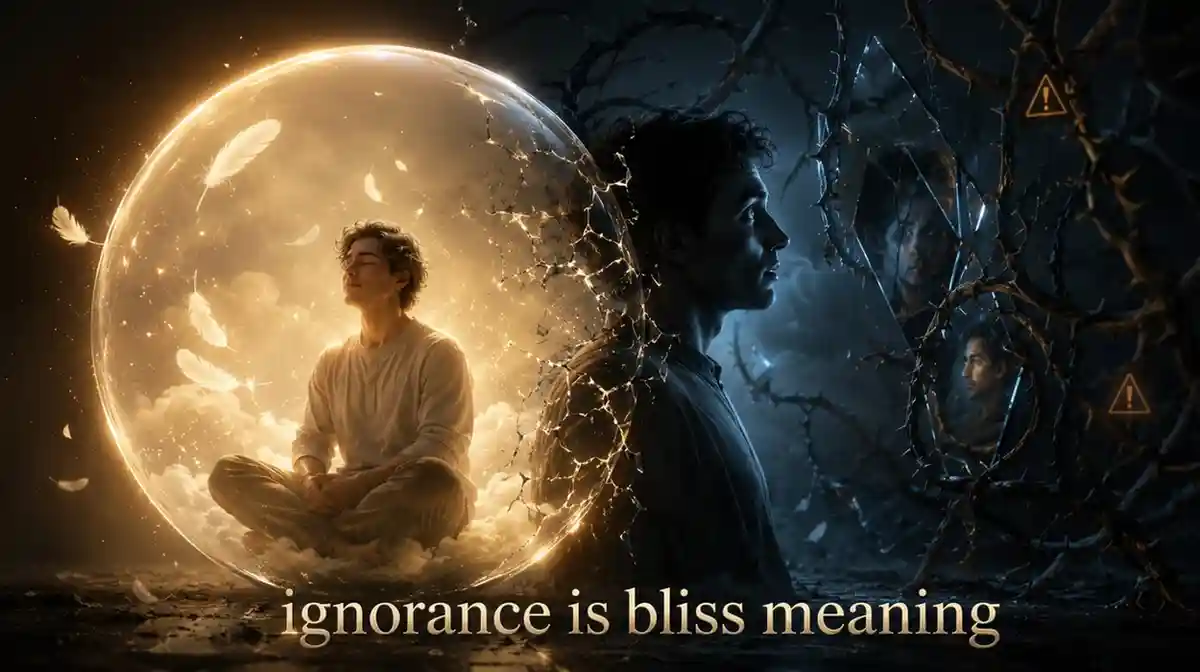
Ignorance Is Bliss Meaning: The Full Story Behind the Proverb
You have heard someone casually say, “Ignorance is bliss.” . Few grasp its layered ignorance is bliss meaning. This phrase can justify avoiding harsh truths—and that choice shapes your mental health, relationships, and decisions. Here, you’ll uncover the proverb’s 18th-century origin, its psychological wiring, and when staying unaware truly serves you versus when it backfires.
What Exactly Is the Ignorance Is Bliss Meaning?
The core ignorance is bliss meaning is straightforward: not knowing something often feels more comfortable than confronting an unpleasant truth. When you lack awareness of a problem, you escape the immediate stress, anxiety, or pain tied to that knowledge.
This phrase does not promote stupidity. It highlights a psychological shortcut—information avoidance—that the human brain uses to preserve emotional balance. The full ignorance is bliss meaning always involves a trade-off. You trade long-term clarity for short-term peace.
- Literal definition: Remaining unaware of harsh realities can keep you happier.
- Common usage: A remark made when someone chooses not to dig deeper into a troubling situation.
- Psychological anchor: A state of “blissful ignorance” where information gaps shield you from emotional turmoil.
Thomas Gray’s Poem: The 18th-Century Origin of “Ignorance Is Bliss”
The exact line springs from Thomas Gray’s 1742 poem An ode to the far-off prospect of Eton College. Gray watched young students playing carefree and contrasted their innocence with the suffering adulthood brings. He closed the poem with:
“Where ignorance is bliss,
‘Tis folly to be wise.”
Gray did not intend a cheerful endorsement. His words carried sorrow—a longing for childhood innocence before life reveals its pains. The ignorance is bliss meaning here was steeped in nostalgia, not a recommendation to avoid knowledge. Over centuries, popular culture clipped the line and softened its melancholy into a casual excuse.
Primary source: Gray, T. (1742). Ode on a Distant Prospect of Eton College. (Available via Poetry Foundation)
The Psychological Wiring Behind Blissful Ignorance
Your brain actively avoids distressing information. Psychologists label this the ostrich effect, a term coined by researchers Karlsson, Loewenstein, and Seppi in a 2009 study. Individuals “bury their heads in the sand” by avoiding criticism, neglecting medical examinations, or disregarding unfavorable financial data. This isn’t laziness. Information avoidance is a coping mechanism. The mind calculates that staying unaware preserves mood, reduces cognitive dissonance, and conserves mental energy. The ignorance is bliss meaning taps directly into this hardwired tendency.
- Ostrich effect: You check your investment portfolio less often when markets are down.
- Cognitive dissonance: You push away facts that clash with your beliefs because the mental clash feels unbearable.
- Emotional regulation: You mute news notifications to stop anxiety spirals.
Source: Karlsson, N., Seppi, D., & Loewenstein, G. (2009). Selective attention to information is known as the “ostrich effect.” Risk & Uncertainty Journal, 38(2), 95-115.
When Ignorance Is Truly Bliss: Real-Life Scenarios
The ignorance is bliss meaning shines brightest when knowledge adds zero practical value and only inflicts pain. Deliberate unawareness becomes a shield, not a flaw.
- Spoiler protection: You avoid movie plot reveals because surprise heightens enjoyment. Knowing earlier offers no benefit.
- Past relationships: Refraining from checking an ex-partner’s social media prevents unnecessary comparison and hurt.
- Health anxiety management: You skip googling every bodily sensation because symptom-searching often fuels panic, not clarity.
- Gift surprises: Not snooping for hidden presents preserves genuine delight.
- Graphic news media: You limit exposure to violent imagery to protect your mental peace without becoming uninformed about the world.
Ignorance is bliss in these situations, which translates into emotional self-care. You consciously choose peace.
The Dark Side: How Ignorance Destroys Peace of Mind
Used as a blanket excuse, the ignorance is bliss meaning morphs into a destructive force. Willful ignorance postpones problems that grow into crises.
- Health neglect: Ignoring a persistent lump or chest pain because “I don’t want to know” can turn a treatable condition fatal.
- Financial blind spots: Refusing to check bank statements or credit card debt allows fees and interest to snowball silently.
- Relationship rot: Overlooking a partner’s emotional distance, substance misuse, or dishonesty erodes trust until the bond shatters.
- Career stagnation: Avoiding feedback on your performance locks you out of growth and promotion.
Here, the ignorance is bliss meaning becomes a trap. Temporary comfort trades away your future stability.
Willful Ignorance vs. Innocent Unawareness: What’s the Difference?
Understanding the ignorance is bliss meaning requires separating two mindsets. Innocent unawareness means you simply don’t know something exists. Willful ignorance means you suspect or know information is available and actively avoid it.
| Type | Awareness | Action |
| Innocent unawareness | No clue a fact exists | No conscious decision to avoid |
| Willful ignorance | Aware that knowledge is accessible | Deliberately look away or refuse to learn |
The proverb’s darker edge lives in willful ignorance. You sense the truth knocking but lock the door.
The Philosophy of Knowledge and Happiness: A Socratic View
Philosophers have wrestled with the ignorance is bliss meaning for millennia. An unexamined life is not worth living, according to Socrates. He believed genuine happiness stems from self-knowledge, not from comfortable illusions.
Yet another philosophical thread suggests that too much information breeds misery. The 17th-century philosopher Thomas Hobbes described life without knowledge of peace as “solitary, poor, nasty, brutish, and short,” implying that ignorance intensifies suffering. The balance point: knowledge can hurt in the short term but empower in the long run. True wisdom involves discriminating between useless pain and necessary truth.
“Ignorance Is Bliss” in Relationships and Social Dynamics
Couples and friends often live out the ignorance is bliss meaning daily. Small omissions can protect feelings. But large secrets corrode intimacy.
Healthy applications:
- Not tallying every minor chore inequality to keep household peace.
- Letting a partner’s harmless white lie about enjoying a gift slide.
Toxic applications:
- Overlooking signs of infidelity because confronting them feels terrifying.
- Ignoring a friend’s toxic behavior to avoid conflict.
Relationships survive on trust, not information voids. When “ignorance” shields abuse or neglect, bliss becomes a mirage.
Decision Framework: When to Stay Unaware and When to Seek Truth
Use this table to weigh the ignorance is bliss meaning against your real-life decisions.
| Scenario | Ignorance Is Bliss (Benefit) | Ignorance Is Harmful (Risk) | Your Action |
| Medical symptom search | Short-term anxiety relief | Delayed diagnosis, worsened condition | Schedule a doctor’s visit; skip Dr. Google |
| Ex-partner’s new life updates | No jealousy spiral | No real loss | Block or mute; focus on your own progress |
| Financial account monitoring | Momentary stress avoidance | Overdraft fees, credit score damage | Set a weekly five-minute check-in |
| Negative feedback at work | Ego protection | Stalled growth, possible job loss | Request specifics and create an improvement plan |
| News consumption | Lower daily anxiety | Being uninformed about safety or civic duties | Curate a brief, trusted news digest |
This framework keeps the ignorance is bliss meaning practical. Choose blindness only when the outcome changes nothing and the emotional cost is high.
Modern Examples: Social Media Detox and News Avoidance
Digital life amplifies the ignorance is bliss meaning. Constant notifications bombard you with comparison, outrage, and fear. Researchers Golman, Hagmann, and Loewenstein (2017) describe “information avoidance” as a rational response when the information stream offers little control.
- Social media detox: Unfollowing accounts that trigger envy removes pointless emotional drain.
- Doomscrolling breaks: You refuse to consume endless bad news because knowing every tragedy does not equip you to solve it.
- Email batching: Checking messages only three times a day shields deep work from constant interruption.
Used strategically, selective ignorance becomes a productivity and mental health tool. The ignorance is bliss meaning evolves into “I protect my attention fiercely.”
Source: Golman, R., Hagmann, D., & Loewenstein, G. (2017). Information avoidance. Journal of Economic Literature, 55(1), 96-135.
How to Use “Ignorance Is Bliss” Correctly in Writing and Conversation
Grasping the ignorance is bliss meaning sharpens your communication. Use the phrase when someone deliberately or unknowingly avoids an unpleasant fact that has no immediate constructive resolution.
- Correct: “He never read the negative reviews and stayed excited about his book launch. Ignorance is bliss, I suppose.”
- Incorrect (harmful): “She ignored the leak in the gas pipe. Ignorance is bliss!” – This normalizes danger.
- Grammatical note: The saying often stands alone as a complete statement. You can also use it as a noun phrase: “His ignorance-is-bliss attitude worries me.”
Apply it sparingly. Overuse trivializes genuine struggles.
How the Ignorance Is Bliss Meaning Shapes Your Mental Health Choices
Therapists often reinterpret the ignorance is bliss meaning through the lens of acceptance and commitment. Avoiding painful truths temporarily soothes but often feeds anxiety disorders. Real healing comes from facing uncomfortable facts with support.
- Short-term gain: Avoiding panic triggers reduces immediate distress.
- Long-term trap: Avoidance strengthens the fear. You never learn that you can cope.
- Healthy change: Say “I will find out with someone I trust beside me” instead than “I do not want to know.”
Your mental health thrives on calibrated awareness, not permanent blinders. Choose the ignorance is bliss path only as a conscious pause, never as a permanent home.
FAQs: Ignorance Is Bliss Meaning Explained
1. What is the simple meaning of “ignorance is bliss”?
The ignorance is bliss meaning in plain terms: you feel happier when you don’t know about something bad. The phrase captures how not knowing can shield you from worry, disappointment, or sadness, at least for a while.
2. Where did the phrase “ignorance is bliss” originate?
The line first appeared in Thomas Gray’s 1742 poem Ode on a Distant Prospect of Eton College. Gray wrote, “Where ignorance is bliss, ‘tis folly to be wise,” lamenting how childhood innocence fades once harsh realities appear. The poem’s original sorrow later morphed into a common saying.
3. Is ignorance really bliss according to psychology?
Psychology says it can be, temporarily. The ostrich effect shows people avoid negative information to protect their mood. However, sustained avoidance often increases anxiety and worsens real-world problems. The ignorance is bliss meaning holds short-term emotional logic but rarely solves underlying issues.
4. What are some everyday examples of ignorance being bliss?
Avoiding spoilers for a movie, not checking an ex’s social media, skipping sensational news before bed, or not knowing about a surprise party. In each case, missing the information adds joy or prevents pointless pain.
5. Can “ignorance is bliss” be a dangerous mindset?
Yes. When you ignore health warning signs, mounting debt, or toxic relationship patterns, the ignorance is bliss meaning turns destructive. Blindness in high-stakes situations delays solutions and compounds damage.
6. How does “ignorance is bliss” connect to the ostrich effect?
The ostrich effect describes deliberately ignoring negative information, much like the myth of ostriches burying their heads in sand. This directly mirrors the ignorance is bliss meaning—choosing “not to see” to preserve comfort, even when the information matters.
Your Next Step
The ignorance is bliss meaning holds a mirror to your daily choices. Some truths deliver only pain without purpose. Others, though uncomfortable, unlock growth, safety, and genuine connection. You hold the power to distinguish between the two.
Take a moment. Reflect on one area where you have deliberately looked away. Is that ignorance protecting your peace, or is it quietly stealing your future? Write down one small, brave action—a call, a check-up, an honest conversation—and take it this week. Real bliss rarely hides behind closed eyes.
Written by James Hartfield, M.A. in Linguistics and Cognitive Science. James has spent 12 years researching idioms, language behavior, and the intersection of communication and psychology. His work helps readers decode everyday phrases for stronger thinking and healthier choices.