Enigma Meaning: 7 Powerful Ways to Decode This Mysterious Word
Author: Amelia Hart, M.A. Linguistics | Language & Vocabulary Strategist
Fact-checked against: Merriam-Webster, Oxford Learner’s Dictionaries, Online Etymology Dictionary, and Britannica.
Struggling to pin down the enigma meaning? You are not alone. The word appears in books, news, and daily speech, but people rarely explain it. That gap can weaken your writing and confidence. This guide fixes that. You will get clear definitions, real examples, synonyms, and the word’s surprising WWII history—all in one place.
Key Takeaways
- Enigma meaning centers on a deeply puzzling person, thing, or situation.
- The word comes from Greek ainigma, which means riddle.
- Use it for people, objects, events, and codes—not just mysteries.
- It differs from “mystery” and “puzzle” in depth and solvability.
Enigma Meaning at a Glance
| Aspect | Details |
| Part of speech | Noun |
| Core definition | A person, thing, or situation that is mysterious, puzzling, or hard to understand |
| Secondary definition | A riddle or obscure question |
| Origin | Greek ainigma, from ainissesthai “to speak in riddles” |
| First known use | Around the 1530s in English |
| Synonyms | Mystery, puzzle, riddle, conundrum, paradox |
| Antonyms | Open book, known quantity, clear answer |
| Common contexts | People, codes, history, art, science |
What Is the Core Enigma Meaning?
The enigma meaning most dictionaries list is simple on the surface: something hard to understand or explain. Merriam-Webster points to a person or thing that is mysterious, puzzling, or ambiguous. Oxford Learner’s Dictionaries adds that it often describes a person, situation, or thing that resists easy explanation.
Think of a locked diary with no key, a patient who never shares feelings, or a signal from deep space that repeats without a pattern. Each one fits the core enigma meaning.
Important detail: the word works as a noun. You do not say “enigmaic” in standard English. You say “He is an enigma” or “That event remains an enigma.”
Enigma Meaning: Origin and Etymology
The enigma meaning did not start in English. The word entered the language around the 1530s through Latin aenigma, which came from the Greek ainigma. That Greek noun means “riddle” or “dark saying.” Its root, ainissesthai, means “to speak in riddles” or “to speak obscurely.”
English borrowed the word because no native term captured that same blend of secrecy and complexity. The Online Etymology Dictionary traces the root further to ainos, meaning “tale” or “story.” That connection makes sense: a riddle is a story with hidden meaning.
How to Use Enigma in a Sentence
Writers and speakers use enigma meaning to describe something that resists a clear answer.Here are some instances of the word in use: The Roanoke colony’s disappearance remains an enigma for American historians.
- Maya never explained her sudden career change; she became an enigma to her closest friends.
- The Mona Lisa’s smile reads as an enigma even after five centuries.
- Astronomers detected an enigma: a repeating radio burst with no known source.
- His calm reaction to the crisis was an enigma to everyone in the room.
Use “an enigma” or “the enigma of” before a noun. For example: “The enigma of her silence kept the team guessing.” This pattern keeps the word natural.
Enigma vs. Mystery vs. Puzzle: Key Differences
Understanding enigma meaning becomes easier when you separate it from two close cousins.
| Word | Core Meaning | Best Use |
| Enigma | Deeply puzzling person, thing, or event with hidden layers | People, art, codes, unexplained events |
| Mystery | Something unknown or unexplained | Crimes, investigations, secrets |
| Puzzle | A problem designed to be solved through logic | Games, riddles, math problems |
A puzzle invites a solution. A mystery asks for discovery. An enigma often remains partially hidden even after you learn more. That is why people say a person is an enigma rather than a puzzle—you can know someone for years and still not fully understand them.
Synonyms and Antonyms for Enigma
Searching for a synonym? The best enigma meaning synonyms depend on context.
| Synonym | Shade of Meaning | Example |
| Mystery | Something unknown | The cause of the fire is a mystery. |
| Puzzle | A solvable problem | The crossword puzzle took ten minutes. |
| Riddle | A question with a hidden answer | The Sphinx asked a riddle. |
| Conundrum | A confusing problem | The policy created a conundrum. |
| Paradox | A self-contradictory truth | Her kindness was a paradox to her critics. |
Antonyms include: open book, known quantity, clear answer, and transparent situation.
Choose “riddle” for wordplay, “paradox” for contradiction, and “enigma” for layered depth.
Types of Enigmas: People, Objects, Events, and Codes
The enigma meaning stretches across four common categories:
- Personal enigma: A person who hides emotions or behaves in contradictory ways.
- Object enigma: A physical item whose purpose or origin stays unknown, such as the Voynich manuscript.
- Historical enigma: An event without a confirmed explanation, like the lost colony of Roanoke.
- Cipher enigma: A code or message designed to resist easy decoding, like the WWII Enigma machine.
Each type shares one trait: the answer is not immediately visible.
Famous Examples of Enigmas in History and Culture
History gives you rich examples of enigma meaning in action.
- The Sphinx: A creature whose riddle had life-or-death stakes in Greek myth.
- Mona Lisa: A portrait whose smile has generated centuries of debate.
- D.B. Cooper: A hijacker who vanished after parachuting with ransom money.
- Voynich manuscript: A codex from the fifteenth century in an unidentified script.
- Roanoke colony: A settlement that disappeared with only the word “CROATOAN” left behind.
These examples show why the word carries a sense of depth—not just a missing fact, but a missing explanation.
The Enigma Machine: When a Word Became a Cipher
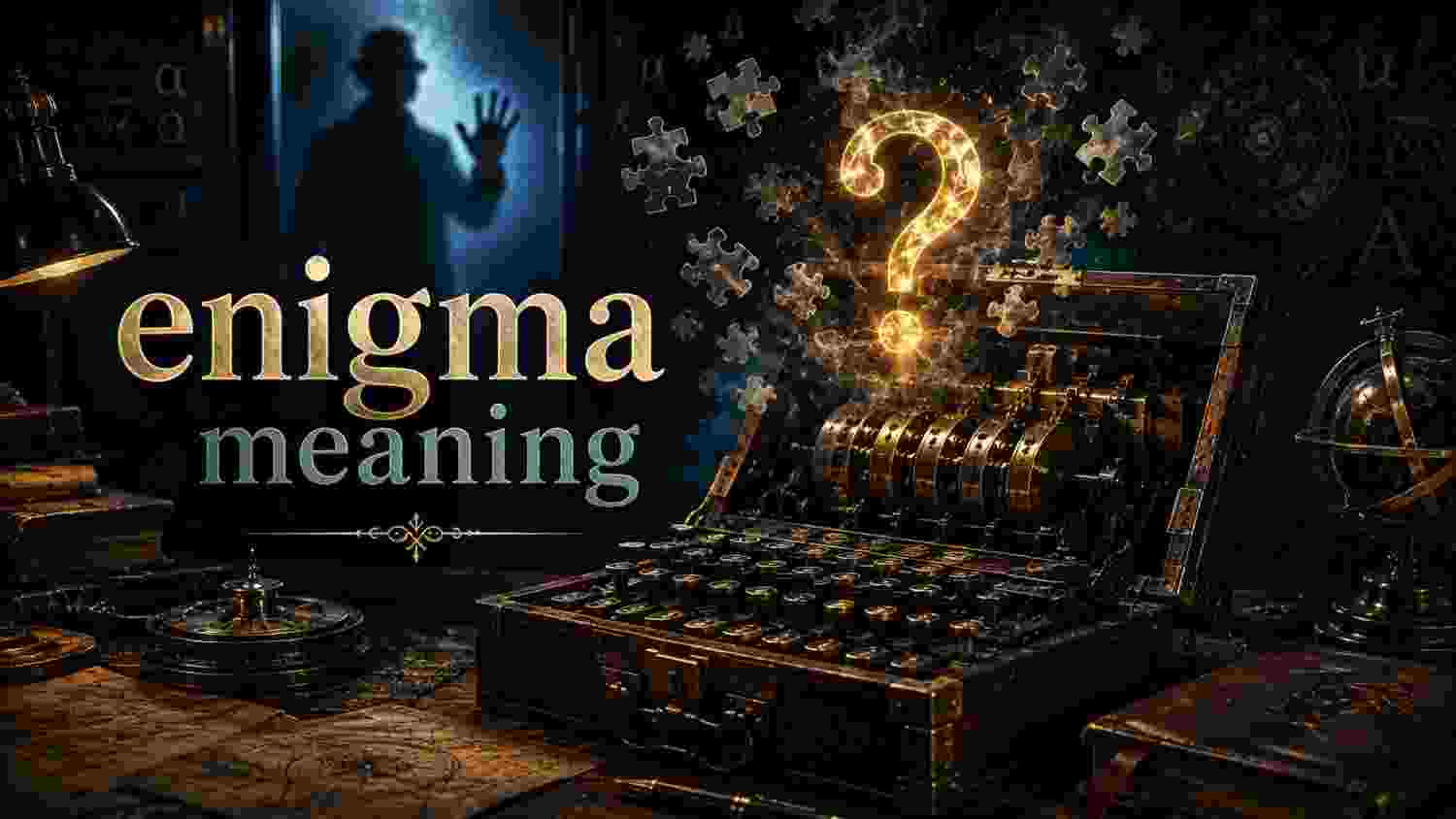
During World War II, the German military used a cipher device called the Enigma machine. Its name was no accident. The machine created billions of possible letter combinations, turning every message into a cryptographic enigma.
Alan Turing and a team at Bletchley Park built early computing tools to crack the code. Their work shortened the war and laid groundwork for modern computing. Britannica records the Enigma machine as one of the most important cipher devices in history.
This real machine shows how the core enigma meaning—something deeply hard to understand—can have practical, world-changing stakes.
Enigma in Literature and Art
Writers and artists use the enigma meaning as a creative tool.
- J.R.R. Tolkien’s The Hobbit uses riddles between Bilbo and Gollum. The riddles are puzzles, but Gollum himself becomes an enigma.
- F. Scott Fitzgerald’s Jay Gatsby is an enigma to his guests: rich, magnetic, and secretive.
- René Magritte’s paintings, such as The Son of Man, hide faces behind objects, creating visual enigmas.
Use the word to describe a character whose motives remain unclear even after the final page.
Why People Call a Person an Enigma
When someone calls a person an enigma, they usually mean the person is hard to read. The label can be positive or negative.
- Positive: intriguing, deep, independent, thoughtful.
- Negative: distant, evasive, confusing, inconsistent.
The enigma meaning in relationships often signals a gap between what a person shows and what they feel.
Example: “Everyone at the office liked Daniel, but no one knew anything about his life. He remained an enigma.”
How to Decode an Enigma: Practical Tips
You can use enigma meaning with more precision by following five steps:
- Identify the target: Are you describing a person, event, object, or message?
- Ask what makes it hard to understand. Is the information missing, contradictory, or hidden?
- Check if “puzzle” or “mystery” fits better. If a clear answer is likely, choose puzzle.
- Use “enigma” when the difficulty comes from depth, secrecy, or layered complexity.
- Read the word in context. Write two original sentences and compare them with dictionary examples.
Common Misconceptions About Enigma Meaning
The phrase enigma meaning sometimes gets stretched in the wrong direction.
- Myth: Enigma means the same as secret.
Fact: A secret is deliberately hidden; an enigma may have no clear answer at all. - Myth: Only people can be enigmas.
Fact: Objects, events, codes, and artworks can be enigmas. - Myth: Enigma is negative.
Fact: It can signal depth, charm, and fascination. - Myth: Every enigma has a solution.
Fact: Some enigmas remain unresolved for centuries.
Enigma Meaning in Everyday Communication
Using enigma meaning correctly sharpens your writing. When you write “The test results were an enigma,” you tell the reader the results were not just unknown but deeply confusing. That extra weight improves clarity. Replace vague words like “weird” or “strange” with enigma when the situation calls for layered mystery.
Try this: Next time you describe a confusing character, object, or event, ask whether the enigma meaning applies. If yes, use it once—not every sentence.
Frequently Asked Questions
1. What does enigma mean in simple terms?
Enigma means a person, thing, or situation that is deeply puzzling or hard to understand.
2. Can a person be called an enigma?
Yes. People who are private, contradictory, or hard to read are often called enigmas.
3. What is the difference between enigma and mystery?
An enigma suggests a deeper, often unsolvable puzzle. A mystery is something unknown or unexplained but may have a discoverable answer.
4. Where does the word enigma come from?
It comes from the Greek ainigma, meaning riddle, and ainissesthai, meaning to speak in riddles.
5. What was the Enigma machine?
The Enigma machine was a German cipher device used in World War II. Alan Turing and his team at Bletchley Park cracked its code.
6. How do you use enigma meaning in a sentence?
Use it as a noun: “The cause of the signal remains an enigma to astronomers.” Or “Her motives were an enigma to her own family.”
Your Next Step With Enigma Meaning
Now you have a complete enigma meaning toolkit. Use it to describe people, events, objects, and codes with more precision. Bookmark this guide for quick reference. Share it with a friend who loves words. Practice by writing three sentences with enigma today. Have a question or an example? Leave it in the comments below.
Primary Sources for This Guide
- Merriam-Webster: Enigma Definition & Meaning — https://www.merriam-webster.com/dictionary/enigma
- Oxford Learner’s Dictionaries: Enigma — https://www.oxfordlearnersdictionaries.com/definition/english/enigma
- Online Etymology Dictionary: Enigma — https://www.etymonline.com/word/enigma
- Britannica: Enigma cipher machine — https://www.britannica.com/topic/Enigma-code-machine
About the Author: Amelia Hart, M.A. Linguistics, has spent 12 years teaching vocabulary and editing language content for academic publishers. She specializes in making word origins and meanings clear for everyday readers.