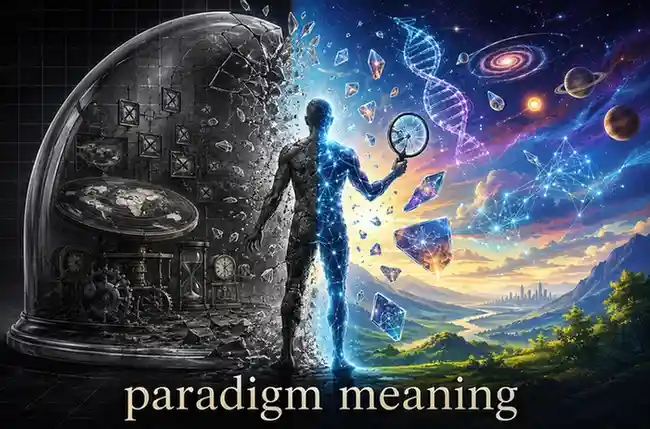
Paradigm Meaning: Your Complete Guide to Definitions, Shifts & Real-Life Examples
You hear the word “paradigm” in business meetings, self-help books, and science documentaries. Yet most people can’t explain the true paradigm meaning when asked.Because of that gap, you are left wondering and unable to identify the unseen guidelines that influence your choices. Miss that understanding, and you stay trapped in old patterns. This guide gives you the paradigm meaning in simple terms, unpacks game-changing shifts, and shows how to rewrite your own mental operating system for sharper thinking and faster growth.
What Does “Paradigm” Mean? The Core Definition
The paradigm meaning starts with a simple idea: a paradigm is a set of beliefs, concepts, and practices that form the way you see the world. Think of it as the lens you never remove. Every fact you accept, every solution you consider, and every expectation you hold runs through that lens.
In everyday language, paradigm meaning refers to a standard model or pattern. In science, it becomes the shared framework a community uses to solve problems. The word comes from the Greek paradeigma, meaning pattern or example. Stick with that root, and you realize a paradigm isn’t just an idea—it’s the blueprint that shapes ideas before they even form.
Paradigm Meaning in Philosophy: Thomas Kuhn’s Revolutionary Idea
Philosopher Thomas Kuhn cemented the modern paradigm meaning in his 1962 book The Structure of Scientific Revolutions. He defined a paradigm as “universally recognized scientific achievements that, for a time, provide model problems and solutions for a community of practitioners.” That definition changed how we talk about knowledge itself.
Kuhn argued that science doesn’t progress in a straight line. It jumps forward through paradigm shifts—moments when the old framework breaks and a new one takes over. Before Kuhn, people saw science as a slow accumulation of facts. After Kuhn, paradigm meaning became inseparable from the idea of intellectual earthquakes that reset entire fields.
External Source: Stanford Encyclopedia of Philosophy’s entry on Thomas Kuhn provides a deep analysis of his paradigm theory.
Paradigm Shifts Explained: How New Frameworks Replace Old Ones
A paradigm shift happens when the dominant model can no longer explain emerging data. Anomalies pile up, trust erodes, and someone—or a group—offers a radically new map. The shift isn’t a tweak; it’s a complete replacement of the fundamental assumptions.
Grasping the paradigm meaning requires understanding these shifts as non-negotiable breaks. Once a new paradigm settles in, you can’t see the world the old way anymore. Copernicus placing the sun at the center of the solar system didn’t improve the Ptolemaic model. He demolished it and rebuilt astronomy from scratch.
The Difference Between a Paradigm and a Mental Model
| Concept | Focus | Scope | Example |
| Paradigm | Shared framework for a community or era | Broad, systemic | Newtonian physics |
| Mental Model | Personal thinking shortcut | Individual, specific | “Supply and demand” as a lens |
Paradigm meaning covers the collective agreement, while mental models are the personal tools you use within that agreement. You can replace a mental model with a better one without triggering a paradigm shift. But changing the paradigm itself alters every mental model downstream. Recognizing the distinction saves you from trying to fix a broken system with isolated tweaks.
Real-Life Examples of Paradigms in Science
The history of science is an example of paradigm meaning in action. Each example demonstrates the pattern: established order, growing cracks, and a sudden leap.
- The Copernican Revolution: Earth was the unmoving center. Then Copernicus and Galileo showed a sun-centered solar system. The paradigm meaning flipped astronomy permanently.
- Darwinian Evolution: Life was fixed, created in final form. Darwin’s natural selection introduced a dynamic, branching tree. Biology got a new operating system.
- Germ Theory of Disease: Before Pasteur and Koch, “bad air” explained sickness. Identifying microorganisms replaced miasma theory and built modern medicine.
- Relativity and Quantum Mechanics: Newton’s clockwork universe gave way to Einstein’s spacetime and the strange probabilities of quantum theory.
Each case proves that a shift in paradigm meaning doesn’t add facts—it redefines what counts as a fact.
External Source: Harvard University Press’s summary of Kuhn’s The Structure of Scientific Revolutions outlines these shifts in detail.
Paradigm Meaning in Business and Leadership
In business, paradigm meaning translates to the unspoken rules that govern strategy, innovation, and competition. A company’s paradigm determines how it defines value, how it treats customers, and what it believes is possible.
Netflix destroyed the video-rental paradigm when it replaced late fees and physical stores with streaming subscriptions. Amazon rewired retail paradigms by betting on unlimited selection and customer reviews when competitors still guarded physical floor space. These leaders saw the old paradigm as a cage, not a home. They rewrote the rules and forced entire industries to follow.
External Source: Harvard Business Review article “Leading Change: Why Transformation Efforts Fail” by John Kotter illustrates how deep paradigm shifts require seeing and challenging shared assumptions.
How Personal Paradigms Shape Your Daily Decisions
Your personal paradigm is the sum of beliefs about yourself, money, relationships, and possibility. It filters every decision, often without your permission. If your paradigm says “I’m bad with numbers,” you’ll avoid budgets, skip investment opportunities, and prove yourself right.
Personal paradigm meaning reveals itself in repeating outcomes. A string of failed relationships points to a relationship paradigm. Repeated career frustration signals a professional paradigm lock. You don’t just have thoughts; you live inside a belief system that manufactures those thoughts. Changing the output demands changing the factory, not the product.
Signs You’re Stuck in an Outdated Paradigm
- Constant frustration without clear cause: The rules you follow don’t match reality anymore, but you keep applying them.
- Dismissing new information as irrelevant: Your paradigm acts as an immune system, attacking data that contradicts it.
- Feeling “right” while results prove otherwise: Winning arguments but losing outcomes screams paradigm mismatch.
- Blaming external factors exclusively: Old paradigms protect themselves by pointing the finger away from core assumptions.
- Repeating the same advice that stopped working: If your proven playbook now produces failure, the paradigm has expired.
Catching these signals early turns paradigm meaning from a dictionary term into a diagnostic tool. You stop defending a sinking ship and start asking which map you’ve been using.
How to Shift Your Paradigm for Personal Growth
A deliberate paradigm shift follows a process, not a mood. These steps work for personal, professional, and organizational frameworks.
- Identify the current paradigm. Write down the unspoken rules you operate by. Ask: “What must I believe to feel this way repeatedly?”
- Challenge the evidence that sustains it. Most paradigms rest on outdated childhood experiences or single events. Test them against today’s facts.
- Seek contrasting models. Read biographies, study different cultures, interview people who excel where you struggle. Paradigms dissolve in the presence of living counterexamples.
- Install a new paradigm with small wins. Practice the new belief in low-risk situations. Stack evidence that the new lens works.
- Protect the new framework. Avoid environments that reinforce the old paradigm. Surround yourself with people who embody the shift you want.
This isn’t positive thinking fluff. It’s a surgical replacement of the mental architecture that generates your results.
The Role of Language and Culture in Forming Paradigms
Language carries paradigms through metaphors and categories. When a culture describes time as money, its people treat minutes like currency. The paradigm meaning gets baked into everyday phrases, making it invisible and non-negotiable.
Culture acts as the incubator. A collectivist society grows a relational paradigm; an individualist one plants a self-reliance framework. You inherit thousands of paradigms before you choose a single one consciously. Recognizing that inheritance is the first act of genuine freedom.
Common Misconceptions About Paradigm Meaning
- “An opinion is just another word for a paradigm.” Mood affects opinions. Paradigms are structural and resist casual revision.
- “Paradigm shifts happen overnight.” The buildup takes years of anomaly accumulation. The visible break is the climax, not the whole story.
- “Paradigms are exclusive to scientists.” All educators, parents, leaders, and creative professionals labor within unseen frameworks that determine what is feasible.
- “New paradigms are always superior.” A paradigm may be novel and unworkable. The measure is explanatory and predictive power, not novelty.
Clearing these misunderstandings sharpens your use of paradigm meaning in real conversations.
Frequently Asked Questions About Paradigm Meaning
What is a simple definition of paradigm?
A paradigm is a dominant framework of beliefs and practices that shapes how a group or individual perceives and solves problems.
Who first introduced the modern paradigm meaning?
Thomas Kuhn introduced the concept in The Structure of Scientific Revolutions (1962), defining it as shared achievements that guide scientific research.
How does a paradigm differ from a worldview?
A worldview is broader and often philosophical or religious. Paradigm meaning is narrower, tied to specific problem-solving models within a discipline or domain, though the two overlap.
Can an individual have a paradigm?
Yes. Personal paradigms are belief systems about self, relationships, and capability that produce consistent patterns of thinking and behavior.
What triggers a paradigm shift?
Accumulating anomalies that the current paradigm cannot explain eventually force a crisis and the adoption of a new, more coherent framework.
Why does understanding paradigm meaning matter in daily life?
It reveals the hidden rules driving your results. When you see the paradigm, you can change it instead of fighting symptoms.
Rewrite Your Paradigm, Rewrite Your Results
Paradigm meaning isn’t academic jargon you can afford to ignore. It’s the architect of your ceiling. Change the architect, and the blueprint changes. Start examining the unspoken rules in your business, your relationships, and your self-image. Pick one outdated paradigm today and run a small experiment that contradicts it. Watch what happens when you trade a rusty filter for a clear lens. Share your biggest paradigm shift moment with someone you trust—or write it down and notice how the old rule loses its grip. The map you carry determines the destination you reach. Carry a better one.