Proscribed Meaning: Your Complete Guide to Legal & Everyday Clarity
Misunderstanding a single word can invite legal penalties, damage your credibility, or derail a contract. Confusion between “proscribed” and “prescribed” leads to costly miscommunication. Legal documents, compliance policies, and everyday speech suffer when banned terms are misinterpreted. This pillar page clarifies the proscribed meaning, showing exactly what is forbidden, why it matters, and how to apply it flawlessly.
What Is the Proscribed Meaning?
Proscribed meaning refers to the sense of a word, phrase, or expression that an authority formally forbids. When something carries a proscribed meaning, using it in that specific way violates a rule, law, or accepted standard.
Black’s Law Dictionary defines “proscribe” as “to condemn or forbid as harmful or unlawful.” Merriam-Webster traces the verb to Latin proscribere, literally “to publish in writing, to outlaw.” The core idea remains consistent: to publicly prohibit. The proscribed meaning of a term signals that its use in a particular context is banned, not merely discouraged. A statute can proscribe certain contractual clauses. A style guide can proscribe jargon. A platform policy can proscribe hate speech.
The phrase always ties the forbidden nature directly to the meaning itself, not just the word. Grasping the proscribed meaning helps you avoid accidental violations.
Proscribed vs. Prescribed: The Critical Difference
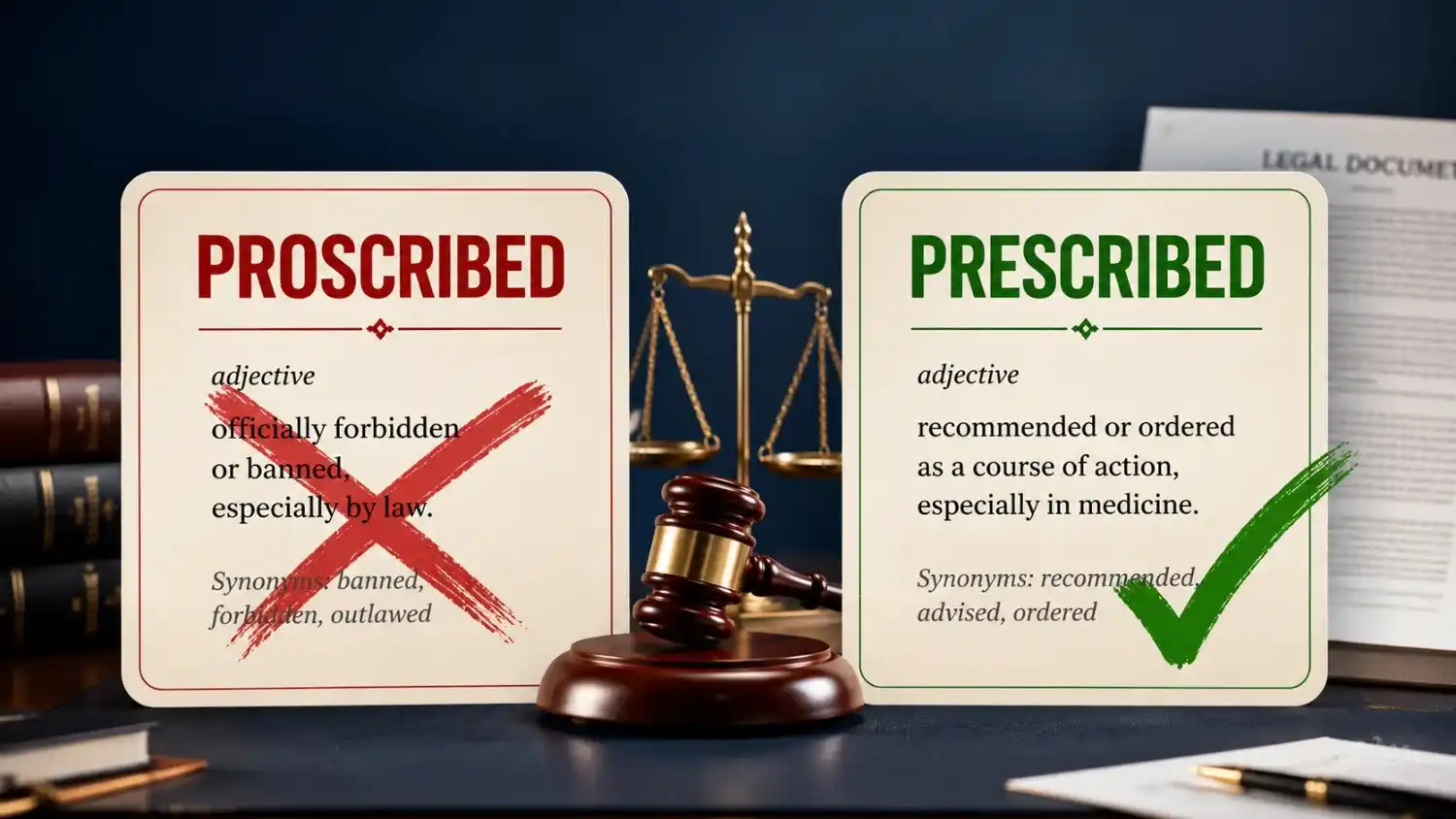
Mixing up “proscribed” and “prescribed” triggers serious errors. One forbids; the other commands.
- Proscribed meaning – A meaning that is banned or outlawed.
- Prescribed meaning – A meaning that is officially recommended or required.
A court prescribes a specific procedure; it proscribes misconduct. A medical board prescribes treatment guidelines and proscribes unethical practices. The distinction shapes every compliance framework. When a regulation says a clause is proscribed, you must remove it. When it says a clause is prescribed, you must include it. Checking which term applies protects your legal standing.
Quick Comparison Table
| Aspect | Proscribed Meaning | Prescribed Meaning |
|---|---|---|
| Core action | Forbids, bans, outlaws | Requires, commands, recommends |
| Legal effect | Renders language void or illegal | Makes language mandatory |
| Consequence | Penalty, nullification, sanctions | Non-compliance penalty, rejection |
| Example in law | Proscribed discriminatory clauses | Prescribed safety warnings |
| Example in writing | Proscribed clichés in formal reports | Prescribed citation format |
This contrast clarifies why the proscribed meaning carries heavy weight in contracts, legislation, and corporate policy.
Etymology and Historical Roots of “Proscribe”
The word “proscribe” comes from the Latin proscribere, formed by pro- (forth, publicly) and scribere (to write). In ancient Rome, proscription meant publishing a list of citizens declared outlaws. Those on the list lost property and legal protection. That public, written condemnation embedded the concept of an official ban deep into the word’s DNA.
By the 15th century, English adopted “proscribe” to mean “to condemn, to denounce, to outlaw.” The noun “proscription” followed. Today, the proscribed meaning retains that sense of authoritative prohibition. When a dictionary labels a usage “proscribed,” it tells you that educated or official consensus treats that sense as unacceptable. Understanding this lineage helps you see why the term carries institutional force, not just personal dislike.
Proscribed Meaning in Legal Contexts
Legal systems rely on proscribed meaning to set boundaries. Laws do not simply discourage harmful acts; they proscribe them. A criminal code proscribes theft, fraud, and assault by defining the prohibited conduct precisely. The meaning of “weapon” in a statute might proscribe certain items and leave others outside the ban. Courts then examine whether a defendant’s action falls within that proscribed meaning.
Contract law offers sharp examples. An employment agreement may proscribe non-compete clauses that are unreasonably broad. If a court finds a clause proscribed by public policy, it strikes it down. The proscribed meaning in that scenario is the interpretation that violates statutory protections. In United States v. Alvarez, 567 U.S. 709 (2012), the Supreme Court examined the Stolen Valor Act, which proscribed false claims about military honors. The ruling highlighted how a law must narrowly define the proscribed meaning of prohibited speech to survive constitutional challenge.
Always check whether a contract term carries a proscribed meaning in your jurisdiction. Using it can void the entire provision.
Proscribed Terms in Regulatory Compliance and Corporate Policy
Regulators publish exhaustive lists of proscribed terms and practices. GDPR Article 5 proscribes data processing that is not “lawful, fair and transparent.” The European Data Protection Board clarifies the proscribed meaning of “legitimate interest” to prevent businesses from twisting it into a blanket permission. Financial regulators proscribe misleading statements in prospectuses. Violating these proscriptions triggers fines and reputational damage.
Corporate policies mirror this language. An employee handbook proscribes harassment by defining the exact prohibited behaviors. The proscribed meaning of “gift” in an anti-bribery policy might cover cash, travel, and even excessive entertainment. Clear definitions eliminate loopholes. Internal audit teams scan for any use of terms in a proscribed sense.
Mapping out all proscribed meanings in your compliance documents strengthens your defense during an investigation. Train your team to spot the banned interpretations, not just the banned words.
How Courts Interpret Proscribed Language
Judges use specific canons to unpack proscribed meaning. The plain meaning rule starts with the ordinary sense of the words. If a statute proscribes “vehicles in the park,” the court first asks whether an ambulance fits the everyday proscribed meaning of “vehicle.” When plain meaning produces an absurd result, courts may look to legislative intent.
The rule of lenity applies in criminal law. When a penal statute’s proscribed meaning is ambiguous, courts construe it in favor of the defendant. This principle ensures the state cannot punish conduct unless the law clearly communicated the ban. For civil regulations, the Chevron doctrine (where still applicable) often deferred to an agency’s reasonable interpretation of what its rule proscribes.
Judges also rely on dictionaries contemporaneous with the statute. A term’s proscribed meaning in 18th-century English can differ from modern usage. Originalist judges examine how the public understood a constitutional prohibition at ratification. This method makes historical semantics a powerful tool for determining what the law actually bans.
Proscribed Meaning in Linguistics: Taboo Words and Banned Expressions
Linguists study proscribed meaning under the umbrella of linguistic prescriptivism and taboo. A community proscribes certain words because of their power to offend, harm, or violate social norms. Slurs carry a proscribed meaning that society actively suppresses in public discourse. Curse words have a proscribed meaning in formal settings.
Language academies and style guides publish lists of proscribed usages. The Chicago Manual of Style proscribes dangling participles and illogical comparisons. Grammar purists proscribe “irregardless” as a nonstandard form. While these bans lack legal force, they shape professional credibility. A resume with proscribed grammar damages a candidate’s chances.
Understanding the proscribed meaning in sociolinguistic terms helps you navigate cross‑cultural communication. A term that is humorous in one culture might carry a proscribed offensive meaning in another.
Common Examples of Proscribed Phrases in Everyday Life
You encounter proscribed meaning far beyond courtrooms and style guides.
- Employment ads: “Recent graduates only” may carry a proscribed meaning that discriminates by age under equal opportunity laws.
- Product labels: “Cures arthritis” bears a proscribed meaning that the FDA classifies as an unapproved health claim.
- Social media: A platform proscribes hate speech by listing categories of banned content. A phrase that seems harmless might carry a proscribed meaning under the policy’s definitions.
- Apartment listings: “Ideal for singles” can carry a proscribed meaning that violates fair housing rules against familial status discrimination.
- Insurance forms: “Acts of God” as a policy exclusion carries a proscribed meaning that courts may narrow to prevent unjust claim denials.
Each example shows how the proscribed meaning lives in the interpretation, not just the surface wording.
Why Proscribed Meaning Matters for Clear Communication
Ambiguous prohibitions create confusion. When a rule’s proscribed meaning remains fuzzy, people either over‑censor or accidentally violate it. Precision protects everyone. A well‑drafted policy lists the exact proscribed meaning of key terms so that compliance becomes measurable.
In cross‑functional teams, legal, compliance, and communications professionals must align on what a proscribed term covers. A marketing slogan might inadvertently echo a phrase whose proscribed meaning exposes the company to false advertising liability. An engineer’s commit message could use a term that the security policy proscribes as an indicator of unprotected data handling.
Clarity saves money, time, and reputation. Treat proscribed meaning as a clarity tool, not a limitation. When everyone knows exactly what is off‑limits, they can innovate freely within safe boundaries.
How to Identify Proscribed Terms in Documents
Use a systematic audit to surface proscribed meaning in any text.
- Scan for authority lists: Gather applicable statutes, regulations, case law, and internal policies. Extract every term whose banned interpretation appears.
- Map definitions: Write the official proscribed meaning beside each term. Do not rely on assumptions.
- Context‑check: A word might have a proscribed meaning only in a specific clause. Compare its use across the document.
- Test with examples: Create “would‑this‑violate?” scenarios and check them against the proscribed definition.
- Peer review: Ask compliance or legal colleagues to flag any buried proscribed sense you missed.
This process turns vague rules into a checklist. Document your findings so future reviews go faster.
Proscribed Meaning in Digital Content and Platform Policies
Online platforms enforce content moderation through detailed definitions of proscribed meaning. Meta’s Community Standards proscribe hate speech by describing protected characteristics and banned attack types. YouTube’s advertiser‑friendly guidelines proscribe “controversial issues” by listing sensitive subjects. A creator reading “proscribed content” must understand the specific meaning assigned to “harassment” or “misinformation” in that policy.
Algorithmic enforcement adds a layer: automated systems scan for patterns that match the proscribed meaning. A phrase might trigger a false positive if the system’s training data conflates a benign use with a banned one. Content creators who understand the proscribed meaning behind moderation rules can craft their messaging to stay compliant without sacrificing authenticity.
Tips to Avoid Unintentional Proscribed Usage
- Keep a glossary of banned interpretations for your industry. Update it quarterly.
- Run compliance‑specific spell‑check using tools that flag proscribed terms based on your rule set.
- Write in plain language. Vague phrasing hides a proscribed meaning that a regulator may exploit.
- Train employees with real examples. Show how a seemingly innocent sentence triggered a violation.
- Insert review gates. Require legal sign‑off on any language that edges near a known prohibition.
Proactive habits turn proscribed meaning from a trap into a guardrail.
The Impact of Proscribed Meaning on Free Speech Debates
The scope of proscribed meaning sits at the heart of free expression disputes. Governments proscribe speech categories like obscenity, defamation, incitement, and true threats. The definitions of these categories determine what speech loses constitutional protection. The U.S. Supreme Court in Brandenburg v. Ohio narrowed the proscribed meaning of “incitement” to speech directed at producing imminent lawless action and likely to do so.
Universities proscribe hate speech through codes that define proscribed conduct. Critics argue that overly broad proscribed definitions chill legitimate debate. Advocates counter that clearly proscribed meanings protect vulnerable groups. The quality of the definition determines whether the policy survives legal challenge and public trust.
This intersection reminds us that proscribed meaning is never neutral. It always reflects a choice about which harms society will ban and which it will tolerate.
Proscribed Meaning in Academic Writing and Style Guides
Academic integrity codes proscribe plagiarism by defining exactly what “original work” means. Style guides proscribe redundancy, jargon, and biased language. The APA Publication Manual proscribes the use of “he” as a generic pronoun, prescribing “they” instead. Here, the proscribed meaning of “generic he” is a banned interpretation tied to outdated norms.
Editors and peer reviewers enforce these rules. A manuscript containing a proscribed term may face immediate rejection. Mastering the proscribed meanings in your field accelerates publication and builds authority. Create a personal checklist drawn from your target journal’s guidelines. Update it when style guides issue new proscriptions.
Frequently Asked Questions
What does proscribed meaning mean in simple terms?
It is a word or phrase’s banned, forbidden interpretation. When a rule says a meaning is proscribed, using that sense violates the rule.
How is proscribed meaning different from prescribed meaning?
Proscribed forbids; prescribed requires. A proscribed meaning tells you what you cannot do; a prescribed meaning tells you what you must do.
Can a word have a proscribed meaning in one context but not another?
Yes. A term’s proscribed meaning often depends on the field, jurisdiction, or document. For example, “light” might carry a proscribed meaning under aviation safety rules but remain ordinary elsewhere.
Why do legal documents use proscribed language?
To set clear boundaries. Proscribed language defines exactly what the law or contract prohibits, removing ambiguity and enabling enforcement.
What happens if you use a proscribed term in a contract?
The clause may be void or unenforceable. You could face legal penalties, regulatory action, or reputational harm, depending on the severity of the proscription.
How can I check if a phrase is proscribed in my industry?
Review applicable statutes, regulatory guidance, case law, and internal policies. Build a glossary that maps proscribed meanings and update it regularly with input from legal counsel.
Strengthen Your Communication by Mastering Proscribed Meaning
Precise knowledge of what words are banned and why turns legal risk into operational clarity. Review your next contract, policy, or content draft with a proscribed‑meaning lens. Identify every term that a court, regulator, or style guide has formally condemned. Replace ambiguous bans with crystal‑clear definitions. When you treat proscribed meaning as a precision tool, you protect your rights, your reputation, and your audience.
Share a real‑world example where a proscribed meaning caught you off guard. Your experience could help others spot the same pitfall before it costs them.
Authored by Alex Harmon, Legal Language Consultant, drawing on extensive work in regulatory compliance and forensic linguistics. Sources include Black’s Law Dictionary, Merriam-Webster, United States v. Alvarez (2012), The Chicago Manual of Style, and GDPR Article 5.