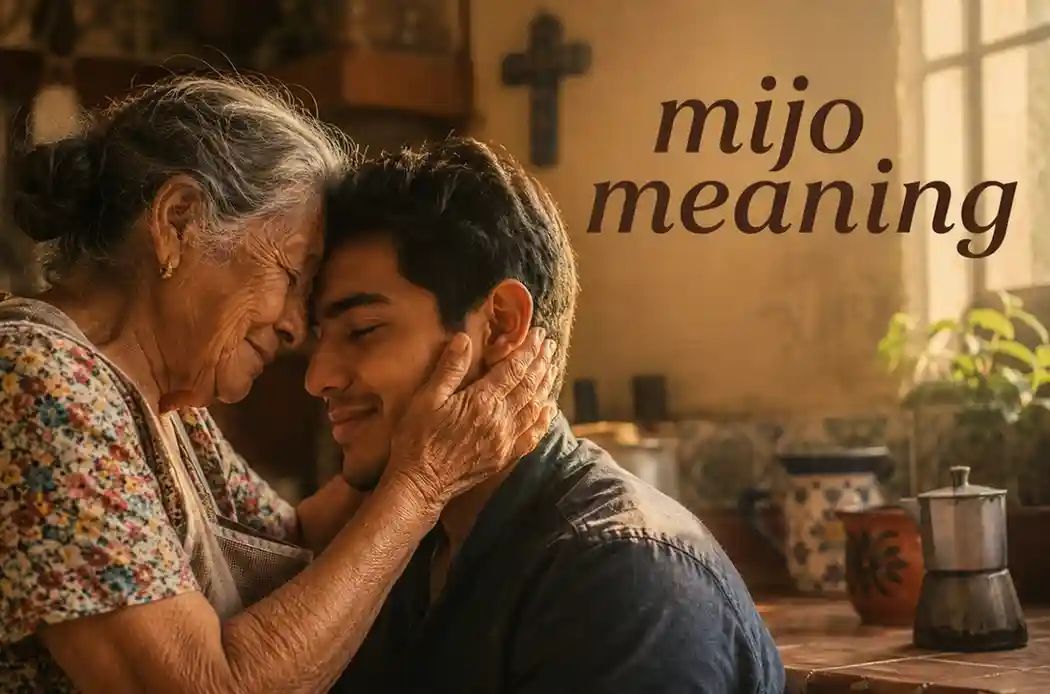
Mijo Meaning: A Complete Guide to This Spanish Term of Endearment
You hear someone call you “mijo” and your mind jolts. Are they being sweet, condescending, or maybe even flirting? Misreading a single word can spark awkward tension. This guide unpacks the full mijo meaning—its origin, emotional layers, regional flavors, and the exact moments it fits. You will walk away ready to use and respond to “mijo” with natural ease.
What Does Mijo Mean? – The Core Definition
The simplest mijo meaning is a contraction of “mi hijo,” which translates literally to “my son.” In everyday Spanish, however, it has evolved into a warm, affectionate term that reaches far beyond biological family. A shopkeeper might call a teenage customer “mijo” just as easily as a grandmother calls her grandchild the same. The word wraps familiarity, care, and a touch of protective affection into two syllables. Grasping this flexible mijo meaning unlocks an entire cultural code of closeness.
The Origin and Etymology of Mijo
“Mijo” was born from the rapid, informal speech of everyday Spanish speakers. Dropping the “h” and blending “mi hijo” into one smooth sound gave the language a linguistic hug. According to the Royal Spanish Academy (RAE), “mijo” is classified as a colloquial contraction documented across Latin America and parts of Spain. Its roots trace back to Latin “filius” (son), but the emotional texture is purely Hispanic—woven into the fabric of family-centered societies where even strangers are treated like kin. The mijo meaning you hear today carries centuries of oral tradition.
Mijo vs. Mija: Understanding the Gender Difference
Grasping the mijo meaning also requires its counterpart: “mija.” Mijo is used for males (boys, young men, or any male you want to address tenderly). Mija is the feminine form, short for “mi hija” (my daughter). The words are identical in sentiment; the switch depends on the person you are speaking to. Calling a girl “mijo” sounds odd, just as calling a grown man “mija” can create confusion or unintended humor. The rule is straightforward—match the gender, and you instantly show you understand the language’s affectionate heartbeat.
How to Pronounce Mijo Correctly
Nail the pronunciation, and you immediately honor the word’s origin. Say “MEE-ho.” The “j” carries a soft, breathy “h” sound—never a hard English “j.” Stress the first syllable gently, and let the second syllable float out. This softness mirrors the tenderness embedded in the mijo meaning itself. Even if your accent isn’t perfect, pronouncing it with warmth will always be received better than a flat, robotic attempt.
When to Use Mijo: Contexts and Examples
The mijo meaning shines brightest in real-life moments. You can use it with:
- Your own child or a younger relative: “Mijo, ¿ya hiciste la tarea?” (Mijo, did you do your homework?)
- A close family friend’s child: “Pásale, mijo, siéntate donde quieras.” (Come in, mijo, sit wherever you like.)
- A neighbor’s kid who needs guidance: “Mijo, ten cuidado al cruzar la calle.” (Mijo, be careful crossing the street.)
- In a shop or casual service setting: “¿Qué vas a llevar, mijo?” (What will you have, mijo?)
Avoid using it with authority figures or in highly formal business meetings—it presumes a familial closeness that can feel disrespectful if misjudged. The key is existing warmth or a clear age gap that invites nurturing speech.
The Emotional Weight of Mijo: More Than Just a Word
When someone calls you “mijo,” they’re not just saying “son.” They’re wrapping you in a subtle layer of protection, affection, and belonging. My grandmother used “mijo” as a complete sentence—it meant “I love you, I see you, and you matter.” That emotional charge is the true mijo meaning. It can soothe a crying child, defuse a tense moment, or make a complete stranger feel at home. This little word builds an invisible bridge between two people.
Regional Variations: How Mijo Is Used Across Spanish-Speaking Countries
While the core mijo meaning remains stable, regional flavor adds spice. In Mexico, you’ll hear it constantly—from street vendors to abuelitas. In Colombia, the “j” becomes even softer, almost like “mío.” In some Caribbean dialects, the word blends into a very fast “m’ijo.” In Spain, “mijo” is less common outside Andalusia and the Canary Islands, where “hijo” or “cariño” might take its place. Despite the variations, one thing stays solid: the word is a vehicle of everyday tenderness. Knowing these nuances helps you catch the local rhythm and build instant rapport.
Mijo in Popular Culture and Media
Songs, telenovelas, and movies have cemented the mijo meaning in global consciousness. Mexican singer Vicente Fernández often wove the term into his rancheras, amplifying its nostalgic pull. Netflix series like Gentefied and One Day at a Time drop “mijo” into dialogue, signaling family intimacy without subtitles needing explanation. When you hear it in media, you’re being invited into an inside circle—one where love speaks in two syllables.
Common Misconceptions About Mijo
Some people think “mijo” is only for blood relatives. Others believe it’s infantilizing or flirtatious by default. Both assumptions miss the full mijo meaning. It can be romantic if paired with a certain tone between adults, but that’s a tiny slice of its spectrum. Mostly, it’s a community glue—a verbal pat on the head that doesn’t require a family tree. Don’t let a narrow definition rob you of the word’s generous spirit.
How to React to a Call from Mijo
Your response depends on context. If an elder says it, a warm smile and a respectful reply in kind—like “gracias” or “sí, aquí estoy”—works beautifully. If a peer uses it playfully, you might respond with “dime, mijo” (tell me, mijo) if the rapport is mutual. The mijo meaning invites reciprocity, so matching the speaker’s warmth honors the exchange. If you’re not Hispanic, simply receiving it with a grateful nod is enough; no one expects a perfect Spanish comeback.
Mijo vs. Other Spanish Terms of Endearment (Comparison Table)
Understanding the mijo meaning becomes easier when you see it alongside similar affectionate words. The table below breaks down the differences so you can choose the right term for every situation.
| Term | Literal Meaning | Usage Context | Gender |
| Mijo | My son (contraction of mi hijo) | Affectionate for boys/men, all ages | Male |
| Mija | My daughter (mi hija) | Affectionate for girls/women, all ages | Female |
| Cariño | Dear, darling | Romantic or parental, any gender | Neutral |
| Cielo | Sky, heaven | Romantic, very close friends | Neutral |
| Amor | Love | Romantic partners, sometimes children | Neutral |
| Chico/a | Boy/girl | Casual, friendly address among peers | Gendered |
| Mi vida | My life | Deeply affectionate, romantic or parental | Neutral |
Can You Use Mijo in Formal Settings?
Short answer: rarely. Because the mijo meaning is built on closeness, using it in a job interview, with a client you just met, or toward a senior executive can backfire. It signals an intimacy that does not exist yet. In some Caribbean workplaces, older colleagues might use it with younger ones to create a mentoring vibe, but you must read the room. When in doubt, default to “señor,” “señora,” or the person’s name. Politeness never dilutes respect.
Learning to Use Mijo Naturally: Practical Tips
Start by listening. Watch Spanish-language family vlogs, shows, or simply eavesdrop on conversations at a local panadería. Notice who says it, the tone, and the reaction. Try it with a young family member you are close to. Let your voice drop into a caring register—the word falls flat without genuine affection. The mijo meaning emerges fully only when your intention matches the sound. Record yourself saying it, then ask a native speaker for feedback. Small efforts like these turn you from a textbook learner into someone who speaks from the heart.
Frequently Asked Questions About Mijo Meaning
What is the literal mijo meaning in English?
The literal mijo meaning is “my son,” formed by blending “mi hijo” into one word. However, the cultural translation is closer to “sweetheart,” “buddy,” or “dear” when used outside the family.
Can a girl be called mijo?
No. A girl or woman is called “mija.” Using “mijo” for a female goes against the gendered structure of Spanish and can cause confusion or embarrassment.
What does it mean when a girl calls you mijo?
When a girl calls you “mijo,” she is often expressing a nurturing or playful tone. It rarely signals romantic interest by itself; the context, her age, and your relationship define the exact meaning.
Is mijo the same in all Spanish-speaking countries?
The core mijo meaning remains consistent, but pronunciation and frequency shift. Mexicans use it daily and broadly, while in parts of South America you might hear it less and with softer consonant sounds.
Can I use mijo with someone older than me?
Typically, no. The term flows downward or between peers who share a close bond. Using “mijo” toward an older person can sound disrespectful unless you are mimicking an endearing family dynamic.
Does mijo have a negative meaning?
Rarely. In very specific sarcastic tones, someone could use “mijo” to condescend (“Ay, mijo, no sabes nada” – Oh, sweetie, you know nothing). But the overwhelming everyday mijo meaning is positive and affectionate.
Embrace the Warmth of “Mijo” Today
You now hold the entire mijo meaning in your hands—not just a definition, but a roadmap to cultural connection. This small word can soften a stranger’s face, deepen a family bond, and unlock doors in Spanish-speaking communities worldwide. Try saying it to a child you love, or simply welcome it when an abuela offers it to you. Language lives in moments like these. If this guide gave you a new lens on the word, share it with a friend who loves Spanish, or drop a comment about your own “mijo” story. Your next real-life conversation will feel warmer, richer, and unmistakably human.
About the Author: Alejandra Torres is a bilingual language coach and cross-cultural communication specialist. Raised in a Mexican-American household, she has spent over a decade helping learners move beyond textbook Spanish into authentic, heart-centered expression. Her work is regularly cited in language academies and cultural blogs.
Sources:
- SpanishDict (spanishdict.com) – Definition and usage examples of “mijo”
- Collins Dictionary (collinsdictionary.com) – Spanish-English translation and etymology notes
- Real Academia Española (rae.es) – Colloquial contraction entries for “mijo” and “mija”
- FluentU Spanish Blog (fluentu.com) – Regional usage patterns of Spanish terms of endearment
- ThoughtCo (thoughtco.com) – Cultural context and formality in Spanish address terms