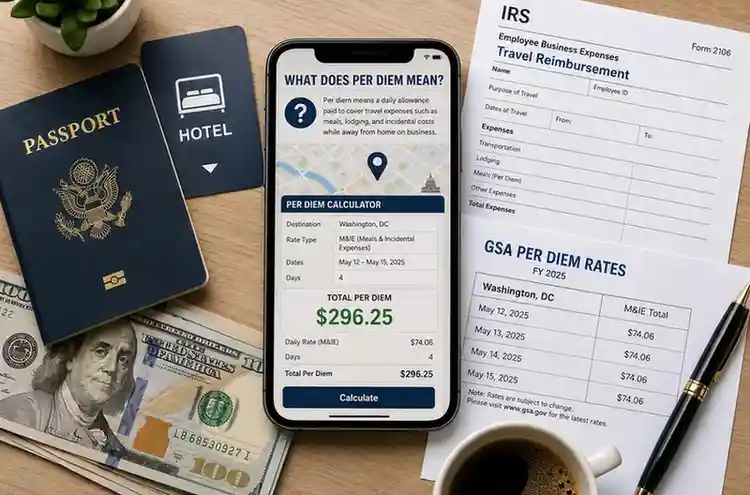
What Does Per Diem Mean? Your Complete Per Diem Guide
Confused by the term “per diem” on your check stub or travel policy? You aren’t alone. Misreading this daily allowance can lead to missed tax breaks or payroll errors. This guide strips away the jargon. You’ll discover exactly what per diem means, how rates are set, and how to use per diem to keep more money in your pocket—whether you’re an employee, a business owner, or a self-employed traveler.
What Does Per Diem Mean?
If you’ve ever asked, “What does per diem mean?” the answer is simple. Per diem is a fixed daily allowance an employer pays to cover lodging, meals, and incidental expenses when an employee travels for work. The phrase comes from Latin: per (by) and diem (day). So, what does per diem mean in your daily work life? It means you get a set amount per travel day instead of saving every receipt for reimbursement. Companies use per diem because it slashes paperwork and gives workers predictable spending money.
A per diem payment replaces the old system of tracking every coffee, parking fee, and tip. When you understand what does per diem mean for your paycheck, you can plan your spending without stress. The key lies in how the IRS treats the payment—properly structured per diem stays tax-free.
How Per Diem Works: The Basics of Daily Allowances
A per diem arrangement breaks your travel reimbursement into two buckets: lodging and Meals & Incidental Expenses (M&IE). Your employer sets a daily limit based on government rates or company policy. You receive the allowance before, during, or right after the trip. If the payment follows IRS accountable plan rules, you do not report it as income.
The process works in three simple steps:
- Your employer confirms the travel location and dates.
- They apply the correct daily lodging and M&IE rate for that city.
- They pay you the per diem amount multiplied by the number of travel days, adjusting for partial days.
Because the allowance is fixed, you keep any leftover cash if you spend less than the daily rate. That’s a perk many employees love once they grasp what does per diem mean for their wallets.
Who Qualifies for Per Diem? Employees, Contractors, and Self-Employed
Many people wonder, “What does per diem mean for me if I’m not a federal worker?” The truth: per diem isn’t just for government travelers. Private-sector employees, independent contractors, and even self-employed individuals can use daily allowances when work takes them away from their tax home overnight.
- Employees – Your employer must have a written accountable plan that meets IRS rules. The travel must be business-related and away from your main work location.
- Contractors – Agencies often pay travel nurses, consultants, and IT specialists a per diem to cover short-term assignment costs. The payment structure must separate the per diem from your hourly rate to protect tax-free status.
- Self-Employed – Sole proprietors and single-member LLCs can deduct actual expenses or use the federal per diem rate for meals and incidental expenses on their Schedule C.
The question “what does per diem mean” becomes especially critical for mixed-status workers. A travel nurse, for instance, might receive a tax-free per diem only if they maintain a permanent tax home elsewhere.
Per Diem vs. Actual Expense Reimbursement: Key Differences
Many first-time business travelers struggle to compare per diem with traditional reimbursement. Here’s how they stack up.
| Feature | Per Diem | Actual Expense Reimbursement |
| Receipt requirement | No receipts for M&IE; lodging may need proof of payment | Every expense needs a receipt |
| Administrative burden | Low—just verify travel days | High—collect, review, and file receipts |
| Employee flexibility | You keep any unspent daily amount | You only get back what you spent |
| Tax treatment | Tax-free if under accountable plan rules | Tax-free with proper substantiation |
| Predictability | Predictable daily payment | Variable, depends on spending |
When you ask “what does per diem mean” in practice, the answer often points to freedom. You can eat frugally and pocket the difference, or treat a client to a nice dinner and cover the shortfall yourself.
Comprehending CONUS and OCONUS GSA Per Diem Rates
The U.S. General Services Administration sets per diem rates for travel within the 48 contiguous states (CONUS). Rates update each federal fiscal year, effective October 1. You can look up a specific city and date on the GSA website. For 2025, the standard CONUS rate is $110 for lodging and $68 for M&IE, though many high-cost destinations exceed that baseline.
Outside the continental U.S. (OCONUS), including Alaska, Hawaii, and U.S. territories, the Department of Defense establishes rates. International per diem rates come from the U.S. Department of State. These sources give you the exact daily allowance by city and travel season.
GSA also publishes a list of non-standard areas (NSAs) where lodging rates run higher. Chicago, New York City, and San Francisco all appear on that list. Tying your per diem policy to GSA rates adds an instant layer of defensibility during an IRS review, because the government accepts these numbers as reasonable.
External source: General Services Administration, Per Diem Rates (gsa.gov/perdiem)
Meal and Incidental Expenses (M&IE) Breakdown: What’s Covered
M&IE covers far more than a restaurant bill. The GSA defines incidental expenses as fees and tips given to porters, baggage carriers, hotel staff, and transportation stewards. The meal portion includes breakfast, lunch, dinner, and any snacks. It does not cover alcohol unless your employer’s policy explicitly allows it—and most don’t.
When you ask “what does per diem mean for my meal spending,” the answer carries a unique rule: on the first and last travel day, you can only claim 75% of the full M&IE rate. This rule applies regardless of what time you leave or return. Plan your budget accordingly. For example, a full M&IE rate of $79 drops to $59.25 on those bookend days.
The IRS also offers a simplified method called the high-low substantiation method. It replaces dozens of location-based M&IE rates with one “high” rate and one “low” rate for travel within CONUS. Employers who want less admin often use this approach.
Lodging Per Diem: How Rates Are Determined
Lodging rates are location-specific and seasonally adjusted in some regions. GSA calculates them by analyzing average daily room rates in each non-standard area, then applying a margin to cover taxes and fees. In major cities like Boston, the lodging per diem often exceeds $250 per night.
You need actual lodging receipts to validate the expense, even when your company pays a flat per diem for lodging. M&IE is the only piece that is truly receipt-free. So, what does per diem mean for your hotel bill? It means your employer reimburses you up to the government-set ceiling, not the full amount of any upgraded suite.
If you double up in a room with a coworker, the reimbursement rules get murky. The IRS generally requires you to split the lodging cost and only claim the portion you paid. Over-claiming triggers a red flag.
External source: IRS Publication 463, Travel, Gift, and Car Expenses (irs.gov)
Per Diem for Business Travelers: Tax Rules and Accountable Plans
An accountable plan is the legal framework that keeps per diem payments out of your taxable income. Three rules must be met:
- The expense must have a business connection—work travel away from your tax home.
- You must adequately account for the expenses within a reasonable time, typically 60 days.
- You must return any excess reimbursement or per diem that exceeds the federal rate.
If any of these rules break, the per diem becomes a taxable non-accountable plan payment. Your employer then reports it on your W-2 as wages, and you pay income and payroll taxes on it.
What does per diem mean when the plan fails? It means extra tax, plain and simple. Employers who skip the substantiation step still withhold taxes on the entire allowance, wiping out the advantage. Always verify your employer’s plan status with HR or your tax preparer.
Per Diem in Special Industries: Truck Drivers, Travel Nurses, and Government Contractors
Certain professions rely heavily on per diem structures.
- Truck Drivers – Long-haul drivers often receive a per diem for meals. The IRS allows transportation workers subject to DOT hours-of-service rules to deduct 80% of their per diem meal expense (as of 2025), a unique benefit.
- Travel Nurses – Hospitals and staffing firms blend per diem into compensation packages. To keep the allowance tax-free, nurses must duplicate living expenses by maintaining a permanent residence. The travel nursing pay stub should clearly separate hourly wages from tax-free per diem.
- Government Contractors – Defense contractors and consultants working on federal projects follow the Joint Travel Regulations (JTR) and GSA rates. Compliance audits here are rigorous.
In all these roles, truly understanding what does per diem mean shields you from accidentally triggering wage reclassification.
How to Calculate Per Diem: A Step-by-Step Guide with Detailing Table
Calculating per diem by hand takes minutes once you know the method. Let’s walk through a 3-day business trip to Chicago in June 2025, using the Cook County GSA rates: lodging $177, M&IE $79. The employee departs Monday morning and returns Wednesday afternoon.
Step 1: Determine the destination’s entire lodging and M&IE charges.
Step 2: Apply the 75% M&IE rule for the first and last travel day.
Step 3: Multiply lodging by the number of nights where overnight stays occur.
Step 4: Add the adjusted M&IE amounts.
Here’s the full per diem calculation table:
| Day | Date | M&IE Rate Applied | Lodging Rate Applied | Total Per Diem |
| Monday (departure) | June 2 | $59.25 (75% of $79) | $177 (overnight) | $236.25 |
| Tuesday (full day) | June 3 | $79.00 | $177 (overnight) | $256.00 |
| Wednesday (return) | June 4 | $59.25 (75% of $79) | $0 (no overnight) | $59.25 |
| Trip Total | $197.50 | $354.00 | $551.50 |
Take note of how the final day solely produces M&IE. That’s exactly what does per diem mean when the rubber hits the road—partial days get a haircut.
Common Per Diem Mistakes That Trigger IRS Scrutiny
Avoid these errors to keep your per diem payments clean.
- Claiming full M&IE on travel days one and last – Always use 75% on the bookend days.
- Pocketing lodging per diem without a receipt – The IRS requires lodging receipts or a valid hotel folio.
- Paying per diem without a written accountable plan – Verbal policies don’t count.
- Treating local travel as per diem-eligible – Trips that don’t require an overnight stay usually don’t qualify.
- Mixing per diem and hourly wages – This blurs the line and can convert tax-free allowances into taxable compensation.
- Using outdated GSA rates – Rates change every October 1. An old rate can cause overpayment or underpayment.
- Failing to reconcile overpayments – Employees must return excess per diem within 120 days, or it becomes taxable.
- Ignoring the high-low method limits – The low rate applies only to locations not on the IRS high-cost list.
Getting these details right answers the deeper question of what does per diem mean in terms of tax compliance: it means a paper trail the IRS will respect.
Recordkeeping Requirements for Per Diem Payments
Even though per diem slashes receipt hoarding, you still need records.
- Dates, places, and business purpose of the trip must be logged. A simple calendar entry plus a meeting agenda suffices.
- Lodging receipts are mandatory if your per diem includes a lodging amount. Electronic folios are fine.
- M&IE receipts are not required, but many employers request a one-line daily confirmation.
- Employers must keep the accountable plan document on file and enforce the excess-return policy.
Using an expense app that timestamps entries adds a layer of proof. The IRS expects you to submit these records within 60 days of the trip’s end. Late filing doesn’t automatically kill the tax-free treatment, but it weakens your position during an audit.
Per Diem for Employers: Setting a Policy That Saves Money and Keeps You Compliant
A well-written per diem policy attracts traveling talent and cuts accounting costs. Include these components:
- Scope – Define who qualifies and what counts as business travel.
- Rate source: Use the high-low approach or refer to GSA rates for lodging and M&IE.
- Partial day rule – State that M&IE pays at 75% on departure and return days.
- Receipt requirements – Clarify that lodging receipts are required but meal receipts are not.
- Overpayment return – Set a deadline (usually 120 days) for employees to return excess per diem.
- Tax treatment disclaimer – Inform employees that per diem may become taxable if rules aren’t followed.
Train your payroll team on the accountable plan rules. A single payroll run that fails to separate per diem from wages can trigger back taxes and penalties for the entire traveling workforce. Done right, per diem keeps everyone out of trouble.
External source: U.S. Department of State, Foreign Per Diem Rates (aoprals.state.gov)
Frequently Asked Questions About Per Diem
1. What does per diem mean in simple terms?
Per diem is a daily cash allowance for travel meals, tips, and lodging, paid instead of asking you to submit every receipt.
2. Are per diem payments taxable?
They are tax-free when paid under an IRS accountable plan that requires a business trip, substantiation, and return of excess amounts. Otherwise, they become taxable wages.
3. How do I look up GSA per diem rates for a city?
Visit gsa.gov/perdiem, enter the city or ZIP code, and select the travel dates. The tool shows the exact lodging and M&IE rates.
4. What is the difference between per diem and a travel stipend?
A travel stipend is a fixed sum often paid up front without requiring expense tracking, making it fully taxable. Per diem follows government rates and remains tax-free when rules are met.
5. Can I claim per diem if my employer doesn’t offer it?
Self-employed individuals can deduct the federal per diem meal rate on their tax return. W-2 employees cannot deduct unreimbursed travel expenses under current tax law (Tax Cuts and Jobs Act suspended miscellaneous deductions through 2025).
6. Do I need to return unused per diem money?
Under an accountable plan, you must return any amount that exceeds the federal per diem rate for that location. If the payment matches the federal rate exactly, you keep any leftover M&IE.
Now you know exactly what does per diem mean—and how to use it without stumbling into tax trouble. If you’re an employee, review your next travel reimbursement statement line by line. If you run a business, update your accountable plan to match the latest GSA rates. Bookmark the GSA per diem lookup tool and share this guide with your team. Got a specific travel scenario? Leave a comment below or consult a trusted tax advisor who understands travel allowances.