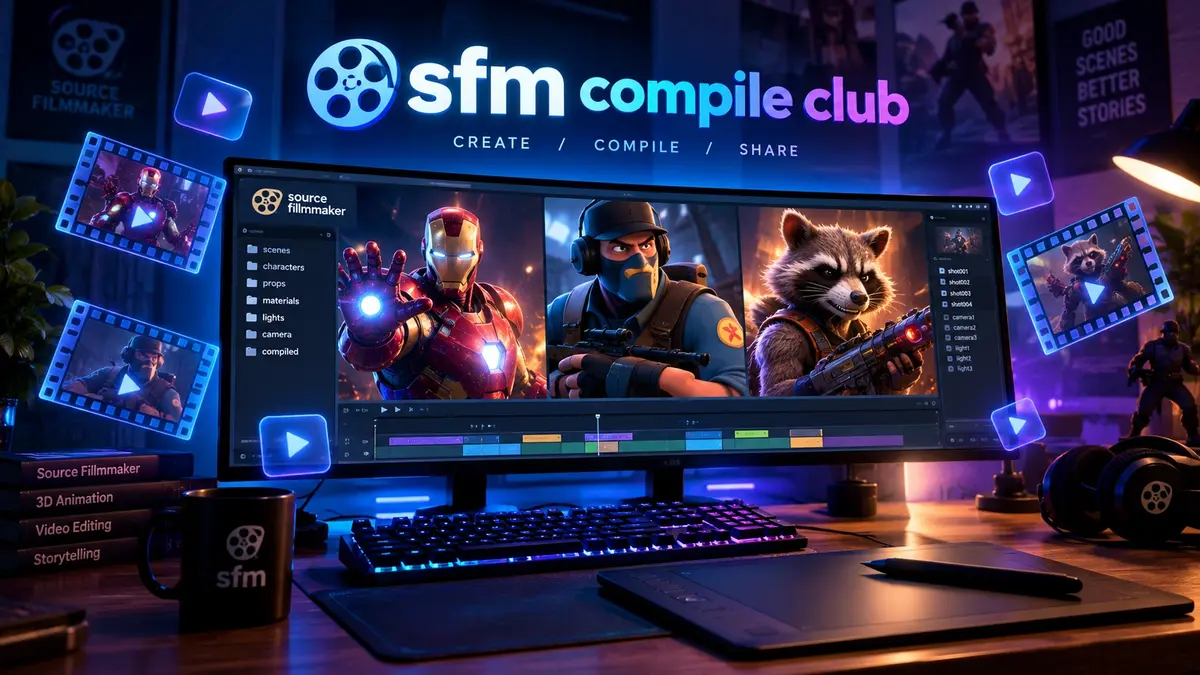
SFM Compile Club: A Practical Guide to Source Filmmaker Animation Compilations
TL;DR: SFM Compile Club describes the community channels and curators who collect Source Filmmaker animations into single compilation videos. This guide covers the tools, workflow, copyright realities, and where to find the best content — including the current Marvel Rivals wave.
You’ve probably seen one without realizing what it was. A 15-second clip of Spider-Man doing something ridiculous in a hyper-detailed 3D environment, sandwiched between a Team Fortress 2 skit and an Overwatch cinematic. That’s the SFM compile club ecosystem in a nutshell — and it’s bigger than most people realize.
This guide breaks down what these compilations actually are, how creators build them using real tools, and why the Marvel Rivals wave has pulled in millions of new viewers. Whether you’re a casual watcher or thinking about making your first animation, you’ll leave with a clear picture of how this corner of the internet actually works.
What is SFM Compile Club?
SFM Compile Club refers to community-driven channels and online hubs that curate, edit, and publish compiled collections of 3D animations created in Valve’s Source Filmmaker (SFM). These compilations combine short fan animations featuring popular characters — such as Marvel Rivals, Team Fortress 2, and Overwatch — into bingeable videos shared on YouTube, Reddit, and TikTok.
Table of Contents
- What Exactly Is Source Filmmaker?
- How the Compilation Community Formed
- Why SFM Compilations Keep Growing
- Marvel Rivals and the New Wave of SFM Content
- How SFM Compilations Are Actually Made
- Where to Find the Best SFM Content
- Copyright, Fair Use, and Creator Etiquette
- FAQ
Quick Overview
- SFM = Source Filmmaker, Valve’s free 3D animation tool available on Steam since 2012
- Compile = a curated video stitching together multiple short SFM clips from different animators
- The community lives primarily on YouTube, r/SFM, r/SourceFilmmaker, and Discord servers
- Marvel Rivals, TF2, Overwatch, and Five Nights at Freddy’s dominate the content landscape
- Core tools include SFM itself, Crowbar, Blender, and VTFEdit
- No paid software is required to start creating
What Exactly Is Source Filmmaker?
Source Filmmaker is a 3D animation application that Valve built on top of the Source game engine. It launched publicly through Steam in July 2012, and the price tag was zero — which immediately set it apart from industry tools like Maya or Cinema 4D that cost thousands per year.
The interface gives you a timeline, a graph editor for keyframe animation, a camera system, and a lighting rig that behaves similarly to real-world cinematography setups. You drag character models into a scene, pose their skeletal rigs, set your camera angles, and render the output as a video file.
Because SFM runs on the same engine behind Half-Life 2, Team Fortress 2, and Portal 2, it ships with native access to those game assets. That’s why early SFM content was almost entirely TF2 and Left 4 Dead animations — those were the models people already had on their hard drives.
The learning curve is real but manageable. Most creators report getting comfortable with basic posing and camera work within a couple of weeks, though mastering lighting and lip-sync takes considerably longer.
How the Compilation Community Formed
The earliest SFM uploads were standalone shorts — a two-minute TF2 comedy sketch here, a dramatic Portal scene there. Creators poured weeks into individual clips that often ran under 90 seconds, and the YouTube algorithm didn’t always reward that kind of effort.
Compilations solved a practical problem. Viewers wanted longer watch sessions, and curators realized they could assemble 15 to 30 clips from different animators into a single 10-to-20-minute video. The format gave smaller creators exposure they’d never get on their own, and it gave audiences a reason to stay on a channel.
The “club” branding emerged organically. Channels started treating their compilations like recurring shows — weekly drops, themed episodes, seasonal roundups. Community members began submitting their clips directly to curators through Discord servers and Google Forms, creating a pipeline that looked a lot like a small production studio.
Today, the most active compilation hubs maintain submission guidelines, quality standards, and even credit sequences that tag every contributing animator by name. It’s a surprisingly organized system for something that grew out of people messing around with free game assets.
Why SFM Compilations Keep Growing
Short-form 3D animation occupies a specific niche that’s hard to replicate with other media. A well-timed SFM clip delivers a visual punch in under 30 seconds — the kind of content that performs well on YouTube Shorts, TikTok, and Instagram Reels. When you bundle dozens of these clips together, you get a video that holds attention through constant variety.
The numbers back this up. According to Pew Research Center’s Social Media Fact Sheet, YouTube remains the most widely used online platform among U.S. adults, with video consumption continuing to climb across every age demographic. SFM compilations plug directly into that behavior — they’re long enough to generate meaningful watch time but varied enough to prevent drop-off.
There’s also a feedback loop that keeps the format alive. Animators see their work featured in a popular compilation, gain subscribers, and produce more content. Curators get better submissions, which attracts more viewers. The cycle reinforces itself without requiring any centralized coordination.
Marvel Rivals and the New Wave of SFM Content
The Marvel Rivals release handed the SFM community a gift: a roster of instantly recognizable characters with high-quality 3D models that port cleanly into Source Filmmaker. Within weeks of the game’s launch, creators were extracting character rigs and building cinematic scenes that rivaled official Marvel promotional material.
What makes the Marvel Rivals SFM compile trend stand out is the tonal range. You’ll find a dramatic Iron Man vs. Magneto showdown followed immediately by a clip of Groot awkwardly trying to fit through a doorframe. That unpredictability is exactly what keeps compilation viewers watching past the first few minutes.
The technical quality has also jumped. Modern SFM animators are using physically-based rendering materials, volumetric lighting, and particle effects that weren’t common in the TF2 era. The result is content that looks closer to a Pixar short than a game mod — which broadens the audience well beyond the traditional gaming community.
How SFM Compilations Are Actually Made
This is where most surface-level guides fall short, so let’s get specific. Creating a compilation involves two separate workflows: individual animation production and the curation and editing process.
Individual Animation Pipeline
Model sourcing and porting. Most animators don’t build characters from scratch. They pull rigged models from the Steam Workshop, SFM Lab, or dedicated community repositories. When a model comes from a non-Source game like Marvel Rivals or Overwatch, creators use Crowbar to decompile model files and Blender to re-rig or convert the mesh into a format SFM can read. Texture files often need conversion through VTFEdit to match Source’s native format.
Scene assembly. Once models are loaded, the animator builds the environment using SFM’s map browser or imports custom maps. Lighting is set up using a combination of ambient occlusion, directional lights, and point lights — many creators reference real cinematography guides for three-point lighting setups.
Animation and rendering. Keyframe animation happens in SFM’s timeline and motion graph. For more complex movement, some animators import motion capture data from Blender or Mixamo. Rendering uses SFM’s built-in engine, and a single high-quality frame can take several seconds to process on mid-range hardware. Final output is typically rendered at 1920×1080 at either 24 fps for a cinematic look or 60 fps for smoother motion.
Compilation Curation Pipeline
Submission review. Curators receive dozens of clips per cycle through Discord channels or submission forms. They filter for visual quality, audio clarity, and originality — rejecting anything with watermarks from other channels or obvious re-uploads.
Editing and sequencing. The selected clips are imported into a video editor like DaVinci Resolve or Adobe Premiere. Editors normalize audio levels across clips — this is critical because individual animators export at wildly different decibel ranges — and apply consistent transitions. The sequencing alternates between high-energy and slower clips to maintain pacing.
Credit and export. Every contributing animator gets an on-screen credit with a link to their channel. The final video is exported at the highest bitrate the platform allows, then uploaded with detailed timestamps in the description so viewers can jump to specific clips.
Where to Find the Best SFM Content
YouTube is the obvious starting point. Search for “SFM compile” and sort by upload date to find the most recent roundups. Channels that post on a consistent weekly or biweekly schedule tend to have the strongest curation standards. Pay attention to the descriptions — good curators link every original animator, which makes it easy to follow individual creators you enjoy.
Reddit hosts two active communities worth bookmarking: r/SFM and r/SourceFilmmaker. Both subreddits feature original animations, work-in-progress threads, and technical help posts. The r/SFM community is particularly active with Marvel Rivals content right now, and you’ll often find clips there weeks before they appear in larger compilations.
Discord is where the real networking happens. Most major compilation channels run private or semi-private Discord servers where animators share early drafts, troubleshoot rendering issues, and coordinate collaboration projects. Finding these servers usually starts with checking the About section or community tab on a curator’s YouTube channel.
TikTok and Instagram Reels are better for discovery than deep dives. The short format limits what you’ll see, but the algorithm is aggressive about surfacing new SFM creators. If a clip catches your eye, check the creator’s bio for a YouTube link to their longer work.
Copyright, Fair Use, and Creator Etiquette
This topic doesn’t get enough attention in beginner guides, and ignoring it can get your channel struck down fast. SFM compilations sit in a legally complicated space because they involve three layers of intellectual property: the original game studio’s character designs, the individual animator’s creative work, and any background music used in the edit.
The U.S. Copyright Office’s fair use guidelines evaluate four factors: the purpose and character of the use, the nature of the copyrighted work, the amount of the original used, and the effect on the market for the original. Most SFM compilations argue transformative use — the animations create new narratives that don’t compete with the original games or films — but that argument hasn’t been thoroughly tested in court for this specific medium.
In practice, the community operates on a set of unwritten rules that most serious curators follow:
- Always credit the original animator with a visible on-screen tag and a link in the description.
- Ask permission before including someone’s work, especially if the compilation is monetized.
- Honor takedown requests immediately. If an animator asks you to remove their clip, do it within 24 hours — no arguments.
- Avoid using copyrighted music unless you have a license or the track is from a royalty-free library.
- Don’t re-upload other curators’ compilations. This happens more than you’d think, and it’s the fastest way to get reported by the community.
Following these norms won’t give you ironclad legal protection, but it will keep you in good standing with the creators whose work makes your compilations possible.
Key Takeaways
- Source Filmmaker is a free, Steam-based 3D animation tool that’s powered a creative community since 2012
- Compilations solve a real problem: they give short clips a longer shelf life and give small creators real exposure
- The production pipeline involves Crowbar, Blender, VTFEdit, and careful audio normalization during editing
- Marvel Rivals has become the dominant source of new SFM content thanks to its high-quality character models
- Copyright etiquette matters — credit every animator, ask permission, and honor takedown requests without hesitation
FAQ
What is an SFM compile club?
An SFM compile club is a community channel or online hub that collects short Source Filmmaker animations from multiple creators and edits them into a single compilation video. These are typically published on YouTube on a regular schedule and cover gaming franchises like Marvel Rivals, TF2, and Overwatch.
Is Source Filmmaker still active in 2025?
Yes. While Valve hasn’t released major updates in years, the community remains extremely active. The Steam Workshop continues to receive new models daily, and the Marvel Rivals trend has brought a significant wave of new animators into the ecosystem.
What tools do I need to make SFM animations?
At minimum, you need Source Filmmaker (free on Steam) and a computer with a dedicated GPU. Most creators also use Crowbar for model decompilation, Blender for rigging and porting, and VTFEdit for texture conversion. For compilation editing, DaVinci Resolve is a popular free option.
Why are Marvel Rivals SFM compiles trending?
Marvel Rivals features detailed character models that port well into Source Filmmaker, and the game’s massive roster gives animators endless creative possibilities. The contrast between cinematic battle scenes and comedy sketches keeps compilation viewers engaged.
Can I get a copyright strike for making SFM compilations?
It’s possible. Game studios and music labels can issue takedowns if they believe your content infringes on their rights. The safest approach is to credit all animators, avoid copyrighted music, seek permission for monetized content, and respond to any claims promptly.
Where do SFM creators find character models?
Most models come from the Steam Workshop, SFM Lab, or community Discord servers. For non-Source games, creators extract models from game files using tools like Crowbar or NinjaRipper, then convert them in Blender before importing into SFM.
Conclusion
The SFM compilation scene works because it solves problems for both creators and viewers. Animators get exposure they’d struggle to find on their own, and audiences get a steady stream of varied, entertaining content without having to dig through thousands of individual uploads. It’s a genuinely collaborative ecosystem, even when the people involved have never met.
If you’re thinking about getting involved — whether as a viewer, a curator, or an animator — the barrier to entry has never been lower. Download SFM, join a Discord server, and start experimenting. The community is surprisingly welcoming to newcomers, and your first clip might end up in someone’s compilation sooner than you expect.