What Does Per Stirpes Meaning in Estate Planning?
Introduction
Losing a loved one is devastating. Watching family members fight over inheritance afterward makes it worse. You want your assets distributed fairly, but confusing legal terms like “per stirpes” leave you wondering if your will actually protects your grandchildren and future generations. Understanding per stirpes meaning empowers you to create an ironclad estate plan that honors your wishes and prevents family disputes for decades to come.
What Is Per Stirpes and Why It Matters
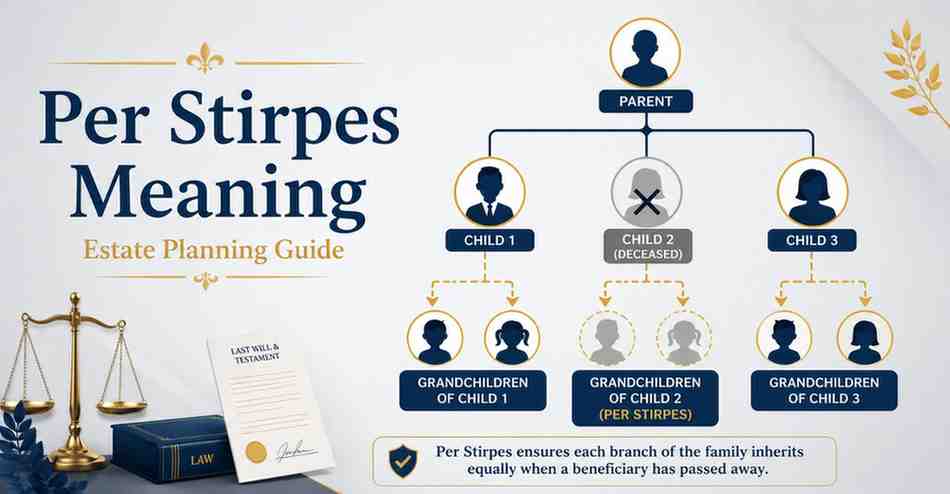
Per stirpes is a Latin term meaning “by roots” or “by branch.” This legal designation determines how your assets pass to beneficiaries when a named heir dies before you.
Under per stirpes distribution, if your child predeceases you, their share automatically transfers to their children (your grandchildren) rather than being redistributed among your surviving children.
Key characteristics:
- Protects bloodline inheritance rights
- Maintains equal branch distribution
- Prevents unintentional disinheritance
- Creates multi-generational security
The American Bar Association confirms that per stirpes remains the most common default distribution method in estate planning documents.
How Per Stirpes Distribution Actually Works
Understanding the mechanics helps you visualize how your assets flow through family branches.
Basic example:
Sarah, Michael, and Jennifer are your three kids. You leave your $900,000 estate divided equally among them ($300,000 each). Michael dies before you, leaving two children.
Per stirpes distribution:
- Sarah receives $300,000
- Jennifer receives $300,000
- Michael’s children split his $300,000 share ($150,000 each)
Each original branch receives one-third, regardless of how many people ultimately inherit within that branch.
Per Stirpes vs. Per Capita: Critical Differences
These two distribution methods create dramatically different outcomes.
Per stirpes (by branch):
- Inheritance follows family lines
- Deceased beneficiary’s share goes to their descendants
- Unequal amounts possible among grandchildren
Per capita (by head):
- Equal division among all living beneficiaries at the same generation
- Deceased beneficiary’s share redistributes to surviving siblings
- All same-generation heirs receive identical amounts
Example comparison:
| Scenario | Per Stirpes | Per Capita |
| 3 children, 1 predeceased with 2 kids | Surviving children: $300k each; Grandchildren: $150k each | Surviving children: $450k each; Grandchildren: $0 |
| Asset total | $900,000 | $900,000 |
| Number of recipients | 4 people | 2 people |
Forty percent of challenged wills are the result of selecting the incorrect approach, according to the National Association of Estate Planners & Councils.
Real-World Per Stirpes Examples
Scenario 1: Multiple generations
Emma creates a trust naming her four children as beneficiaries per stirpes. Two children predecease her, one leaving three kids and another leaving one child.
Distribution of $1,000,000 estate:
- Surviving child #1: $250,000
- Surviving child #2: $250,000
- Deceased child #1’s three children: $83,333 each (total $250,000)
- Deceased child #2’s one child: $250,000
Scenario 2: Skip generation
If a child dies with no descendants, their share typically redistributes to surviving siblings under strict per stirpes rules (though modern variations exist).
When to Use Per Stirpes in Your Estate Plan
Per stirpes makes sense when you want to:
Protect bloodlines: Ensure each family branch receives their ancestral share regardless of deaths.
Plan for uncertainty: You cannot predict who outlives whom, especially in large families.
Maintain fairness: Prevent surviving children from receiving windfalls at the expense of deceased children’s families.
Simplify updates: As the family develops, fewer changes will be made thanks to automatic adjustments.
Estate planning attorney recommendations from the Estate Planning Council suggest per stirpes for families with:
- Three or more children
- Existing grandchildren
- Significant age gaps between children
- Blended family situations
Common Per Stirpes Mistakes to Avoid
Missing explicit language: Assuming “to my children” automatically includes per stirpes protection. Always specify the distribution method.
Conflicting clauses: Using per stirpes in one section and per capita in another creates legal chaos.
Forgetting adopted children: Most states include adopted children in per stirpes distribution, but verify your documents explicitly state this.
Ignoring state variations: Some states use “per stirpes” differently than others. California, Texas, and Florida each have unique interpretations.
Outdated beneficiary forms: Your will might specify per stirpes, but retirement accounts and life insurance operate separately. Coordinate all documents.
Per Stirpes in Different Estate Planning Documents
Wills: The most common place to designate per stirpes distribution for probate assets.
Trusts: Revocable living trusts should mirror your will’s distribution method to avoid conflicts.
Beneficiary designations: Life insurance, retirement accounts (401k, IRA), and payable-on-death accounts need separate per stirpes instructions.
Transfer-on-death deeds: Real estate passing outside probate requires explicit per stirpes language.
Important consideration table:
| Document Type | Requires Separate Per Stirpes Designation | Overrides Will |
| Last Will | Primary designation | No |
| Living Trust | Yes | N/A |
| Life Insurance | Yes | Yes |
| 401(k)/IRA | Yes | Yes |
| Bank Accounts (POD) | Yes | Yes |
| Real Estate (TOD) | Yes | Yes |
State Laws and Per Stirpes Variations
Different states apply distinct interpretations of per stirpes meaning.
Strict per stirpes: Divides assets at the first generational level, even if all first-generation beneficiaries are deceased.
Modern per stirpes (per capita at each generation): Divides at the first generation with living members, then pools and redistributes equally within each subsequent generation.
Per capita with representation: Hybrid approach combining elements of both methods.
State-by-state considerations:
- Community property states (California, Texas, Arizona, etc.) apply different rules for married couples
- Some states default to per stirpes without explicit language
- Others require specific wording or default to per capita
According to Cornell Law School’s Legal Information Institute, consulting a licensed attorney in your state prevents costly distribution errors.
Tax Implications of Per Stirpes Distribution
Per stirpes doesn’t change tax liability, but it affects who pays.
Estate taxes: The estate pays before distribution regardless of method (relevant for estates over $13.61 million in 2024).
Inheritance taxes: Six states impose these (Iowa, Kentucky, Maryland, Nebraska, New Jersey, Pennsylvania). Per stirpes distribution might push some beneficiaries into higher tax brackets while keeping others below thresholds.
Generation-skipping transfer tax: When assets skip a generation (grandparent to grandchild), special 40% GST tax might apply. Per stirpes can trigger this unexpectedly.
Income tax on inherited IRAs: Per stirpes beneficiaries of retirement accounts face the 10-year distribution rule under the SECURE Act, creating annual income tax obligations.
Strategic planning table:
| Asset Type | Tax Consideration | Per Stirpes Impact |
| Primary residence | Step-up in basis | Shared basis among multiple heirs |
| IRA/401(k) | Ordinary income tax | Multiple beneficiaries = separate inherited IRAs |
| Life insurance | Generally tax-free | Clean distribution |
| Taxable investments | Capital gains | Cost basis splits proportionally |
Updating Your Estate Plan for Per Stirpes
Life changes require estate plan updates to maintain per stirpes effectiveness.
Review triggers:
- Birth or adoption of children/grandchildren
- Death of named beneficiary
- Divorce or remarriage
- Significant asset value changes
- Moving to a new state
- Tax law changes
Update process:
- Review all existing documents
- Verify per stirpes language consistency
- Update beneficiary designation forms
- Consider new family dynamics
- Consult with estate planning attorney
- Execute new documents properly (witnesses, notarization)
- Distribute copies to executor and trustee
The American College of Trust and Estate Counsel recommends reviewing estate plans every 3-5 years minimum.
Per Stirpes for Blended Families
Blended families face unique per stirpes challenges requiring careful planning.
Biological vs. Stepchildren: Unless specifically stated otherwise, per stirpes normally only covers biological and lawfully adopted children. His, hers, and ours scenarios: You might want equal treatment across all children regardless of biological parent.
Solutions:
- Create separate per stirpes branches for each set of children
- Use hybrid distribution combining per stirpes and specific bequests
- Establish trusts with customized distribution rules
- Name specific individuals rather than relying on class designations
Example structure:
“I give my fortune in equal shares per stirpes to my biological children [names] and my stepchildren [names], treating all as my children for distribution purposes.”
Professional Guidance for Per Stirpes Planning
While understanding per stirpes meaning helps, professional assistance ensures proper implementation.
When to hire an estate planning attorney:
- Estates over $500,000
- Multiple marriages or children from different relationships
- Business ownership interests
- Out-of-state property
- Special needs beneficiaries
- Tax planning needs
Cost considerations:
- Simple will with per stirpes: $300-$1,000
- Complete estate plan (will, trust, powers of attorney): $1,500-$5,000
- Complex estates: $5,000-$15,000+
Finding qualified professionals:
- Board certification in estate planning
- State bar association references
- Experience with similar family situations
- Clear fee structures
- Regular continuing education
The National Association of Estate Planners maintains a directory of certified professionals at naepc.org.
Frequently Asked Questions
What happens if all my children predecease me under per stirpes?
The assets pass to the next generation down (your grandchildren). If a child died with no descendants, their share typically redistributes to surviving siblings’ branches. If no descendants exist at all, your will’s contingency provisions activate, or state intestacy laws determine distribution.
Can I use per stirpes for some beneficiaries and not others?
Yes, you can create different distribution methods for different assets or beneficiary groups. Clearly label each section to avoid confusion. For example, you might leave your home per stirpes to children but divide investment accounts per capita among grandchildren.
Does per stirpes include adopted children?
In most states, legally adopted children receive identical treatment to biological children under per stirpes distribution. Stepchildren not legally adopted typically don’t qualify unless explicitly named. Always specify your intentions in estate documents.
What’s the difference between per stirpes and right of representation?
These terms often mean the same thing, though some states define “right of representation” as modern per stirpes (distribution at the first generation with living members). Your state’s laws determine the precise meaning. Use explicit distribution instructions rather than relying on terms alone.
Can per stirpes distribution be challenged in court?
While beneficiaries can contest any will, properly drafted per stirpes language withstands most challenges. Grounds for successful contests include lack of capacity, undue influence, fraud, or improper execution—not disagreement with the distribution method. Clear, professionally drafted documents minimize vulnerability.
How does per stirpes work with charitable beneficiaries?
Charities don’t have descendants, so per stirpes doesn’t apply to them. If you name a charity that dissolves before your death, specify a replacement charity or how that share redistributes. Common approach: “To [Charity Name], or if it no longer exists, to a similar charity selected by my executor.”
Taking Control of Your Legacy
Your estate plan shapes your family’s financial future for generations. Per stirpes meaning extends beyond legal jargon—it represents your values, your vision for fair treatment, and your commitment to protecting every family branch.
Create or update your estate plan this week. Schedule a consultation with a qualified estate planning attorney who can customize per stirpes provisions to your unique family situation. Verify that every asset—from your home to retirement accounts—includes consistent distribution instructions.
Your descendants will thank you for the clarity, fairness, and foresight you demonstrate today.
Author Expertise: This guide incorporates established estate planning principles from the American Bar Association, Cornell Law School Legal Information Institute, and the National Association of Estate Planners & Councils. Consult licensed professionals in your jurisdiction for personalized advice.
Sources:
- American Bar Association – Estate Planning Resources
- Cornell Law School – Legal Information Institute
- National Association of Estate Planners & Councils
- American College of Trust and Estate Counsel
- Internal Revenue Service – Estate and Gift Tax Guidelines