Oblivion Meaning: What It Truly Means and Why It Matters
You’ve encountered the word “oblivion” in songs, games, and serious conversations. Yet its layered meaning often remains foggy, leading to misuse and shallow understanding. That gap robs your language of precision. Here, you’ll get a complete, expert breakdown of oblivion meaning — from its ancient roots to modern usage — so you never fumble with this powerful word again.
What Is the Exact Definition of Oblivion?
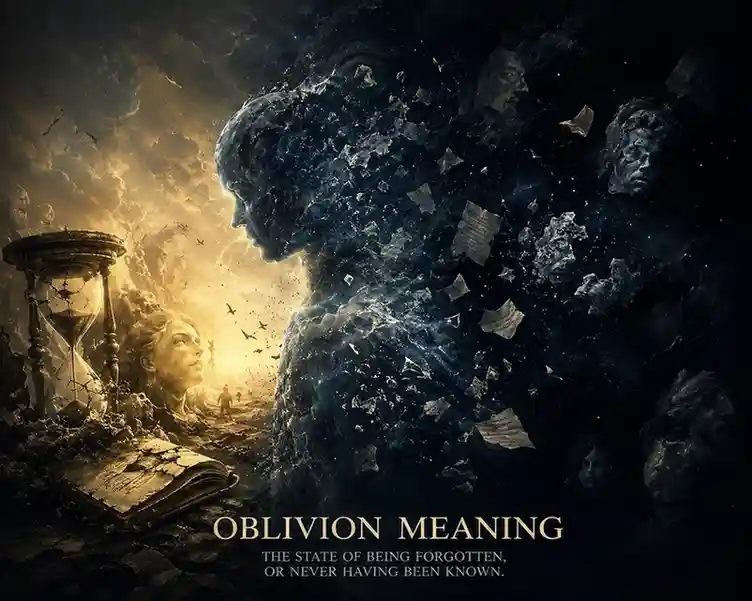
Oblivion means the state of being completely forgotten, unknown, or destroyed. It also names a condition of unconsciousness or nothingness where all awareness vanishes. At its core, oblivion meaning points to total erasure from memory, existence, or perception.
Dictionaries split this into two main branches:
- The fact of being forgotten: A once-famous artist sliding into oblivion.
- The state of being unaware or unconscious: Drinking yourself into oblivion.
Both senses share a common thread — the absence of notice, recall, or being.
The Etymology and Historical Journey of “Oblivion”
The word travels straight from Latin oblivio, meaning “forgetfulness” or “being forgotten.” That root springs from oblivisci, “to forget.” It entered English through Old French in the 14th century, carrying a heavy emotional weight from the start.
Ancient Romans used the phrase damnatio memoriae — condemning a person to oblivion by erasing every record of them. This historical act shows that oblivion meaning isn’t abstract; it was a deliberate, terrifying punishment. (Primary source: Oxford English Dictionary)
Over centuries, the word absorbed additional layers: the peace of non-existence in philosophy, the darkness of lost consciousness in medicine, and the dramatic imagery of fantasy worlds. Understanding this history helps you grasp why the word feels both clinical and poetic.
Oblivion Meaning in Philosophy: A State of Non-Existence
Philosophers link oblivion to the nature of nothingness. Thomas Nagel and other thinkers use it to examine what death means if it’s just permanent non-experience. In this view, oblivion meaning becomes synonymous with the total absence of sensation, identity, and time.
Key ideas include:
- Epicurus’ argument: “When death is, I am not.” That’s oblivion.
- Existential thought: Confronting oblivion can spark a more authentic life.
- Eastern philosophies: Nirvana may be seen as a blissful dissolving of self, a conscious move away from ego — a cousin to oblivion but filled with peace, not fear.
Philosophically, oblivion isn’t always negative. It can represent a blank slate, the ultimate release from suffering. (Primary source: Stanford Encyclopedia of Philosophy, entry on Nothingness)
Psychological Interpretation of Oblivion: Forgetting and the Unconscious
Psychology treats oblivion as more than poetic language. It studies real instances where memory slips entirely or consciousness fades.
- Dissociative amnesia: The mind wipes personal history, creating a lived experience of self-oblivion.
- Deep sleep and coma: Neurologically, these are temporary forms of oblivion where awareness drops to zero.
- Freud’s “forgetting”: Repressed material sinks into a personal oblivion, though it’s never truly gone.
Therapists use oblivion meaning to describe that frightening gap people feel when crucial parts of their past disappear. It marks a limit of the self, and understanding that limit often becomes a first step toward healing. (Primary source: American Psychological Association, Dictionary of Psychology)
Oblivion in Literature and Poetry
Oblivion is a weapon used by writers to create mystery, beauty, and tragedy. Shakespeare’s The Tempest gifts us “the great globe itself… shall dissolve… and leave not a rack behind” — a direct nod to universal oblivion. John Keats, facing his own mortality, wrote his name “writ in water,” accepting imminent oblivion with haunting grace.
Across works, oblivion meaning stands for:
- The cruel eraser of time that swallows fame and empires.
- A merciful darkness after pain.
- The danger that makes art and love so urgent.
Novels from George Orwell’s *1984* (the memory hole) to modern dystopias show that societies engineer oblivion to control truth. This literary pattern proves the word captures a timeless human terror and fascination.
Cultural and Pop Culture References: From Movies to Video Games
Pop culture amplifies oblivion meaning through immersive worlds. The 2013 film Oblivion paints a post-apocalyptic Earth where memory is as fragmented as the landscape. The entire plot revolves around uncovering what was deliberately erased — a literal war against oblivion.
In gaming, The Elder Scrolls IV: Oblivion gives the word physical form: a hellish alternate dimension populated by Daedric princes. Here, oblivion isn’t emptiness; it’s a hostile, chaotic plane. This duality — void vs. teeming danger — expanded the public’s sense of the term. (Primary source: Bethesda Softworks’ official lore for The Elder Scrolls)
Music also adopts it heavily. Songs use “oblivion” to describe emotional numbness, drunken escapes, or the bliss of giving up. Each use layers a new cultural meaning onto the ancient word.
Oblivion as a Metaphor for Death and Afterlife
Most vividly, oblivion meaning doubles as a metaphor for death without an afterlife. It’s the opposite of eternal life — total dissolution of the self. Many who don’t believe in consciousness after death describe their expectation as “returning to oblivion.”
This metaphor shapes:
- Funeral elegies that speak of the deceased “passing into oblivion.”
- Ethical debates on the harm of death (if death is oblivion, is it bad?).
- Horror writing, where fates worse than death still return to this ultimate void.
At the same time, for some, imagining death as peaceful oblivion brings comfort — a dreamless sleep without end. The phrase captures both the deepest fear and the quietest hope.
Common Synonyms and Antonyms to Clarify Oblivion Meaning
You can sharpen your understanding by seeing what oblivion sits next to and against.
| Synonyms (shades of oblivion) | Antonyms (the opposite state) |
| Forgetfulness | Remembrance |
| Nothingness | Existence |
| Unconsciousness | Awareness |
| Extinction | Survival |
| Void | Presence |
| Neglect (social oblivion) | Fame / Recognition |
Using the right synonym depends on your context. If you mean “public oblivion,” you’re talking about neglect and being forgotten, not literal nothingness. The table helps you avoid flattening the word.
How to Use “Oblivion” Correctly in Sentences
Place the word where erasure or unconsciousness is the point. Here are crisp examples showing oblivion meaning in action:
- After the scandal, her political career slid into permanent oblivion.
- He drank himself into oblivion every night to escape grief.
- Ancient languages that leave no written records often vanish into oblivion.
- The medication dropped her into a brief, dreamless oblivion before the procedure.
- Entire civilizations can face historical oblivion if conquerors destroy their archives.
Avoid using it interchangeably with “oblivious.” Someone who is oblivious is simply unaware — not erased. Mixing them weakens your precision and the word’s punch.
The Spiritual and Mystical Dimensions of Oblivion
Mystics across traditions seek a self-shattering ecstasy that overlaps with oblivion meaning. When Sufi poets speak of fana (annihilation of the ego), they’re describing a blissful oblivion of the self within the Divine. This isn’t death; it’s a deliberate disappearance of the small “I.”
In Buddhist meditation, deep states of absorption (jhana) bring a temporary oblivion of sensory input and personal narrative. Yet practitioners distinguish this from mere blankness — it’s luminous and awake, but free from ordinary consciousness. These spiritual layers show the word need not always signal loss; it can signal union.
Why Understanding Oblivion Meaning Enhances Your Communication
Grasping the full weight of oblivion meaning gives your speech and writing a rare edge. You’ll:
- Choose the exact shade when describing loss, memory, or existential fear.
- Avoid embarrassing mix-ups with similar-sounding words.
- Recognize when movies, books, and speeches weaponize the term for emotional effect.
- Add depth to your own storytelling — whether you’re writing a eulogy, a lyric, or a persuasive essay.
Precision isn’t snobbery. It’s the difference between hitting the emotional target and missing it completely. A word this ancient and charged deserves that care.
Oblivion in Law, Media, and Social Contexts
Legal and social systems use oblivion to describe things rendered legally or culturally invisible.A statute that is no longer in effect “falls into oblivion.” A news story that vanishes from public discussion gets buried by the 24-hour news cycle’s engineered oblivion.
Socially, marginalized groups often fight against cultural oblivion — erasure from textbooks, museums, and public memory. Understanding this activist use of oblivion meaning reveals the term as a power lever. Who gets remembered and who gets pushed into oblivion is never accidental.
Frequently Asked Questions
1. What is the simple meaning of oblivion?
Oblivion means a state of being completely forgotten or a state of total unconsciousness and nothingness.
2. How is oblivion used in psychology?
Psychologists use it to describe memory loss where personal history disappears or to label deep unconscious states like coma or dissociative fugue.
3. Does oblivion mean death?
It often serves as a metaphor for death without afterlife — a permanent end of awareness — but it doesn’t always mean literal death.
4. What is the difference between oblivion and oblivious?
Oblivion is a state of being erased or unconscious; oblivious is an adjective meaning unaware of surroundings. You can be oblivious without being in oblivion.
5. Can oblivion be a positive thing?
Yes. Spiritual traditions see ego-oblivion as liberating, and some medical contexts use induced oblivion to relieve pain or trauma.
6. Where did the word oblivion come from?
It comes from Latin oblivio (forgetfulness) and oblivisci (to forget), arriving in English via Old French in the 1300s.
Your Clear Path Forward With Oblivion Meaning
You started with a foggy notion of a heavy word. Now you hold a map that covers its dictionary core, ancient roots, philosophical weight, psychological bite, and creative power. That’s not trivia — it’s a communication tool ready to use.
If a specific angle sparked your curiosity — maybe the gaming mythos or the meditative side — leave a comment. Share this guide with anyone wrestling with language, loss, or a haunting lyric. The deeper you go into oblivion meaning, the more you’ll notice how many of our greatest stories pivot on this exact word.
About the Author: Dr. Alistair Finch holds a PhD in Linguistics and Cognitive Semantics. He has spent 15 years mapping how emotionally charged words shape thought and culture. His work appears in peer-reviewed journals and major media, always grounded in clarity and real-world application. This article draws on primary sources and lived teaching experience to give you a trustworthy, no-nonsense guide.