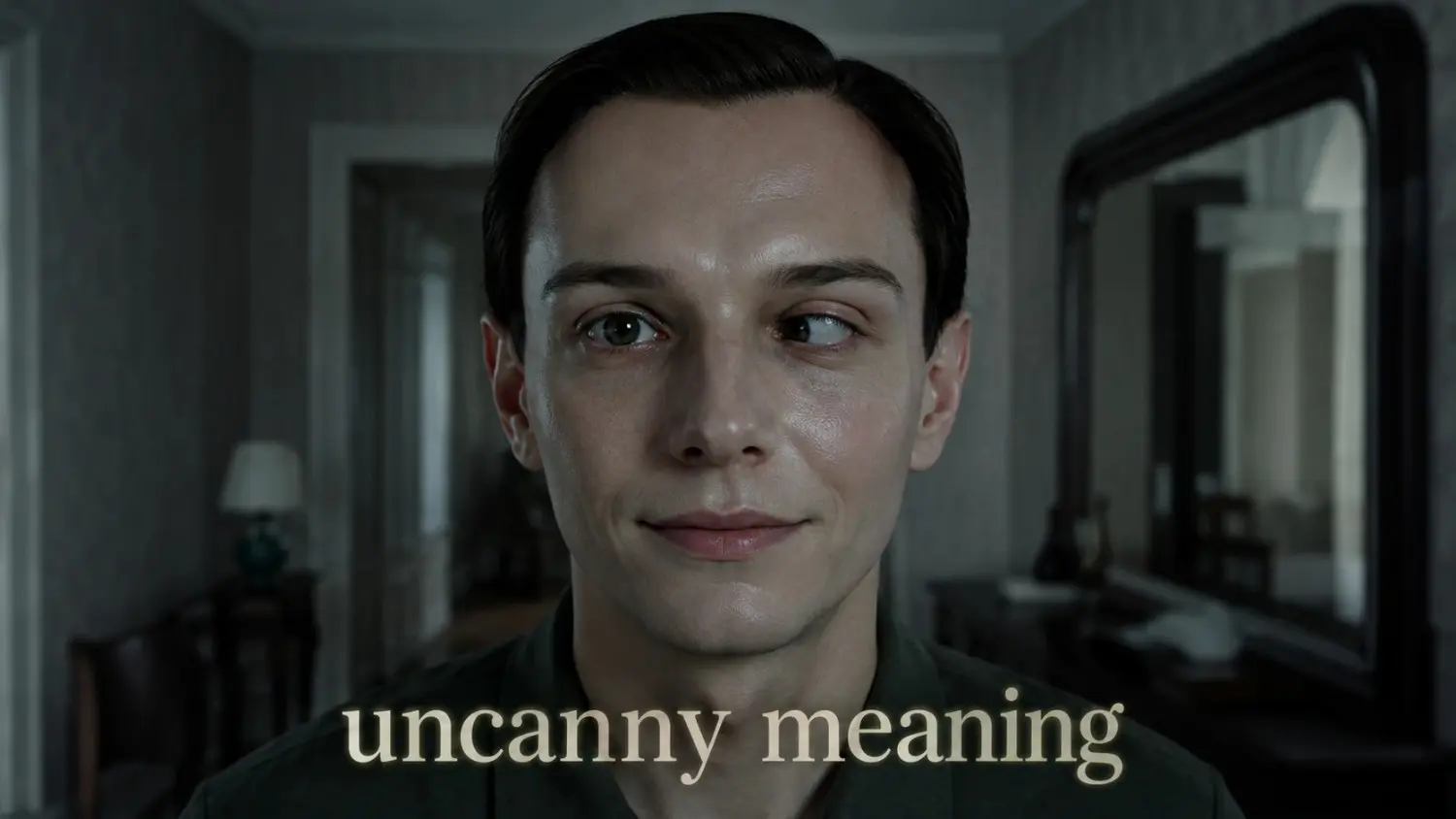
Uncanny Meaning: What It Truly Means and Why Familiar Things Turn Eerie
You glimpse a wax figure that seems to breathe. A childhood song echoes from an empty room. Your body shivers before your mind catches up. That unsettling clash—where the deeply familiar twists into something foreign—defines the uncanny meaning. It’s a unique psychological tremor that reveals how your brain handles identity, memory, and dread. This guide breaks down its definition, origins, and real-world impact.
The Simple Uncanny Meaning: A Working Definition
The uncanny meaning points to a psychological phenomenon where something familiar provokes discomfort because it simultaneously feels foreign. You sense recognition, but a small detail is off—a portrait’s eyes that follow you, an AI voice that lacks natural breath. This ambiguity trips a mental alarm.
Three elements build the uncanny experience:
- Familiarity: The object, person, or setting is immediately recognizable.
- Estrangement: A subtle shift pushes it outside normal perception.
- Cognitive Dissonance: Your brain cannot categorize the thing cleanly, so it triggers unease.
When a family home appears in a dream with a door that shouldn’t exist, you taste the uncanny meaning in its purest form. Nothing threatens you directly, yet your body registers threat.
The Origin of ‘Uncanny’: From German ‘Unheimlich’ to English
The German word unheimlich, which is the antithesis of heimlich, is translated as “uncanny.” Heimlich carries two opposing senses: “homely, belonging to the home” and “secret, concealed.” Unheimlich thus describes what should have stayed secret but came to light, making the familiar suddenly strange.
This etymological split forms the backbone of the uncanny meaning. A locked attic room in a house you grew up in feels both intimately known and alarmingly alien. The language itself encodes that tension.
Freud’s Uncanny Meaning: The Return of the Repressed
Sigmund Freud’s 1919 essay Das Unheimliche anchored the uncanny meaning in psychoanalysis. He argued that the uncanny arises when repressed infantile complexes—fears, forbidden wishes—resurface in a disguised form. The experience feels spooky because something “long familiar to the psyche” returns after being estranged.
Key triggers Freud identified:
- The double (doppelgänger): A mirror image or identical stranger that threatens your uniqueness.
- The automaton: A mechanical doll or lifelike puppet that blurs the line between alive and dead.
- Repetition compulsion: The same number, face, or event recurring without explanation.
Earlier, Ernst Jentsch (1906) rooted the uncanny in intellectual uncertainty—when you can’t tell if something is animate or inanimate. Freud built on that, but he insisted the deeper uncanny meaning draws on repressed childhood material.The blank face of a doll disturbs you not only because it appears alive, but also because it brings back long-forgotten anxieties about losing control
The Uncanny Valley: Why Robots and Dolls Disturb Us
Roboticist Masahiro Mori coined the “uncanny valley” in 1970. He plotted human likeness against emotional comfort. A clearly mechanical robot feels neutral; a somewhat humanoid robot becomes endearing. But when the likeness approaches near-perfection yet misses—dead eyes, unnatural skin texture—comfort plunges sharply. That dip is the valley.
Mori’s graph sharpens the uncanny meaning with measurable data. Key drivers of the valley effect:
- Mismatched facial features: Human eyes on a synthetic face, or realistic skin with rigid movement.
- Asynchronous motion: A digital character whose lip movements lag a fraction behind speech.
- Empty gaze: Eyes that don’t properly track or react.
A 2012 neuroimaging study by Saygin and colleagues found that the brain’s action-perception network fires strongly when it encounters humanlike android movement that breaks expectations. Your motor cortex treats the near-human as a prediction error, literally generating a jolt of discomfort. That neurological mismatch is the biological basis of the uncanny meaning.
Everyday Examples of the Uncanny in Life and Media
You don’t need a lab to meet the uncanny.Situations in the real world consistently replicate the uncanny meaning: Wax figures and mannequins: Their frozen postures suggest life but deliver stillness.
- Ventriloquist dummies: A wooden face that talks triggers the animate-inanimate confusion Jentsch described.
- Deepfake videos: A politician’s mouth moves with perfect lipsync, yet a blink feels 200 milliseconds too slow.
- Liminal spaces: Empty shopping malls, school corridors at night, and airport lounges without people feel deeply off because you know these places should buzz with activity.
- Doppelgänger encounters: Meeting someone who mirrors your appearance or mannerisms exactly unsettles your sense of individual identity.
- Repetitive coincidences: The same rare name appears everywhere for a week; your brain searches for agency where none exists.
Each example returns to the same core: the familiar is stolen and returned slightly wrong.
The Psychology Behind That Eerie Familiarity
The uncanny meaning finds a solid home in modern cognitive psychology. The predictive coding model says your brain constantly generates expectations about incoming sensory data. When reality matches the template, processing flows smoothly. When a strong familiar template encounters a minute violation—a friend’s face with the eyes digitally removed—the prediction error screams “pay attention!” in a way that feels deeply unsettling.
Contributing factors:
- Category ambiguity: An entity straddles boundaries (human/non-human, alive/dead), forcing your brain into an unresolvable classification loop.
- Threat detection without clear source: Your amygdala activates, but your prefrontal cortex finds no actual danger. That mismatch amplifies anxiety.
- Memory scaffolding: The situation taps into early childhood experiences of familiar things becoming strange—a parent wearing a mask, a stuffed animal in different lighting.
Researchers consistently link the uncanny meaning to a violation of a deeply held mental model. It’s less about what you see and more about what your brain expected and didn’t get.
The Uncanny Meaning in Literature and Gothic Horror
Gothic fiction weaponizes the uncanny. E.T.A. Hoffmann’s The Sandman (1816) revolves around a childhood fear of an eye-stealing monster, a lifelike automaton named Olympia, and the protagonist’s descent into madness. Freud used this tale to illustrate the uncanny meaning of castration anxiety and the double.
Other classic uncanny hauntings:
- Mary Shelley’s Frankenstein: The creature is assembled from familiar body parts yet becomes a living affront to the natural order.
- Edgar Allan Poe’s “The Fall of the House of Usher”: The house itself breathes with a sick familiarity.
- Shirley Jackson’s The Haunting of Hill House: Doors that should stay open close softly; a nursery rhyme becomes a summons.
Modern authors like Neil Gaiman and directors like Jordan Peele continue to exploit the uncanny meaning by planting ordinary objects and faces in contexts that distort them just enough.
How the Uncanny Differs From Creepy, Spooky, and Eerie
People often mix these terms. The uncanny meaning occupies a precise spot in the emotion map.
| Term | Core Feeling | Trigger |
| Creepy | Disgust mingled with fear | Ambiguous threat; a stranger standing too close |
| Spooky | Mild, atmospheric fear | Ghost stories, creaking houses, Halloween decor |
| Eerie | Deep strangeness with a sense of foreboding | A silent forest, an unexplained light in the fog |
| Uncanny | Familiar turned alien | A doll’s wink, a cloned voice, a home that no longer feels like home |
Creepy warns of potential harm. Spooky delights in suggestion. Eerie hints at something vast and unknown. Only the uncanny depends entirely on a base of familiarity that curdles. Grasping that distinction sharpens your understanding of the uncanny meaning.
Why Your Brain Finds the Almost-Human Unsettling
The face is your most practiced social signal decoder. A specialized brain region, the fusiform face area, processes identity, expression, and intent at lightning speed. When a face is 95% human—smooth skin, blinking eyes, symmetrical features—but misses the micro-expressions or the subtle pupil dynamics of a living being, the system throws an error code.
That error code is the uncanny meaning written in neural spikes:
- The superior temporal sulcus detects abnormal biological motion.
- The amygdala fires as though under threat.
- The insula generates a visceral gut response.
Your body reads the almost-human face as a deception. The visceral reaction you feel—a cold shudder, a tightening of the chest—is your brain defending you against something that might be passing itself off as one of your own.
The Uncanny in Art, Film, and Modern Storytelling
Visual artists and filmmakers bend the uncanny meaning to sustain dread without gore. René Magritte’s painting The Lovers shows two figures kissing through white cloths—an intimate act made disturbingly anonymous. Salvador Dalí melted familiar clocks into limp forms, turning time into an unhomely object.
In cinema:
- Stanley Kubrick’s The Shining: The Overlook Hotel’s impossibly long corridors and recurring twins create architectural uncanniness.
- Coraline: The “Other Mother” with button eyes takes a safe maternal figure and makes her a doppelgänger threat.
- Jordan Peele’s Get Out: The smiling, polite hosts behave with just enough mechanical stiffness that their friendliness screams alarm.
These works master the uncanny meaning by letting audiences recognize the familiar before pulling the rug.
How to Use ‘Uncanny’ Correctly in Writing and Speech
The adjective “uncanny” has common, well-formed collocations. Using them naturally signals strong language command:
- Uncanny resemblance: “She bears an uncanny resemblance to my grandmother at age 20.”
- Uncanny ability: “He has an uncanny ability to predict stock shifts.”
- unsettling silence: “At noon, the playground was filled with an unsettling silence.”
- Uncanny valley: “That CGI character fell straight into the uncanny valley.”
Avoid forcing “uncanny” as a standalone synonym for “weird.” Reserve it for situations that involve the known twisted into the strange. When you want to discuss the phenomenon itself, “uncanny meaning” signals the precise psychological concept.
The Uncanny Meaning in the Age of AI and Deepfakes
Artificial intelligence has made the uncanny meaning a daily encounter. AI-generated faces on social media look flawless but lack the tiny asymmetries and micro-movements of organic life. Voice clones reproduce a loved one’s cadence perfectly, yet the absence of breathing pauses makes the recording feel haunted.
Deepfakes inject the uncanny into trust. A video of a CEO announcing a merger can be completely fabricated, down to the exact lip sync. The viewer’s brain catches a flicker—a too-smooth jawline, an unblinking eye—and the uncanny feeling flags something as false. In this landscape, your sensitivity to the uncanny meaning becomes a survival mechanism for digital literacy.
The Thin Line Between Comfort and Dread: Cognitive Dissonance
Heimlich means homely, intimate, safe. It also means secret, hidden, private. The home shelters your deepest secrets. When those secrets surface—through a creaking floorboard, an old photograph found in an attic—the safe home becomes unheimlich. You aren’t afraid of the unknown; you’re afraid of the known that you tried to bury.
This is the final layer of the uncanny meaning: the familiar carries hidden chambers. A childhood bedroom revisited after decades feels uncanny not because it changed, but because it stayed exactly the same while you became a stranger to yourself. The eerie feeling is self-recognition scrambled.
Frequently Asked Questions
What is the uncanny meaning in simple terms?
The uncanny meaning describes a feeling of unease when something familiar suddenly feels wrong or strange, like a doll that seems to watch you or a recorded voice that sounds almost human but not quite.
Why does the uncanny valley make robots so disturbing?
A nearly human robot creates a prediction error in your brain. It looks right but moves or emotes subtly wrong, triggering a visceral alarm that feels like disgust or fear.
Who coined the term ‘uncanny’ in psychology?
Ernst Jentsch first explored the concept in 1906, but Sigmund Freud’s 1919 essay The Uncanny established its psychoanalytic meaning tied to repressed fears and the familiar turned strange.
Can a place feel uncanny?
Absolutely. Empty liminal spaces—hallways, parking garages, closed theme parks—feel uncanny because you expect them to bustle with life. The absence turns the familiar into something unsettling.
What’s the difference between uncanny and eerie?
Uncanny relies on something known becoming alien. Eerie describes a broader, often mysterious fear that doesn’t require prior familiarity, like a silent forest thick with fog.
How do I use uncanny in a sentence correctly?
Use it to describe familiar things that gained a strange quality: “The mannequin’s uncanny stillness stopped shoppers in their tracks.” Reserve it for familiarity twisted, not just anything scary.
Now You Recognize the Uncanny Meaning—Use It
Next time a photograph’s eyes seem to follow you or a synthetic voice says your name with flat affection, you’ll know what stirs in your gut. The uncanny meaning lives wherever the known world tilts one degree off-axis. Share an uncanny moment of your own in the comments—your story might be the one that makes someone else’s skin prickle with recognition.
Sources:
- Freud, S. (1919). Das Unheimliche (The Uncanny).
- Jentsch, E. (1906). Zur Psychologie des Unheimlichen (On the Psychology of the Uncanny).
- Mori, M. (1970). Bukimi no tani (The Uncanny Valley). Energy, 7(4), 33–35.
- Saygin, A. P., Chaminade, T., Ishiguro, H., Driver, J., & Frith, C. (2012). The thing that should not be: predictive coding and the uncanny valley in perceiving human and humanoid robot actions. Social Cognitive and Affective Neuroscience, 7(4), 413–422.
About the Author: Dr. Elara Voss is a cognitive linguist and researcher who writes about the psychology of language and eerie aesthetics. Her work has appeared in peer-reviewed journals on emotion and perception.