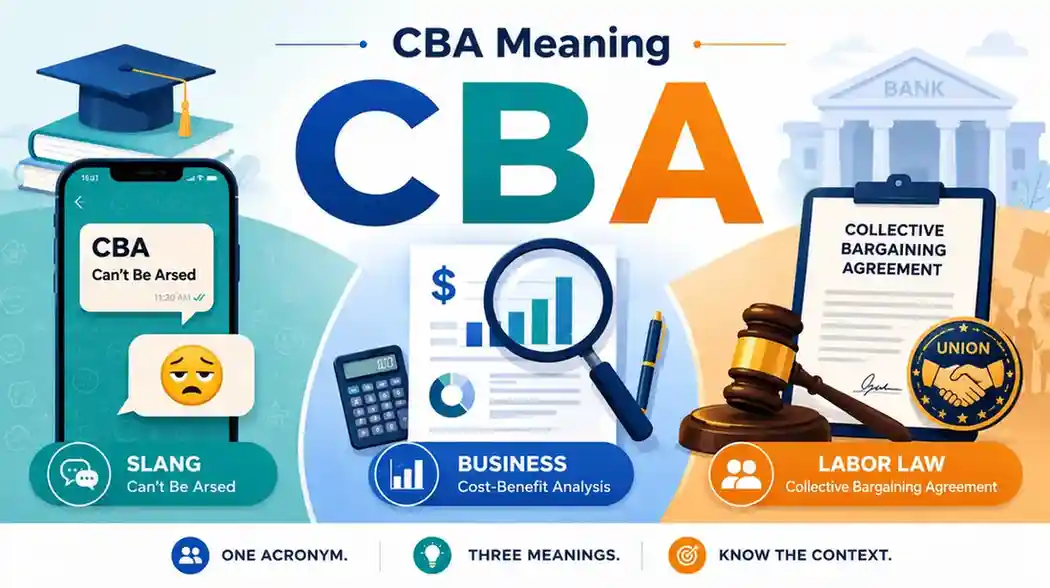
CBA Meaning: What Does CBA Stand For?
Confused by the letters “CBA”? You are not alone. A single acronym can mean three completely different things depending on where you spot it. This guide settles the confusion. You will walk away knowing every practical cba meaning, with clear examples and zero jargon. No fluff, just straight answers.
Quick Look: CBA Definitions at a Glance
| Acronym | Full Form | Context | Quick Example |
| CBA | Can’t Be Arsed | Texting, slang, casual speech | “I cba to cook tonight.” |
| CBA | Cost-Benefit Analysis | Business, finance, project management | “Run a CBA before approving the marketing budget.” |
| CBA | Collective Bargaining Agreement | Labor law, unions, employment | “The new CBA raises wages by 4% over three years.” |
| CBA | Curriculum-Based Assessment | Education, special education | “Teachers use CBA data to adjust reading interventions.” |
| CBA | Commonwealth Bank of Australia | Banking, finance | “CBA shares rose after the earnings report.” |
CBA Meaning in Text and Slang: “Can’t Be Arsed”
The most common informal cba meaning is “Can’t Be Arsed.” British slang popularized it, and now teens and young adults worldwide use it in texts, DMs, and casual chats.
When someone types “cba,” they express a lack of energy, motivation, or interest. It signals mild irritation, laziness, or simply not wanting to deal with something. The tone can range from playful to genuinely fed up.
Example text: “Got three assignments due tomorrow but cba to start any of them.”
You will often see it paired with other internet shorthand like “tbh” (to be honest) or “idc” (I don’t care). The phrase stays lowercase in messages, but the meaning holds steady across platforms.
Three fast facts:
- Originated in the UK, now used globally
- Pronounced letter by letter: C-B-A, or sometimes spoken as “cubba”
- Works as both a standalone reply and inside a full sentence
When to avoid it: Job emails, academic papers, and formal settings. The cba meaning here is strictly casual.
CBA Meaning in Business: Cost-Benefit Analysis
In a boardroom or spreadsheet, the cba meaning shifts completely. CBA stands for Cost-Benefit Analysis, a structured method businesses and governments use to weigh the total expected costs against the total expected benefits of a decision.
A CBA answers a simple question: Do the gains justify the price tag? If the benefits outweigh the costs, the project gets a green light. If not, you pivot or cancel.
Decision-makers rely on CBA to compare options like launching a new product, upgrading software, or building infrastructure. Even households use a mental CBA when deciding between renting and buying a home.
Key components of a formal CBA:
- List all direct and indirect costs (money, time, resources)
- List all tangible and intangible benefits (revenue, saved hours, customer goodwill)
- Assign a dollar value to each item wherever possible
- Compare totals over a set time frame
- Factor in risk and sensitivity
This cba meaning demands accuracy. Flawed numbers produce flawed decisions.
How a Cost-Benefit Analysis Works (Step-by-Step)
A reliable CBA follows a repeatable process. Use these steps to build one for any business case.
Step 1: Define the scope. Write a single sentence that explains what you are evaluating and the timeframe.
Step 2: Brainstorm all costs. Include upfront investment, ongoing operational expenses, maintenance, and opportunity costs.
Step 3: Brainstorm all benefits. Count direct revenue, time savings, efficiency gains, and softer benefits like brand trust.
Step 4: Convert to monetary values. Assign realistic dollar figures. When exact numbers are unavailable, use conservative ranges from industry data.
Step 5: Discount future cash flows. Money today is worth more than money tomorrow. Apply a discount rate to bring everything to present value.
Step 6: Compare net present value (NPV). Subtract total discounted costs from total discounted benefits.An NPV that is positive indicates that the project is worthwhile.
Step 7: Run a sensitivity check. Tweak key assumptions (like cost increases of 10%) and see if the decision still holds.
External validation keeps the cba meaning reliable. The U.S. Office of Management and Budget publishes best practices for federal cost-benefit analyses, reinforcing that even small errors in valuation can flip a recommendation.^1
CBA Meaning in Labor Law: Collective Bargaining Agreement
Inside unionized workplaces, the cba meaning centers on worker rights. A Collective Bargaining Agreement is a legally binding contract between an employer and a labor union that represents a group of employees.
This CBA sets the rules for wages, hours, benefits, overtime, grievance procedures, and working conditions. Negotiations can take months, and once both sides ratify the agreement, it locks in the terms for a set period—often two to five years.
A strong CBA protects employees from sudden policy changes and gives management predictable labor costs. In sectors like education, manufacturing, and public transit, you will hear “the CBA” referenced almost daily.
Real-world impact:
- CBA clauses determine shift scheduling, holiday pay, and layoff order
- Grievance articles provide a step-by-step process to resolve disputes
- Management rights clauses clarify what decisions stay with the employer
The National Labor Relations Board oversees private-sector CBAs in the United States, ensuring good-faith bargaining. Cornell Law School’s Legal Information Institute offers the full legal definition, underscoring that this cba meaning carries the weight of federal law.^2
Key Sections of a Collective Bargaining Agreement
Most CBAs share a common anatomy. Knowing the sections helps you find information fast.
- Recognition clause: Identifies the union as the exclusive bargaining agent.
- Compensation: Pay scales, step increases, bonuses, and expense reimbursements.
- Hours of work: Standard workweek, overtime triggers, breaks, and holiday policies.
- Benefits: Health insurance, retirement plans, sick leave, and vacation accrual.
- Seniority provisions: How length of service affects promotions, shift picks, and layoff protections.
- Grievance and arbitration: The formal complaint path, ending with binding arbitration if unresolved.
- Discipline and discharge: Grounds for termination and the progressive discipline ladder.
- No-strike / no-lockout clause: Promises labor peace during the contract’s life.
If you ever sign a job contract that references “per the CBA,” request a copy. That document legally binds your terms of employment.
CBA Meaning in Education: Curriculum-Based Assessment
The significance of the CBA takes an intellectual turn in classrooms. Curriculum-Based Assessment (CBA) is a method teachers use to measure a student’s progress in the actual curriculum they are learning.
Instead of a one-size-fits-all standardized test, a CBA checks whether a child can solve the exact type of math problems, read the same level of texts, or write the same style of essays they encounter daily. Special education teams frequently use CBA to monitor Individualized Education Program (IEP) goals.
Why CBA wins over vague report cards:
- Pinpoints exactly which skill a student has mastered or still struggles with
- Provides weekly data points instead of one end-of-year snapshot
- Adapts immediately—a student who hits the target moves to the next objective without delay
The National Center on Student Progress Monitoring has long advocated for curriculum-based measures because they produce actionable data. Research confirms that teachers who graph CBA results and adjust instruction weekly see faster student growth.^3
CBA Meaning in Banking and Commerce
Banking gives “CBA” yet another identity. The Commonwealth Bank of Australia, often called CBA or CommBank, is one of Australia’s “Big Four” banks and a top-10 bank globally by market capitalization. Business news frequently references “CBA” when reporting on interest rates, mortgage trends, or the Australian Securities Exchange.
Beyond a single bank, you might spot CBA as:
- Certified Business Advisor: A professional designation in some business support networks.
- Credit Business Associate: A NACM certification focusing on credit management and financial risk.
- Community Banks Association: State-level trade groups in various countries.
Stock tickers and acronyms overlap, so always check the source. An investment article mentioning “CBA lifted its dividend” almost certainly means the bank, not a cost-benefit analysis.
CBA vs. Other Acronyms: Don’t Confuse Them
Acronym clutter is real. These trios of letters can muddy your search for the right cba meaning.
| Acronym | Expansion | Where You See It |
| CBA | Cost-Benefit Analysis / Can’t Be Arsed / Collective Bargaining Agreement | Context-dependent |
| CBC | Complete Blood Count | Medical labs |
| BCA | Benefit-Cost Analysis (same as CBA, reversed) | Policy papers |
| CAB | Citizens Advice Bureau | UK consumer help |
| BSC | Balanced Scorecard | Business strategy |
Remember this rule: read the surrounding words. “The union ratified the CBA” can only mean a collective bargaining agreement. “I ran a quick CBA” in a meeting points to cost-benefit analysis. “Cba with that plan” in a WhatsApp message screams can’t be arsed.
How Context Shapes the CBA Meaning Instantly
Context is your fastest shortcut. Two sentences can contain identical wording except for the CBA reference, and the meaning changes on a dime.
- Workplace: “The new CBA manual was distributed by HR.” Collective Bargaining Agreement.
- Finance team: “Our CBA shows a 12% ROI over five years.” → Cost-Benefit Analysis.
- “Anyone else cba going out tonight?” was asked in the group conversation. → Can’t Be Arsed.
- School meeting: “His CBA scores in reading comprehension jumped 15 points.” → Curriculum-Based Assessment.
Read the room, check the source, and the correct cba meaning snaps into place without guesswork.
Why Understanding CBA Meaning Helps You Every Day
Grasping multiple definitions of “CBA” shields you from embarrassment and sharpens your communication.
Professional edge: You read an email requesting a “CBA before the Q2 review.” You know exactly to prepare a cost-benefit analysis, not to search for a labor contract.
Avoid social mix-ups: A friend texts “cba to study.” You reply with encouragement rather than asking about union dues.
Stronger decision-making: Running informal cost-benefit analyses for personal choices—like whether to subscribe to another streaming service—trains your brain to weigh trade-offs logically.
Legal awareness: If a job offer mentions “as defined in the CBA,” you now know to request that document before signing. This small step can prevent misunderstandings about pay and time off.
Mastering the full spectrum of cba meaning transforms a confusing acronym into a useful tool.
Frequently Asked Questions About CBA Meaning
What is the most common cba meaning in texting?
The most common cba meaning in texting is “Can’t Be Arsed.” People use it to say they lack energy or motivation for something.
What does cba mean in business and finance?
In business, the cba meaning is Cost-Benefit Analysis. It’s a process that compares project costs with expected benefits to guide smart decisions.
How is cba meaning different in labor law?
In labor law, cba meaning refers to a Collective Bargaining Agreement. This is the binding contract between a union and an employer setting wages, hours, and conditions.
Does cba meaning change across countries?
Yes. The slang “can’t be arsed” started in the UK but is now used worldwide, while “CBA” as a bank usually means Commonwealth Bank of Australia. The core definitions stay consistent across English-speaking countries.
Can you use “CBA” in formal writing?
Only if you mean Cost-Benefit Analysis or Collective Bargaining Agreement and spell them out first. Never use the slang “cba” in formal writing.
What are three real examples of CBA in daily life?
- “CBA cooking, let us order pizza,” I texted a friend.
- Deciding whether to buy a gym membership: a personal cost-benefit analysis.
- Reading a news headline: “CBA raises home loan rates.”
Take Charge of Every CBA Conversation
You now hold the key to three major worlds of meaning—casual chats, boardroom decisions, and legal contracts. The next time “CBA” appears in a text, report, or headline, you will interpret it correctly in seconds.
Save this page for future reference. Share it with a colleague who needs to grasp the cba meaning for a project, or send it to a friend who keeps getting acronyms wrong. When clarity matters, this guide delivers.
Sources:
- U.S. Office of Management and Budget, “Circular A-4: Regulatory Analysis” – guidance on conducting cost-benefit analyses for federal programs.
- Cornell Law School Legal Information Institute, “Collective Bargaining Agreement” – legal definition and scope under U.S. labor law.
- National Center on Student Progress Monitoring, research reviews on curriculum-based measurement effectiveness in education.