Surreal Meaning: Your Complete Guide to Definition, Usage, and Examples
You hear people call an experience “surreal,” but you sense they don’t just mean strange. Getting the surreal meaning wrong flattens your expression and invites confusion. This guide gives you a precise, layered understanding—rooted in art, psychology, and everyday speech—so you can use the word with absolute confidence.
The Exact Surreal Meaning: Core Definition
The surreal meaning, according to Merriam-Webster, is “marked by the intense irrational reality of a dream.” Cambridge Dictionary defines surreal as “strange; not seeming real; like a dream.” At its heart, the surreal meaning describes something that feels disconnected from normal logic, as though you stepped into a space where the rules of reality bend.
Dictionaries anchor the definition, but everyday use stretches it further. People apply the surreal meaning to anything so unexpected or emotionally charged that it momentarily breaks their sense of what’s possible. You taste a food that transports you to childhood—that’s a subtle surreal meaning. You watch a car float on floodwater—that’s a stark surreal meaning. The core thread remains: a collision between the real and the fantastical.
The Origin of “Surreal”: How Surrealism Shaped the Word
The word “surreal” backflips into the early 20th century. French poet Guillaume Apollinaire coined surréaliste in 1917, fusing sur- (beyond) with réalisme (realism). André Breton adopted the term in his 1924 Surrealist Manifesto, launching a movement that sought to unlock the unconscious mind and shatter rational thought.
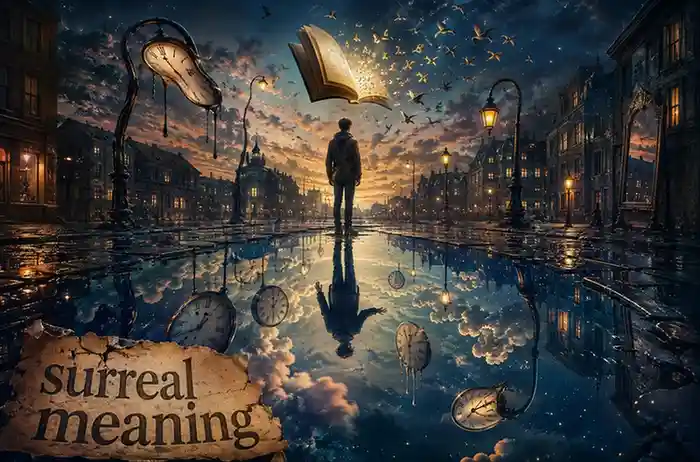
Artists like Salvador Dalí and René Magritte painted clocks that melted and trains that floated, making the surreal meaning a deliberate confrontation with logic. The Surrealist movement gave the word its intellectual and creative weight. Over time, the surreal meaning slipped from gallery walls into common language, but it never lost its undertone of psychological dislocation. Even now, calling a moment “surreal” carries an echo of Breton’s rebellion against reason.
Breaking Down the Surreal Meaning in Everyday Language
In daily conversations, the surreal meaning operates as a shortcut for “unbelievably weird, yet real.” You land a job you thought was out of reach and say, “It feels surreal.” You return to your hometown after a decade and find the streets both familiar and alien—again, surreal. The surreal meaning in these cases signals an emotional overload that short-circuits ordinary description.
People also use the surreal meaning to describe events that blend horror and wonder. Witnessing a natural disaster, surviving a serious accident, or standing in an empty city during lockdown all trigger a surreal meaning that words barely contain. This everyday usage keeps the term vivid and flexible, but it also creates confusion when someone uses it merely as a synonym for “unusual.” The authentic surreal meaning always involves a cognitive tug-of-war between what is real and what feels impossible.
Surreal vs. Unreal vs. Dreamlike: Key Differences
Mixing up surreal, unreal, and dreamlike blurs your meaning. The surreal meaning is not the same as “unreal,” which typically means fake, artificial, or not existing. A plastic flower is unreal; it does not carry the dreamlike tension of the surreal meaning. “Dreamlike” edges closer, but a dreamlike scene may lack the unsettling jolt that defines the surreal meaning.
- Surreal: Real situation that feels illogical or fantastical. Example: Walking through your childhood home now turned into a museum.
- Unreal: Not genuine or exceptionally impressive. Example: The special effects in that movie looked completely unreal.
- Dreamlike: Soft, hazy, pleasant distortion. Example: The meadow at dawn had a dreamlike calm.
The surreal meaning sits between dreamlike and absurd. It points to something that actually happens, yet defies the brain’s standard processing. You don’t call a CGI dragon surreal; you call it unreal or fantastical. You reserve the surreal meaning for moments where reality itself glitches.
15 Real-World Examples That Capture the Surreal Meaning
Examples lock the surreal meaning into your memory. Each sentence below puts the surreal meaning into a concrete, relatable context.
- Watching the sunrise from a hospital window after emergency surgery felt entirely surreal.
- Standing in the empty stadium where I once cheered with 80,000 fans had a deep surreal meaning for me.
- Driving past a house split perfectly in two by a fallen tree gave the whole street a surreal meaning that lingered for days.
- Receiving an email from my favorite author, who quoted my own blog post, instantly charged the morning with surreal meaning.
- The surreal meaning of seeing a deer walk calmly through a flooded subway station stayed with the witnesses for years.
- Holding my first published novel carried a surreal meaning I couldn’t articulate to anyone else in the room.
- A video call with my family across four time zones, all laughing at the same joke, filled me with a quiet surreal meaning.
- The surreal meaning of that silent, car-free freeway during the evacuation made me feel like the last person on Earth.
- Winning the award after three years of rejections packed a surreal meaning that outweighed the trophy itself.
- Eating my grandmother’s recipe, perfectly recreated by a stranger in a foreign city, delivered a surreal meaning that blurred geography and memory.
- Watching a robot perform stand-up comedy in a basement club gave the night a distinct surreal meaning.
- The surreal meaning of that moment—a cat calmly riding a Roomba through a wedding ceremony—broke the tension and left everyone speechless.
- Hearing my own voice narrate a childhood memory in a podcast episode wrapped the surreal meaning in a layer of self-awareness I didn’t expect.
- Opening the door to find fog so thick that the neighbor’s house vanished injected a surreal meaning into an ordinary Tuesday.
- The surreal meaning of dancing in the rain with strangers at a bus stop reminded me that magic hides in the mundane.
Every line situates the fantastical meaning firmly within the textures of everyday life. You can create your own by asking: Did this real event shatter my sense of normal?
How to Use “Surreal” in a Sentence (With Contexts)
Using “surreal” correctly depends on context. The surreal meaning works best when you anchor it to a tangible experience and let the contrast speak.
- Emotional milestone: “Graduating felt surreal after so many years of sacrifice.”
- Odd coincidence: “It was odd to run into my doppelgänger at a modest café.”
- Crisis aftermath: “The eerie silence after the earthquake carried a surreal quality.”
- Creative wonder: “The immersive theater performance left me in a surreal haze.”
Note the grammar: “Surreal” always acts as an adjective. You can say “a surreal experience,” “It felt surreal,” or “The surreal meaning of the event hit me later.” Avoid using “surreal” as a noun. Pair it with sensory details to intensify the surreal meaning for your reader. A sentence like “The cake was surreal” falls flat unless you add why—“The cake was surreal, topped with a spinning sugar carousel that defied gravity.” The surreal meaning emerges from the clash of the ordinary and the extraordinary.
The Psychology Behind Surreal Experiences
Psychologists connect the surreal meaning to how the brain processes anomalies. When reality violates deep-seated expectations, the prefrontal cortex works overtime to reconcile the mismatch. This cognitive load often produces a dissociative feeling—a sense of watching your life from outside your body. That’s exactly when the surreal meaning flares.
Studies on awe and shock explain why intensely positive or traumatic events both trigger the surreal meaning.Because both events overwhelm typical brain frameworks, a wedding proposal on a hilltop can feel just as unreal as a car accident. The brain temporarily labels the experience “not quite real” as a protective buffer. The surreal meaning, then, is not just a poetic flourish; it reflects a genuine psychological mechanism. Experts like psychiatrist Dr. Daphne Simeon have researched depersonalization and derealization, conditions where the surreal meaning becomes chronic and distressing. For most people, though, the fleeting surreal meaning is a healthy signal that you’re processing something extraordinary.
Surreal Meaning in Art and Literature: Beyond the Dictionary
Art and literature still carry the torch of the original surreal meaning. Salvador Dalí’s The Persistence of Memory exemplifies the surreal meaning visually: melting clocks in a barren landscape refuse rational interpretation. René Magritte’s The Treachery of Images with its caption “This is not a pipe” plays with the surreal meaning of representation itself.
In literature, Franz Kafka trapped characters in bureaucratic nightmares where the surreal meaning never lifts. Haruki Murakami populates novels with talking cats and parallel worlds, layering a quiet surreal meaning over everyday Tokyo. The surreal meaning in art doesn’t just decorate—it questions what we accept as real. When you consume these works, you internalize a more expansive surreal meaning that sharpens your own descriptive power. The next time reality wobbles, you’ll recognize the pattern.
Synonyms and Antonyms to Expand Your Vocabulary
Precision matters. The table below groups words by how closely they align with the surreal meaning, so you never flatten your writing again.
Synonyms and Their Relationship to the Surreal Meaning
| Synonym | Nuance | Example Sentence |
| Dreamlike | Soft, floaty, often positive | The foggy garden had a dreamlike beauty. |
| Bizarre | Strikingly odd, less psychological | The protest featured bizarre costumes. |
| Uncanny | Eerily familiar yet wrong | The robot’s smile was uncanny. |
| Fantastic | Extraordinary, hard to believe | The view from the peak was simply fantastic. |
| Absurd | Illogical to the point of humor | The rule about wearing socks with sandals felt absurd. |
| Phantasmagoric | Shifting, hallucinatory scenes | The light show created a phantasmagoric atmosphere. |
Antonyms (Opposite of the Surreal Meaning)
| Antonym | Meaning | Example Sentence |
| Ordinary | Commonplace, expected | The meeting was ordinary in every way. |
| Realistic | True to life | The novel offered a realistic portrait of farm life. |
| Mundane | Dull, routine | Washing dishes felt mundane after the excitement. |
This reference table helps you choose the exact shading. You might find that “uncanny” fits better than surreal when describing a too-perfect replica, while “phantasmagoric” suits a fever dream. The right word amplifies the surreal meaning instead of diluting it.
Why the Surreal Meaning Matters in Communication
Understanding the surreal meaning expands your lexicon of emotions. When you can name the texture of an experience, you connect more deeply with listeners. Saying “I felt weird” gives zero color; saying “I felt a surreal meaning wash over me as I stood in that empty church” paints a vivid internal landscape.
Writers, therapists, and leaders who understand the surreal meaning communicate with more empathy and precision. A CEO describing a merger as “surreal” acknowledges the workforce’s disorientation. A friend who labels your grief-induced detachment as “surreal” validates your experience. The surreal meaning matters because it legitimizes moments that logic cannot digest. It also enriches storytelling, public speaking, and content creation by moving beyond flat adjectives. Every time you correctly deploy the surreal meaning, you add a layer of psychological insight to your message.
Common Mistakes When Using “Surreal” (and How to Avoid Them)
Misusing “surreal” weakens your credibility. The most frequent errors stem from misunderstanding the surreal meaning.
- Using “surreal” as “very real” or “intense”: “The heat was surreal.” Heat is intense, but unless it melted clocks and warped your sense of time, it doesn’t carry the surreal meaning. Replace with “extreme” or “overwhelming.”
- Confusing surreal with unreal: “The actor’s performance was unreal.” If you mean incredibly good, “unbelievable” or “stunning” avoids hijacking the surreal meaning.
- Applying surreal to fictional, expected strangeness: A dragon in a fantasy film isn’t surreal within that world. The surreal meaning requires a clash with accepted reality.
- Overusing for mild surprise: “My coffee order came wrong, totally surreal.” That trivializes the surreal meaning. Reserve it for experiences that genuinely scramble your inner compass.
Fix these by asking, “Did this event genuinely feel like waking dream logic?” If not, pick a simpler word. Protecting the surreal meaning keeps your language precise and powerful.
Frequently Asked Questions About Surreal Meaning
What is the surreal meaning in simple terms?
The surreal meaning, in simple terms, is a feeling that something real is also strangely dreamlike, illogical, or too bizarre to fit normal life. It’s that moment when a real event feels like it belongs in a dream.
How do you use “surreal” in a sentence correctly?
Anchor it to a real, disorienting experience. For example: “Hearing my song on the radio for the first time was completely surreal.” The surreal meaning depends on an actual event that the brain struggles to process.
Is “surreal” the same as “unreal”?
No. “Unreal” usually means fake, artificial, or extremely impressive in a way that seems not credible. The surreal meaning, however, applies to genuine events that feel dreamlike or illogical, not fictional.
Where did the word “surreal” originate?
It came from the French surréalisme, coined by Guillaume Apollinaire in 1917 and later championed by André Breton’s Surrealist movement. The prefix sur- means “beyond,” so the surreal meaning literally points to “beyond realism.”
Can “surreal” describe positive experiences?
Absolutely. The surreal meaning shines in moments of overwhelming joy, like reuniting with a long-lost friend or achieving an impossible goal. The emotional intensity, not the emotion’s valence, triggers the dreamlike quality.
What’s the difference between surreal and absurd?
Absurd means ridiculous, irrational, or laughably senseless. The surreal meaning goes deeper, blending real circumstances with a dreamlike, hallucinatory quality that doesn’t necessarily feel humorous. A surreal situation can be absurd, but not all absurd moments hold the psychic weight of the surreal meaning.
Your Turn to Harness the Surreal Meaning
You now own a full, textured understanding of the surreal meaning—from dictionary roots and artistic fire to psychological wiring and common pitfalls. Start listening for the surreal meaning in your own life. When a moment jolts you out of the ordinary, name it accurately. This single word can transform a flat anecdote into a story that resonates in the bones. Bookmark this guide, share it with a fellow word lover, and let the surreal meaning sharpen your voice every day.
Written by Eleanor Hart, linguist and content strategist with over a decade of experience in language education and SEO. Fact-checked against Merriam-Webster, Cambridge Dictionary, Tate (Surrealism), and clinical psychology sources including Verywell Mind. External sources: Merriam-Webster Dictionary (merriam-webster.com), Cambridge Dictionary (dictionary.cambridge.org), Tate – Surrealism (tate.org.uk), Verywell Mind – Depersonalization (verywellmind.com).