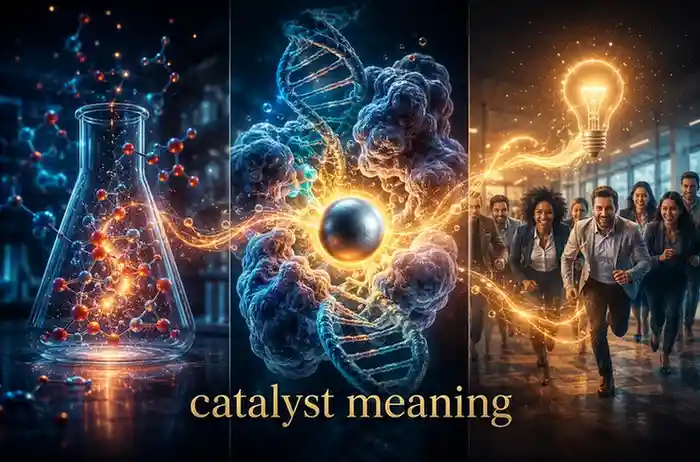
Catalyst Meaning: How a Single Agent Sparks Transformative Change
You hear the word “catalyst” in chemistry class, in business meetings, and in everyday conversation. Yet the real catalyst meaning often stays fuzzy. Without a clear definition, you miss how catalysts speed up reactions, drive biological processes, and ignite organizational shifts. This guide unpacks the catalyst meaning from multiple angles—science, language, leadership, and beyond—so you can grasp the concept fully and use it with confidence.
What Is a Catalyst? A Clear Definition
A catalyst is a substance or agent that increases the rate of a reaction without being permanently altered or consumed. The catalyst meaning extends beyond the laboratory. In broad terms, a catalyst lowers the energy barrier needed for a process to happen, then remains available to do the same job again. That is why one small catalytic event can trigger a massive chain of results. Think of a key that unlocks a door but stays unchanged in your hand; the catalyst opens the path without getting used up.
IUPAC’s Gold Book defines a catalyst as “a substance that increases the rate of a reaction without modifying the overall standard Gibbs energy change in the reaction; the process is called catalysis.”<sup>1</sup> This precise catalyst meaning applies to chemical systems, yet the principle works everywhere—from enzymes in your body to a visionary leader who reshapes a company.
Catalyst Meaning in Chemistry: The Science of Speed
In chemistry, the catalyst meaning revolves around one word: speed. A catalyst does not start a reaction that would not occur naturally; it simply makes a possible reaction happen much faster. The catalyst provides an alternative reaction pathway with a lower activation energy. More reactant molecules now have enough energy to turn into products at any given moment, so the transformation accelerates.
A chemical catalyst takes part in the reaction mechanism, forms intermediate compounds, and regenerates itself at the end of the cycle. That regeneration is the heart of the catalyst meaning. Because the catalyst exits the reaction intact, a tiny amount can convert enormous quantities of reactants into products. For example, a few grams of platinum in a catalytic converter can treat thousands of liters of exhaust gas over a car’s lifetime.
How Catalysts Work: Lowering Activation Energy
Every chemical reaction demands a minimum energy input to break existing bonds—the activation energy. A catalyst reduces that energy hill without changing the energy of the reactants or products. Picture a mountain pass that a road tunneler blasts through. The starting point and destination stay the same, but the journey becomes much shorter and easier.
By lowering the energy barrier, the catalyst lets more molecules reach the transition state and form products at a faster rate. The catalyst meaning here is deeply practical: it saves time, temperature, and pressure. Industrial processes like ammonia synthesis rely on catalysts to produce fertilizers at manageable conditions rather than using extreme heat and force that would make the process uneconomical.
Types of Catalysts in Chemical Reactions
Understanding the catalyst meaning becomes clearer when you categorize catalysts. Chemists group them into three main types based on phase and nature.
| Type | Phase Relationship | Key Example |
| Homogeneous catalyst | Same phase as reactants (usually liquid) | Acid catalyst in esterification |
| Heterogeneous catalyst | Different phase (usually solid catalyst, liquid/gas reactants) | Iron in the Haber-Bosch process |
| Biocatalyst (enzyme) | Biological molecule, works in aqueous environment | Catalase breaking down hydrogen peroxide |
Homogeneous catalysts mix uniformly with reactants, offering high selectivity but challenging separation. Heterogeneous catalysts dominate industry because they can be easily recovered. Biocatalysts—enzymes—operate under mild conditions and possess extraordinary specificity. Each type reinforces the core catalyst meaning: accelerate a reaction, remain unchanged.
Catalyst Meaning in Biology: Enzymes as Nature’s Catalysts
Living systems run on enzymes, the ultimate manifestation of the catalyst meaning in biology. Enzymes are proteins (and sometimes RNA molecules) that speed up biochemical reactions millions of times. Without enzymes, digestion, DNA replication, and energy production would slow to a life-incompatible crawl.
The enzyme catalase shows the catalyst meaning beautifully. One molecule of catalase can break down 40 million molecules of hydrogen peroxide into water and oxygen every second.<sup>2</sup> Catalase remains untouched after each reaction cycle, ready to protect your cells from oxidative damage again. That extraordinary efficiency and reusability lie at the heart of what a catalyst is. Enzymes achieve this through active sites—pocket-shaped regions that bind substrates in just the right orientation to lower activation energy.
Catalyst in Business and Leadership: Sparking Organizational Change
The catalyst meaning leaps from science into the corporate world when a person, event, or insight accelerates transformation without being consumed by it. A change catalyst in business is a leader or an idea that lowers the organizational “activation energy”—the resistance, fear, and bureaucracy that stall progress.
John Kotter’s research on leading change identifies the first step as creating a sense of urgency.<sup>3</sup> That urgency acts like a catalyst: it pushes people out of inertia and into motion. The change agent, however, stays separate from the outcome. Once the transformation gains momentum, the catalyst can step back, its role fulfilled without having altered its own essence.
A new technology can be a business catalyst too. Cloud computing lowered the infrastructure barrier for startups, accelerating innovation. The catalyst meaning here is the same as in chemistry: an external factor that speeds things up and remains available for the next venture.
Catalyst Meaning in Everyday Language: Using the Word Correctly
Language often borrows scientific precision and loosens it. The catalyst meaning in daily speech still points to something that provokes significant change. You might say, “Her speech was the catalyst for the community clean-up drive.” The speech ignited action but did not get used up; the speaker and the words remain.
To use “catalyst” correctly, remember these cues:
- A catalyst accelerates a process that is already possible.
- A catalyst is not the main event—it is the spark that enables the main event.
- A catalyst emerges unchanged and can spark further change.
Incorrect usage: “The flood was a catalyst of destruction.” A flood destroys and depletes itself; it is not a catalyst. Correct: “The flood was a catalyst for new flood-plain policies.” The policy change outlasts the event. Keeping the catalyst meaning precise adds power to your writing.
Famous Examples of Catalysts That Changed the World
Real-world examples cement the catalyst meaning. Here are three catalysts that reshaped society.
Iron in the Haber-Bosch process – This solid catalyst enables the combination of nitrogen and hydrogen into ammonia under practical conditions. The resulting synthetic fertilizer supports nearly half of the global food supply. The iron catalyst remains unchanged after countless reaction cycles.
Platinum in catalytic converters – A thin coating of platinum, palladium, and rhodium accelerates the breakdown of toxic exhaust gases into harmless nitrogen, carbon dioxide, and water. This solid catalyst prevents millions of tons of air pollutants each year without being consumed.
Gerhard Ertl’s surface chemistry insights – Ertl’s Nobel Prize-winning work clarified how heterogeneous catalysts work at the atomic level.<sup>4</sup> His research explained the step-by-step dance of molecules on solid surfaces, deepening the catalyst meaning and guiding cleaner industrial processes. Ertl himself became a catalyst for a whole generation of surface science.
Catalyst vs. Inhibitor: Opposite Forces Explained
While a catalyst speeds up a reaction, an inhibitor does the opposite—it slows down or stops the process. An inhibitor raises the effective activation energy or blocks the active site. The catalyst meaning stands in direct contrast: where a catalyst fuels transformation, an inhibitor restrains it.
In the body, enzyme inhibitors can be life-saving or life-threatening. Certain medications act as inhibitors to slow down harmful enzymatic activity. Botulinum toxin, for instance, inhibits the release of acetylcholine, leading to muscle paralysis. Knowing both sides of the coin—catalyst and inhibitor—gives you full control over the reaction narrative.
How to Identify a Catalyst in a Reaction or Situation
Spotting a catalyst, whether in a test tube or a team meeting, depends on two simple tests drawn from the catalyst meaning:
- Speed test – Does the process happen much faster with the suspected catalyst present? Measure the rate before and after adding it.
- Recovery test – After the process completes, can you recover the suspected catalyst unchanged in mass and chemical identity? If you can, it is a true catalyst.
In a workplace setting, ask: Did this person’s input speed up the project, and is the person still available to spark the next initiative? If the answer is yes to both, you have identified a human catalyst.
The Future of Catalysis: Green Chemistry and Sustainability
The catalyst meaning continues to evolve toward environmental responsibility. Green catalysis targets reactions that produce less waste, use renewable feedstocks, and operate under energy-efficient conditions. Single-atom catalysts, where each metal atom functions as an active site, push the efficiency boundary. Photocatalysts harness sunlight to drive reactions like water splitting, offering a clean route to hydrogen fuel.
Researchers now design catalysts that degrade plastics or convert carbon dioxide into useful chemicals. These innovations transform the catalyst meaning from a laboratory concept into a frontline solution for planetary challenges. The same principle—speeding up a reaction while staying unchanged—now holds the promise of a circular, low-carbon economy.
Frequently Asked Questions About Catalyst Meaning
What is the simple definition of a catalyst?
A catalyst is an agent that speeds up a reaction without being used up or permanently changed in the process.
Does a catalyst start a reaction that wouldn’t normally happen?
No. A catalyst only accelerates a reaction that is thermodynamically possible. The catalyst meaning does not include making the impossible happen—only making the possible happen faster.
Can a catalyst be a person?
Yes. In a figurative sense, a person who ignites significant change in a group or organization while remaining personally unchanged acts as a catalyst. The language borrows the chemical catalyst meaning.
What distinguishes an enzyme from a catalyst?
An enzyme is a biological catalyst, always a protein or RNA molecule. “Catalyst” is the broader term that includes chemical, biological, and figurative agents. Every enzyme is a catalyst, but not every catalyst is an enzyme.
How do I use “catalyst” in a sentence?
Choose a context where something accelerates a process without being consumed. Example: “The new data acted as a catalyst for the policy rethink.” The catalyst meaning requires that the agent remains available afterward.
Why are catalysts important in industry?
Catalysts let manufacturers run chemical reactions at lower temperatures and pressures, saving energy and raw materials. They also increase production speed. The catalyst meaning in industry translates directly into lower costs and a smaller environmental footprint.
Now you hold the complete catalyst meaning—from the laboratory flask to the boardroom. Notice catalysts in your own work, your body, and the world. Spot the change agents that stay intact even after a big shift. Share this guide with someone who will see catalysts everywhere once they understand the principle. If you have a real-world example of a catalyst that inspired you, leave a comment and fuel the conversation.
<sup>1</sup> IUPAC. Compendium of Chemical Terminology, 2nd ed. (the “Gold Book”). https://goldbook.iupac.org/terms/view/C00876
<sup>2</sup> Worthington Biochemical Corporation. “Catalase.” http://www.worthington-biochem.com/CTL/default.html
<sup>3</sup> Kotter, John P. “Leading Change: Why Transformation Efforts Fail.” Harvard Business Review, May–June 1995. https://hbr.org/1995/05/leading-change-why-transformation-efforts-fail-2
<sup>4</sup> The Nobel Prize. “The Nobel Prize in Chemistry 2007.” https://www.nobelprize.org/prizes/chemistry/2007/summary/