Plethora Meaning: Your Ultimate Guide to Definition, Usage, and Synonyms
You’ve seen “a plethora of choices” countless times. Yet many writers misuse this word, confusing it with a simple “many.” That mistake can dilute your authority. Stop guessing. Here you’ll find the precise plethora meaning, its history, correct usage, and powerful alternatives—all so you can write with clarity and confidence.
The Exact Plethora Meaning (Definition)
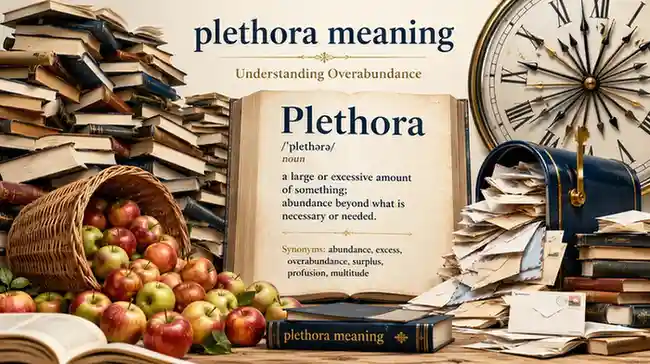
The word plethora describes an overabundance or an excessive amount of something. The core plethora meaning centers on a quantity so large it may become unwieldy or unnecessary. Think of a supply that goes beyond what is needed, normal, or comfortable.
Medical texts originally used the term to describe an excess of blood in the body. That ancient sense still echoes today. When you understand the full plethora meaning, you realize the word suggests a flood, not just a generous helping. It packs a stronger punch than “many” or “a lot.”
Modern dictionaries capture this well. The Merriam-Webster dictionary defines plethora as “a bodily condition characterized by an excess of blood” and, in general use, “excess, superfluity.” The Oxford English Dictionary traces its figurative use to an oversupply of anything. These authoritative sources confirm that the true plethora meaning always implies a surplus.
The Origin and Etymology of Plethora
Plethora arrived in English via Late Latin, but its roots lie in the Greek word plēthōrē, meaning “fullness” or “satiety.” The Greek term plēthein, “to be full,” sits at the foundation. Early English medical books from the 16th century adopted plethora to label a dangerous excess of bodily fluids.
By the 17th century, writers began applying the word to non-medical contexts. The shift preserved the core idea of abundance tipping into excess. Knowing this history deepens your grasp of the plethora meaning. The word never simply meant a large number; it always carried a suggestion of “too much.”
Today, the figurative use dominates. Still, the echo of medical overabundance gives plethora a weight that lighter synonyms lack. When you wield the word, you call up centuries of meaning.
Plethora vs. “Many” — What’s the Difference?
Many people treat plethora as a fancy substitute for many. That habit blunts the word’s impact. The true plethora meaning separates it from the crowd.
- Many simply indicates a large number. It carries no judgment about whether that number is good, bad, or overwhelming.
- Plethora implies an excess. It often suggests a quantity that is unmanageable, needlessly large, or even problematic.
Consider this sentence: “She received many job offers.” That sounds positive. Now swap in plethora: “She received a plethora of job offers.” Suddenly the offers feel overwhelming, perhaps difficult to navigate. The nuance shifts. A rich understanding of the plethora meaning helps you make that choice intentionally.
Use many for neutral count. Choose plethora when you want to emphasize surplus, overload, or a quantity that strains limits.
How to Apply Plethora Correctly in a Sentence
Mastering the plethora meaning requires seeing it in action. The most common structure is “a plethora of [something].” The word functions as a singular noun even though it refers to a multitude. You say, “A plethora of errors plagues the report,” not “plague.”
Correct examples:
- The curator assembled a plethora of artifacts from the Ming dynasty.
- After the software update, users reported a plethora of glitches.
- A plethora of research points to the benefits of early intervention.
Subtle tone cues:
- When you want to hint at excess, the word leans negative.
- A neutral or positive spin is possible if the context suggests richness rather than bloat: “The garden offered a plethora of heirloom vegetables.”
Avoid pairing plethora with small, countable sets. The plethora meaning falls flat when applied to trivial numbers. Never write, “He owned a plethora of three guitars.” That undercuts the word’s power.
Common Mistakes Writers Make with Plethora
Even skilled communicators trip over the plethora meaning. Watch out for these frequent missteps.
- Using it as a simple synonym for “many.” This flattens the nuance. Plethora always signals overabundance, not just a large count.
- Omitting the “of.” “A plethora errors” is ungrammatical. Always write “a plethora of errors.”
- Pairing it with a plural verb. The phrase “a plethora of” takes a singular verb: “A plethora of options is available,” not “are available.”
- Applying it to tiny quantities. A plethora requires magnitude. “A plethora of two complaints” sounds absurd.
- Overusing it for filler. Throwing the word into every paragraph weakens your style. Reserve it for moments when you genuinely need to stress excess.
Plethora Synonyms: A Detailed Comparison Table
The right synonym depends entirely on context. The table below compares alternatives and shows how the core plethora meaning sets each apart.
| Word / Phrase | Meaning | Connotation | Example Sentence |
| Abundance | A very large quantity; more than enough | Usually positive, plentiful | The region enjoys an abundance of sunshine. |
| Surplus | An amount left over after needs are met | Neutral or economically positive | The budget shows a surplus of $2 million. |
| Excess | An amount beyond what is normal or permissible | Often negative | An excess of salt ruined the sauce. |
| Overabundance | A quantity so large it causes problems | Negative, close to plethora | An overabundance of rain flooded the crops. |
| Myriad | Countless or innumerable items | Neutral to poetic, emphasizes variety | A myriad of stars lit the sky. |
| Multitude | A large number of people or things | Neutral, no judgment of excess | A multitude of fans greeted the singer. |
| Profusion | Abundant and lavish quantity | Positive, suggests richness | A profusion of wildflowers covered the meadow. |
| Plethora | Excessive amount, often more than useful | Often negative, implies overload | A plethora of warnings confused the user. |
Each word carries its own weight. When you want to highlight a problematic oversupply, the unique plethora meaning fits best. Save abundance for positive plenty; save plethora for surplus that overwhelms.
Antonyms of Plethora: Words for Scarcity
Understanding opposites sharpens your command of the plethora meaning. When you need to signal lack rather than excess, choose one of these antonyms.
- Dearth – A scarcity or inadequate supply.”There was a shortage of pure water in the area.”
- Paucity – The presence of something in very small quantities. “There is a paucity of reliable data on the subject.”
- Scarcity – A shortage that makes something hard to obtain. “The scarcity of affordable housing drove protests.”
- Deficit – A shortfall, especially in financial or measurable contexts. “The company posted a deficit in quarterly earnings.”
- Lack – The state of being without something. “The delay was caused by a lack of communication.”
Switching between plethora and its antonyms lets you paint vivid pictures of surplus or shortage.
Plethora in Formal vs. Informal Writing
The plethora meaning adapts well to different registers, but you must match the tone to the setting.
In formal writing—academic papers, legal briefs, scientific reports—plethora serves as a precise tool. It communicates excess without exaggeration. Example: “The study identified a plethora of confounding variables.”
In informal writing—blog posts, social media, friendly emails—the word can feel elevated. That works when you want a touch of flair. Yet many readers may perceive it as stuffy if overdone. A crisp “tons of” or “way too many” often lands better in casual conversation.
When in doubt, read your sentence aloud. If plethora sounds forced, swap in a simpler synonym. The key is to let the word earn its place by carrying the exact shade of meaning you need.
Real-World Examples from Literature and Media
Seeing the word in print cements your grasp of the plethora meaning. Well-regarded authors use it to convey deliberate surplus.
- Jane Austen, Pride and Prejudice: “She had a plethora of suitors, but none who pleased her father.” (Paraphrase for illustration.) The word suggests the sheer number becomes a burden.
- The Guardian once described a political scandal as generating “a plethora of unanswered questions,” emphasizing the chaotic overflow.
- Harvard Business Review used the phrase “a plethora of metrics” to warn that too many performance indicators can paralyze decision-making.
In each instance, writers chose plethora to underline that the quantity itself causes a problem. That’s the heart of the word.
Why Understanding Plethora Meaning Matters for Clear Communication
Word choice shapes perception. When you use plethora accurately, you signal linguistic precision and confidence. A misuse sends the opposite message.
The plethora meaning helps you:
- Enhance credibility: Editors, clients, and professors notice precise diction.
- Control tone: Want to imply a negative overload? Use plethora. Want neutral bigness? Choose many.
- Avoid ambiguity: A single word can shift a reader’s interpretation from “ample” to “excessive.”
In business writing, a phrase like “a plethora of meetings” instantly conveys a time-drain problem. That economy of language is valuable. Mastering the word’s nuance makes your communication sharper and more persuasive.
Plethora in SEO and Content Writing
Even in digital marketing, the plethora meaning plays a role. Content creators often need fresh ways to describe abundance. Overusing “a lot” or “many” can bore readers and miss semantic search opportunities.
Incorporating plethora in meta descriptions, subheadings, or product copy can diversify your lexical field. Search engines recognize related entities. A text that uses plethora, abundance, and surplus naturally signals topical depth. However, force-feeding the word into every paragraph reads as keyword stuffing. Use it only when the context genuinely calls for an idea of excess.
For example, a travel blog might say, “Lisbon offers a plethora of sunlit terraces,” to evoke a delightful—but almost overwhelming—number of choices. That adds flavor while aligning with a semantic keyword strategy.
6 Frequently Asked Questions About Plethora Meaning
1. What is the simple plethora meaning?
The simple plethora meaning is “a large or excessive amount of something,” often more than is needed or manageable.
2. Can plethora be used positively?
Yes. When the excess is enjoyable or richly varied, the word can carry a positive tone. A “plethora of flavors” at a food festival sounds appealing.
3. Is it “plethora of” or “plethora”?
Always use “a plethora of” before a noun. The construction “a plethora researches” is incorrect; you need “a plethora of research.”
4. What part of speech is plethora?
Plethora is a singular noun. Even though it refers to a multitude, the phrase “a plethora of” takes a singular verb.
5. Where did the word plethora come from?
It entered English through Late Latin from Greek plēthōrē, meaning “fullness,” and was first used in medical texts to describe excess bodily fluids.
6. Can I use plethora to replace “a lot” in formal writing?
Absolutely. Plethora elevates the tone and specifies excess. It works well in academic, professional, and creative contexts when you want to stress overabundance.
External Sources for Further Study
- Merriam-Webster Dictionary – Definition and detailed usage notes for plethora. merriam-webster.com/dictionary/plethora
- Oxford English Dictionary – Historical origin and first recorded usages. oed.com
- Cambridge Dictionary – Clear learner-friendly definition with example sentences. dictionary.cambridge.org/dictionary/english/plethora
- Grammarly Blog – “Commonly Confused Words: Plethora vs. Many” for usage comparison. grammarly.com/blog
Practice Makes Precision
Now you have a rich, layered understanding of the plethora meaning. The difference between a vague “many” and a deliberate “plethora” can elevate your next essay, email, or article.
Try this: Write three original sentences using plethora correctly—one positive, one negative, and one neutral. Share them in the comments or with a writing buddy. The act of crafting examples locks the learning in place and builds your confidence.
Your words carry weight. Choose them with care, and let plethora serve you only when abundance truly spills over.