Ubiquitous Meaning: Your Definitive Guide to Understanding and Using It Correctly
You read “ubiquitous” in a tech article and paused. Does it mean popular, common, or something more precise? Guessing leads to fuzzy writing and missed nuance. This pillar page clarifies the ubiquitous meaning once and for all. You will learn exact definitions, study clear examples, and grasp how it differs from “pervasive” and “omnipresent.” Master it, and your communication sharpens instantly.
What Does Ubiquitous Mean?
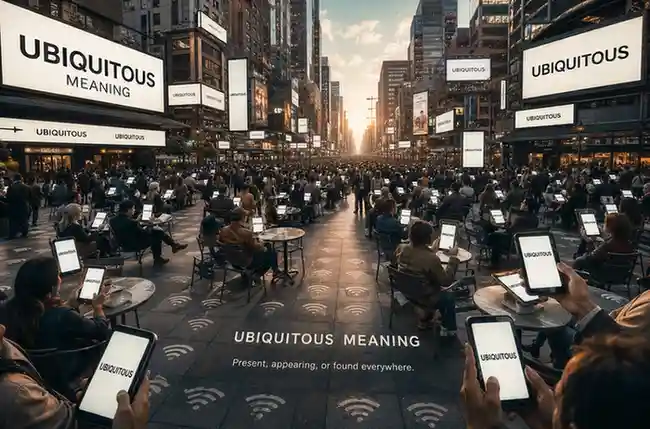
The ubiquitous meaning points to something that appears, or seems to appear, everywhere at the same time. The Oxford English Dictionary defines it as “present, appearing, or found everywhere.” Merriam-Webster adds “existing or being everywhere at the same time.” Collins Dictionary describes a ubiquitous thing as “being everywhere at once: omnipresent.”
Rather than just “very common,” the word carries a sense of simultaneous, all-encompassing presence. Smartphones supply a perfect example. Walk through any city, and you will see them in hands, on desks, and inside bags — they feel inescapable. That near-universal presence captures the ubiquitous meaning exactly.
- Core sense: seeming to be in all places at once
- Often used when something spreads so widely it becomes part of everyday background
- Not simply “popular” — it implies a saturated, unavoidable presence
Ubiquitous Meaning: The Etymology Behind the Word
Knowing the roots deepens your grasp of the ubiquitous meaning. The word entered English from the Latin ubique, meaning “everywhere.” Ubique itself combines ubi (where) and the suffix -que (and, or every). The term originally carried a theological weight: God was described as ubiquitous, present in all places at the same time.
By the early 19th century, secular use spread. Writers began applying it to fashion, ideas, and later technology. The shift from divine omnipresence to smartphones in every pocket reflects how the ubiquitous meaning evolved while keeping its core: something that fills all spaces.
- Latin origin: ubique (everywhere)
- First used in theological contexts
- Modern expansion to describe widespread social and tech phenomena
Ubiquitous vs. Omnipresent vs. Pervasive: Key Differences
People frequently mix these three words, but each carries a distinct shade.
| Word | Core Definition | Connotation | Example |
| Ubiquitous | Seeming to appear everywhere at once | Often neutral or positive; focuses on widespread visibility | Smartphones are ubiquitous in urban life. |
| Omnipresent | Present in all places at the same time | Frequently spiritual or supernatural; physical impossibility for objects | God is omnipresent in many faith traditions. |
| Pervasive | Spreading widely through an area or group, often unwelcome | Often negative; implies infiltration that is hard to escape | A pervasive odor of dampness filled the basement. |
The ubiquitous meaning differs from “omnipresent” because something man-made (like a logo) can be ubiquitous, but only a divine being can truly be omnipresent. Pervasive leans toward something that seeps in — frequently unwanted. Use ubiquitous when you want to highlight surprising or remarkable widespread presence without a negative undertone.
- Ubiquitous: everywhere you look, often neutral
- Omnipresent: everywhere without limit, often divine
- Pervasive: spreading into every part, often unpleasant
Ubiquitous in Everyday Language: Real-World Examples
Concrete examples solidify the ubiquitous meaning better than abstract definitions. Look at these everyday situations:
- Wi-Fi signals in a modern hotel — lobby, rooms, restaurant — create a blanket of connectivity. You expect it everywhere; its absence feels jarring.
- Plastic packaging has become a ubiquitous layer around food, electronics, and household goods. Open any grocery box, and you face it.
- Coffee chains like Starbucks appear on so many street corners that their green logo becomes part of the visual background.
- Fitness trackers strapped to wrists at the office, gym, and airport show how health monitoring turned into a ubiquitous personal habit.
These are not simply “common.” They saturate daily life to such a degree that you stop registering them consciously — which is the true test of the ubiquitous meaning.
- Wi-Fi connectivity
- Plastic packaging
- Global coffee shop chains
- Wearable fitness devices
The Ubiquitous Meaning in Technology and Business
In tech and business writing, the ubiquitous meaning signals a product, service, or trend that has saturated a market. Cloud computing, for example, shifted from a niche IT concept to a ubiquitous backend for nearly every app. Video conferencing platforms exploded from occasional tools to ubiquitous daily channels after remote work normalized.
Marketers chase ubiquitous brand recognition — the moment a logo or jingle becomes background noise everyone accepts. The USB-C port’s transition from novelty to ubiquitous standard for charging cables demonstrates how a single interface can dominate. In these contexts, describing something as ubiquitous signals market triumph and deep cultural embedding.
- Cloud storage now feels invisible but omnipresent
- USB-C as a ubiquitous charging and data standard
- Video calls transforming into a ubiquitous work ritual
Ubiquitous in Literature and Philosophy
Literature stretches the ubiquitous meaning beyond physical objects. A pervasive mood, a haunting memory, or an inescapable social pressure can be described as ubiquitous. In George Orwell’s Nineteen Eighty-Four, the surveillance of Big Brother feels ubiquitous — every wall hides a telescreen. The sensation of being constantly watched saturates the atmosphere, not just the technology.
Philosophers explore ubiquitous concepts like consciousness or time. You cannot step outside time; it is the ubiquitous medium of existence. Recognizing the ubiquitous meaning in philosophical texts helps you spot arguments about conditions that envelop every human experience — things so ever-present we rarely question them.
- Big Brother’s telescreens as ubiquitous surveillance
- Time and consciousness as ubiquitous phenomena
- Moods and societal pressures depicted as inescapable backdrops
Synonyms for Ubiquitous (And When to Use Them)
You can swap in precise alternatives once you understand the ubiquitous meaning deeply.
- Everywhere — informal, immediate.“Wildflowers grew everywhere across the meadow.” Simple, not nuanced.
- Omnipresent — best for theological or metaphorical uses. Reserve it for forces that cannot be physically measured.
- Pervasive — choose when you want to emphasize penetration, often with a negative tint. “A pervasive cynicism poisoned team meetings.”
- Universal — applies to something that includes or affects all people or things. Universal healthcare differs from a ubiquitous coffee chain.
- Rife — implies abundance, usually of something harmful. “The slums were rife with disease.”
When you indicate a strikingly or astonishingly wide presence without any negative or spiritual connotations, choose “ubiquitous.”
That precision elevates your writing.
- Use “ubiquitous” for saturated physical or digital presence
- Save “omnipresent” for divine contexts
- Pick “pervasive” for unwelcome infiltration
Antonyms of Ubiquitous: Words for Scarcity
Understanding the opposite sharpens the ubiquitous meaning. Antonyms include:
- Scarce — insufficient for demand. Clean drinking water remains scarce in many regions.
- Rare — not found in large numbers. A rare and secretive predator is the snow leopard.
- Sporadic — occurring at irregular intervals. Sporadic gunfire echoed in the distance.
- Localized — restricted to a small area. The power outage was localized to three blocks.
Pairing ubiquitous with these terms in your mind creates a mental scale from complete saturation to extreme rarity.
How to Use “Ubiquitous” in a Sentence Correctly
When applying the universal meaning, syntax is important. . Place “ubiquitous” before the noun it describes (attributive use) or after a linking verb (predicative use).
- Attributive: “The ubiquitous presence of street art transformed the neighborhood.”
- Predicative: “By 2025, AI assistants had become truly ubiquitous.”
Common errors: avoid using “ubiquitous” to mean merely “popular” or “well-liked.” A pop song can be hugely popular but not physically everywhere. A security camera network can be ubiquitous without anyone loving it. Stick to the idea of pervading physical or digital space.
Quick check: if you can replace “ubiquitous” with “appearing all around you everywhere,” and the sentence still holds, you have used the ubiquitous meaning correctly.
Common Misconceptions About Ubiquitous Meaning
Misunderstandings abound.
- Myth: Ubiquitous means “very common.” Fact: Common implies frequency, while ubiquitous implies presence across a wide physical or conceptual space. Subway rats are common in a city; subway announcements are ubiquitous because they ring out on every platform.
- Myth: You can say “almost ubiquitous.” Fact: That weakens the word. If something is almost everywhere, say “widespread” or “prevalent.” Ubiquitous already contains the notion of being everywhere, so “almost” undercuts its force.
- Myth: Ubiquitous and omnipresent are interchangeable. Fact: Ubiquitous works for man-made spread; omnipresent belongs to theology and metaphysics.
Clarifying these subtle distinctions deepens your authoritative grasp of the ubiquitous meaning.
The Ubiquitous Brand: When Products Become Everywhere
Some brands achieve a ubiquitous status that transcends marketing. When you enter a supermarket and can’t escape the sight of a particular soda logo, that brand has reached ubiquity. The ubiquitous meaning in a business context describes a presence so broad that it becomes part of the consumer’s environment.
Apple achieved ubiquitous retail visibility with its sleek minimalist stores. Google’s search bar became the ubiquitous starting point for internet navigation. The success and sometimes the backlash — think of an overly ubiquitous fast-fashion chain — demonstrate how saturation can shape public perception. Use “ubiquitous” in case studies to analyze market penetration, not just sales numbers.
Why Understanding Ubiquitous Meaning Improves Your Vocabulary
A precise vocabulary sharpens your thinking. You can describe complex saturation without babbling if you understand the ubiquitous meaning. Instead of “that thing you see absolutely everywhere to the point you stop noticing it,” you deploy one elegant word.
Using it correctly signals strong command of English. It helps you write tighter reports, more vivid narratives, and more persuasive presentations. You also strengthen your ability to detect exaggeration: if a tech startup claims its app is ubiquitous after three weeks, you recognize the misuse immediately. Your critical reading and writing both improve when a single word holds so much weight.
Quick-Reference Table: Ubiquitous Meaning at a Glance
| Aspect | Detail |
| Pronunciation | /juːˈbɪk.wɪ.təs/ |
| Part of Speech | Adjective |
| Literal Sense | Existing everywhere simultaneously |
| Common Use | Seeming to be everywhere; extremely widespread |
| Word Origin | Latin ubique (everywhere) |
| Key Distinction | Describes physical or digital saturation, not divine all-presence |
| Example | “The company’s logo became ubiquitous on city billboards.” |
6 Frequently Asked Questions About Ubiquitous Meaning
1. What is the ubiquitous meaning in simple terms?
Ubiquitous describes something that seems to be present everywhere at the same time — like smartphones or Wi-Fi signals in a modern city. The ubiquitous meaning captures that feeling of total saturation.
2. Is ubiquitous a positive or negative word?
It is generally neutral. Context decides the tone. Describing urban graffiti as ubiquitous can sound negative; calling renewable energy ubiquitous carries a hopeful note. The ubiquitous meaning itself doesn’t judge.
3. Can you explain the ubiquitous meaning with an easy sentence?
“Rainfall is a ubiquitous part of life in the rainforest.” Here the ubiquitous meaning points to a constant, all-surrounding natural element.
4. How does the ubiquitous meaning differ from “pervasive”?
Pervasive suggests spreading deeply, often in an unwelcome way. Ubiquitous highlights broad physical presence without automatically implying harm. Understanding this difference clarifies the ubiquitous meaning.
5. Is it correct to say “almost ubiquitous”?
Strict stylists avoid it. Ubiquitous already means everywhere, so “almost” creates a contradiction. Choose “widespread” or “prevalent” instead.
6. Why does the ubiquitous meaning matter for a good vocabulary?
It packs a precise observation into one word. You replace wordy descriptions and show exact thinking. Mastering the ubiquitous meaning makes your speech and writing crisper and more professional.
Keep Building Your Word Power
The next time you spot “ubiquitous” in an article, you will catch the exact nuance it carries. You now hold a complete toolkit — definition, origin, distinctions, examples, and traps to avoid.Start observing commonplace aspects of your own day, such as the morning traffic hum, the cloud-sync icon on your phone, and the background music in coffee shops. Name them with confidence.
Share your sharpest example of something truly ubiquitous in the comments. Your observation will inspire others to train their eye for words that matter.
Written by Alex Morgan, linguist and vocabulary coach with 12 years of experience in applied English instruction. This guide was fact-checked against the Oxford English Dictionary, Merriam-Webster, and Collins Dictionary to ensure accuracy. All interpretations are original and grounded in primary lexicographical sources.