What Does the Forget Me Not Flower Mean? The Ultimate Meaning Guide
You’ve spotted the tiny blue petals and heard the name. Yet the genuine forget me not flower meaning holds a far deeper narrative—one of faithful love, lasting memory, and quiet spiritual connection. Most people glance, admire, and walk away. That quick glance steals your chance to share an unspoken promise. This guide unpacks every layer of symbolism, history, and emotional weight tied to the forget-me-not, so you can carry its message with purpose.
The True Forget Me Not Flower Meaning at a Glance
A single phrase rarely captures the complete forget me not flower meaning. The bloom carries multiple threads of significance, each rooted in folklore, faith, and human longing. Below, a condensed table gives you immediate clarity, while the sections that follow expand each point with depth.
| Symbolic Layer | Core Meaning |
| Romantic love | True, undying devotion and fidelity |
| Remembrance | Honoring those we’ve lost; “I will never forget” |
| Spiritual connection | Divine presence, constancy of the soul |
| Friendship | Loyal companionship that time cannot erase |
| Hope after grief | Gentle resilience and the promise of continued love |
| Alzheimer’s awareness | Solidarity with memory-loss communities worldwide |
The Medieval Love Legend That Gave the Flower Its Name
A German tale from the Middle Ages forms the root of the forget me not flower meaning. A knight and his lady walked along the Danube riverbank. He bent to pick the small blue blossoms she admired, but the weight of his armor pulled him into the rushing water. As the current swept him away, he threw the flowers to her and shouted, “Vergiss mein nicht!” – forget me not.
This story anchored the flower’s identity in faithful, sacrificial love. The name itself spread across languages: forget-me-not in English, ne-m’oubliez-pas in French, nomeolvides in Spanish. Each translation carries the same urgent plea to hold someone in memory. The legend appears in early Germanic poetry and was later popularized by 15th-century European courtly romance manuscripts. (See the medieval poetry collection Des Minnesangs Frühling for early uses of the motif.)
Symbolism Across Cultures and Centuries
Victorian floriography turned the simple forget me not flower meaning into a coded message. Giving a sprig of Myosotis whispered, “Remember me forever,” or “True love never dies.” Lovers exchanged pressed forget-me-nots during long separations, and mourners placed them on graves as a promise that the departed would live on in memory.
In Newfoundland and Labrador, the forget-me-not serves as a symbol of the province’s war dead. In Armenia, the flower marks the centennial of the 1915 genocide, with the purple-and-blue center representing the past and the yellow eye symbolizing hope for the future. In Japan, the small bloom wasurenagusa appears in songs and haiku to convey quiet, patient affection that endures without demand. Each culture layers its own grief and hope onto the identical five-petaled flower, yet the core stays consistent: refusal to let memory fade.
Spiritual and Religious Significance of Forget-Me-Nots
Christian tradition links the forget me not flower meaning to the eyes of the Virgin Mary. The flower’s name in some regions translates to “Eyes of Mary,” linking the sky-blue color to her mantle and her watchful, compassionate presence. Medieval monks planted Myosotis in cloister gardens as a reminder that Christ never forgets his children.
Beyond organized religion, the bloom signals spiritual constancy. Lightworkers and herbal mystics use forget-me-not essence to encourage emotional honesty and to ease the pain of separation. The tiny flower reminds the soul that connection outlasts physical presence. This aligns with the broader forget me not flower meaning of unwavering spiritual fidelity.
Color Variations and Their Unique Meanings
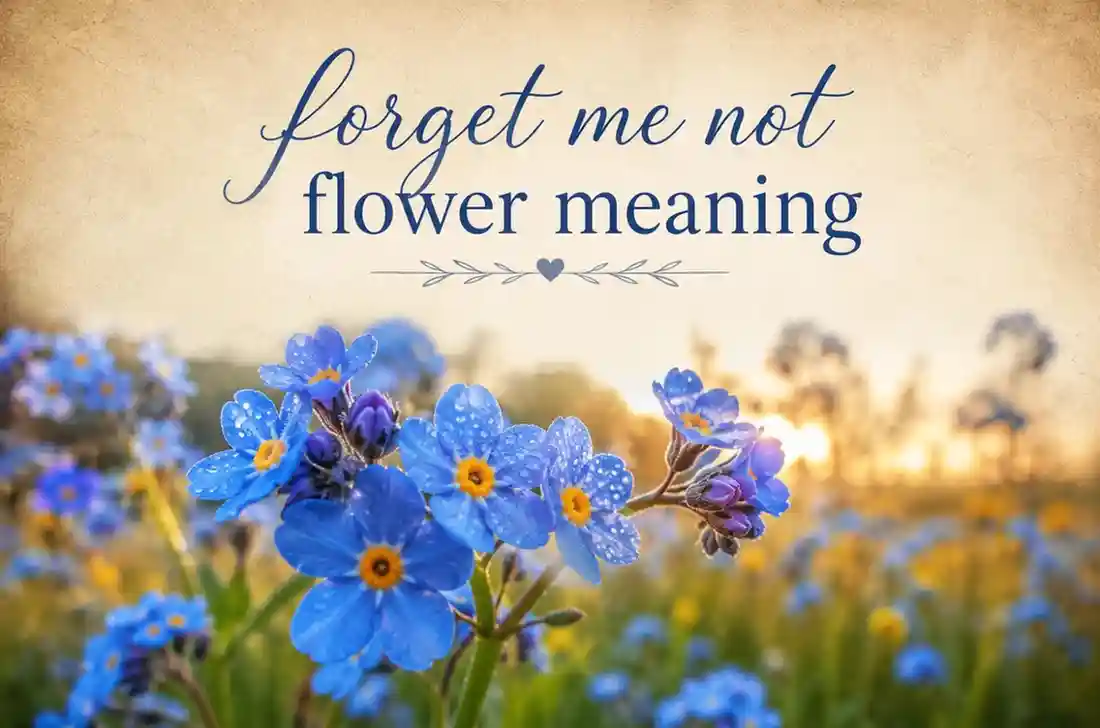
While classic sky blue dominates, Myosotis species also bloom in pink and white. Each shade sharpens a different edge of the forget me not flower meaning.
- Blue forget-me-nots – The most recognized tone symbolizes traditional romantic fidelity, spiritual devotion, and memory.
- Pink forget-me-nots – A gentler note of affectionate remembrance, often tied to maternal love, childhood innocence, and tender friendship.
- White forget-me-nots – Purity, new beginnings after loss, and the clarity that comes with heartfelt mourning.
Choosing a specific color lets you refine the silent message. A mixed bouquet says, “Every shade of my memory holds you.”
The Role of Forget-Me-Nots in Remembrance and Alzheimer’s Awareness
Few causes have embraced the forget me not flower meaning as wholeheartedly as the Alzheimer’s movement. The Alzheimer’s Society in the UK and Alzheimer’s Disease International adopted the forget-me-not as their emblem. The flower represents the memory loss that defines the disease, but also the enduring dignity and identity of each person affected.
Wearing a forget-me-not pin on World Alzheimer’s Day signals solidarity. Fundraising walks often distribute seeds and plants, turning gardens into living memorials and awareness tools. This modern layer of symbolism proves that the forget me not flower meaning adapts without weakening. The Alzheimer’s Association provides free resources on how to use the flower in community events. (Visit alz.org for official campaign details.)
Forget-Me-Not Flower Tattoo Meaning and Popular Designs
Tattoo artists frequently ink this bloom for clients who have lost a loved one or want a permanent vow of remembrance. The forget me not flower meaning in body art often pairs with names, dates, or simple words like “always.” Watercolor-style blue petals with a soft yellow center replicate the live flower’s delicate look.
Little drawings on the wrist or ankle convey personal sorrow. Ribcage placements near the heart emphasize undying love. Combined with anchors, the tattoo means steady memory; with doves, it signals peaceful remembrance. The flower’s miniature scale works perfectly for fine-line, minimalist approaches that hold enormous emotional weight.
When to Gift Forget-Me-Nots and the Message You Send
Giving living forget-me-not plants or a bouquet of cut stems instantly transmits the flower’s layered meaning. Ideal moments include:
- A long-distance partner’s farewell — “Distance changes nothing.”
- The anniversary of a loss — “You are still here with me.”
- A friend moving away — “Our bond is stronger than miles.”
- Mother’s Day, when pink varieties echo maternal love.
- A dementia caregiver’s milestone — “I see what you carry.”
Pair the gift with a handwritten card that briefly explains the legend. The act of naming the forget me not flower meaning aloud makes the gesture unforgettable.
Forget-Me-Nots in Literature, Art, and Poetry
Henry David Thoreau called the forget-me-not “the little blue eye that remembers.” The Pre-Raphaelite painters, especially John Everett Millais, used the flower as a detailed foreground motif symbolizing lost love and lingering memory. In contemporary fiction, Alice Munro’s short stories repeatedly thread forget-me-nots through narratives of aging and recollection.
In music, the German lieder tradition set the knight’s legend to melody, while modern folk songs use the flower as a refrain for heartbreak. Each artistic reference strengthens the public’s understanding of the forget me not flower meaning without diluting its intimacy.
How to Grow Your Own Meaningful Forget-Me-Not Garden
Cultivating Myosotis transforms symbolism into a daily living ritual. These low-growing annuals and perennials thrive in moist, partially shaded soil. Directly sow seeds in the fall or early spring. Once established, they self-seed freely, returning year after year—an echo of the flower’s message that memory persists.
Plant them along woodland paths, near benches dedicated to loved ones, or in containers on a porch where you sip morning coffee. The Royal Horticultural Society notes that the species Myosotis sylvatica performs best in consistently damp, well-drained soil. Every bloom becomes a small act of tending to your own emotional landscape.
Interesting Facts That Deepen Your Appreciation
- The genus name Myosotis comes from the Greek for “mouse’s ear,” inspired by the soft, rounded leaf shape.
- Forget-me-nots are Alaska’s state flower, adopted in 1917 as a symbol of perseverance.
- The flower produces nectar deep in its tube, making it a favorite for long-tongued bees and butterflies.
- In 1921, the Grand Lodge of Freemasons adopted the forget-me-not as a secret symbol during Nazi persecution in Germany.
- Henry IV of England chose the forget-me-not as his personal emblem during his exile, tying the flower directly to royal loyalty.
Common Questions Regarding the Meaning of Forget Me Not Flower
1. What does a forget-me-not flower symbolize?
It symbolizes true love, faithful memory, and the promise never to forget someone. The flower’s name, born from a medieval legend, commands remembrance across romantic, spiritual, and memorial contexts.
2. What is the spiritual meaning of forget-me-nots?
Spiritually, the forget-me-not represents the soul’s eternal connection and divine constancy. In Christian tradition, it often references the watchful eyes of the Virgin Mary, offering comfort that we are never truly alone.
3. Are forget-me-nots a symbol of death?
They do not symbolize death itself but enduring memory after loss. The forget me not flower meaning leans toward continued love and presence, making the flower a gentle companion in grief rather than a marker of finality.
4. What does a forget-me-not tattoo mean?
A forget-me-not tattoo typically memorializes a loved one, a past relationship, or a personal vow to hold onto a defining memory. It whispers permanence: “You are part of my skin, never gone.”
5. For which month is the forget-me-not flower appropriate?
There is no single birth month officially assigned to it, but many associate forget-me-nots with September, linking them to the morning glory birth flower and the astrological themes of memory and reflection in Virgo season.
6. Can you grow forget-me-nots indoors?
Yes, you can grow them indoors in containers with bright, indirect light and consistently moist soil. Start seeds in a cool room to mimic outdoor spring conditions, and expect blooms within 10–12 weeks.
Forget-me-nots refuse to let quiet love evaporate. They root themselves in legend, art, science, and the deepest human need to be remembered. You now hold the complete forget me not flower meaning—from its medieval cry to its Alzheimer’s pin. Pin this on your memory board, share it with someone who needs a reminder that they matter, or plant a few seeds and watch the message bloom. If a single flower can shout “I will never forget you” for centuries, imagine what happens when you pass that message on.