Nefarious Meaning: What This Dark Word Really Means and How to Use It
You hear the word “nefarious” in crime documentaries, courtroom dramas, and news headlines. But what does it actually mean? Many people misuse it or confuse it with similar-sounding words. This creates embarrassing mistakes in writing and conversation. This complete guide breaks down the nefarious meaning with clear definitions, real examples, etymology, synonyms, antonyms, and practical usage tips so you never second-guess this word again.
Complete Quick-Reference Table: Nefarious at a Glance
| Category | Details |
| Word | Nefarious |
| Part of Speech | Adjective |
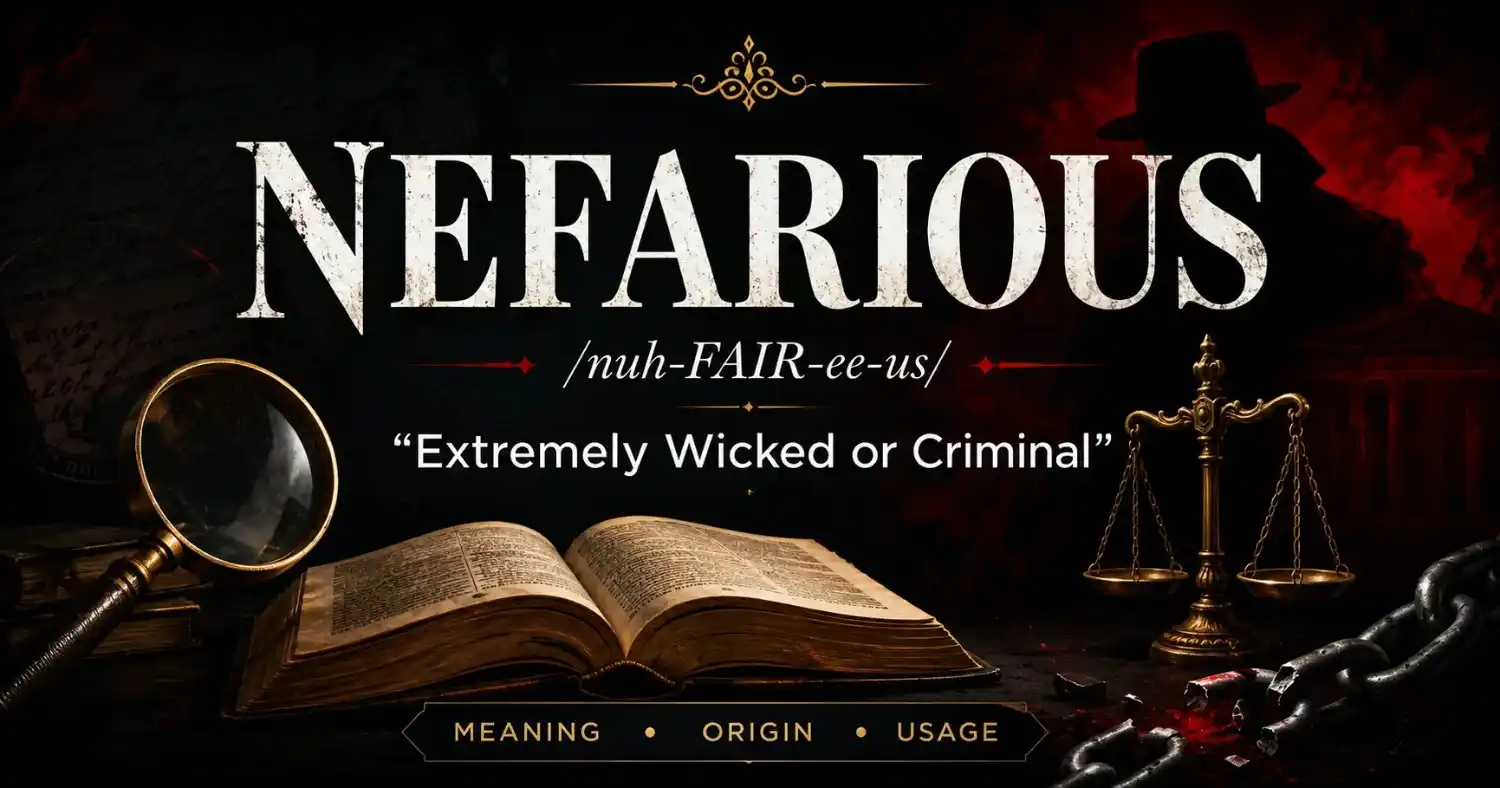
| Pronunciation | nuh-FAIR-ee-us |
| Syllables | 4 (ne·far·i·ous) |
| Core Meaning | Wicked, criminal, or extremely immoral |
| Etymology | Latin nefarius (from nefas = wrong, sin) |
| First Known Use | Early 1600s |
| Formality Level | Formal / Literary |
| Connotation | Strongly negative |
| Common Contexts | Law, journalism, literature, politics |
| Synonyms | Villainous, wicked, heinous, evil, sinister |
| Antonyms | Virtuous, noble, righteous, honorable, good |
| Example Sentence | The detective uncovered a nefarious plot to defraud thousands of elderly citizens. |
| Related Forms | Nefariously (adverb), Nefariousness (noun) |
| Frequency | Moderately used in formal English |
| Commonly Confused With | Nefarious vs. notorious (different meanings entirely) |
What Does Nefarious Actually Mean?
The nefarious meaning is straightforward once you strip away the complexity. Nefarious is an adjective that describes something deeply wicked, criminal, or morally wrong.
This word carries serious weight. You wouldn’t call someone nefarious for cutting in line at a coffee shop. You’d use it for deliberate, calculated evil — fraud schemes, criminal conspiracies, acts of cruelty, or corruption.
Here’s the distinction that matters: nefarious implies intentional wrongdoing. The person or act described isn’t accidentally harmful. There’s a conscious choice to do something sinful, illegal, or deeply unethical.
Key characteristics of something nefarious:
- Deliberately harmful or criminal
- Morally reprehensible by any standard
- Often involves deception or hidden motives
- Typically describes actions, plans, schemes, or the people behind them
The Etymology and Origin of Nefarious
Words carry their history inside them. Understanding where “nefarious” comes from deepens your grasp of its meaning and helps you remember it permanently.
Nefarious entered English in the early 1600s. It traveled directly from the Latin word nefarius, which meant “wicked” or “abominable.”
The Latin root breaks down further:
- Nefas = a wrong, a sin, an impious act
- Ne- = not
- Fas = divine law, what is right or permitted
So at its absolute root, the nefarious meaning translates to something “against divine law” — an act so wrong it violates the most sacred moral codes.
The Romans didn’t throw this word around casually. In ancient Rome, nefas described acts that offended the gods themselves. Sacrilege, betrayal of one’s country, and violations of sacred oaths all fell under this umbrella.
When English writers adopted the word in the 1600s, they preserved that heaviness. According to the Oxford English Dictionary, early uses appeared in religious texts and legal writings where authors needed a word stronger than “bad” or “wrong.”
Nefarious vs. Similar Words: Key Differences
People regularly confuse “nefarious” with other dark-sounding words. This table clears up every common mix-up.
| Word | Meaning | Key Difference from Nefarious |
| Nefarious | Wicked, criminal, deeply immoral | Implies intentional, calculated evil |
| Notorious | Widely known for something bad | About fame/recognition, not morality itself |
| Infamous | Famous for negative reasons | Focuses on reputation, not the act’s nature |
| Heinous | Hatefully or shockingly evil | Emphasizes the shock factor and horror |
| Villainous | Characteristic of a villain | Often used in storytelling contexts |
| Sinister | Suggesting evil or danger | Implies something threatening but hidden |
| Malicious | Intending to do harm | Focuses on harmful intent specifically |
| Devious | Showing cleverness in dishonesty | About cunning methods, not moral weight |
| Malevolent | Having evil intentions toward others | Emphasizes ill will toward specific people |
Nefarious vs. Notorious: The Most Common Confusion
This mix-up happens constantly. Someone says “he’s a nefarious criminal” when they mean “notorious,” or vice versa.
Notorious means widely known — especially for something negative. A notorious criminal is a famous criminal. The word says nothing about the severity of their crimes.
Nefarious describes the quality of the evil itself. A nefarious criminal commits especially wicked, calculated crimes.
A person can be both: “The notorious drug lord ran a nefarious operation spanning three continents.”
How to Use Nefarious Correctly in Sentences
Knowing the nefarious meaning matters little if you can’t deploy the word naturally. Here are authentic examples across different contexts.
In Law and Crime
- Federal investigators dismantled a nefarious human trafficking ring operating across state lines.
- The prosecutor described the defendant’s actions as nefarious and premeditated.
- Identity theft remains one of the most nefarious crimes of the digital age.
In Politics and Journalism
- Whistleblowers exposed the nefarious lobbying practices that influenced the legislation.
- The leaked documents revealed nefarious dealings between the corporation and government officials.
- Voters grew suspicious of the candidate’s nefarious campaign funding sources.
In Literature and Entertainment
- The novel’s antagonist hatched a nefarious plan to seize control of the kingdom.
- Comic book villains often pursue nefarious goals like world domination.
- The film explored the nefarious underworld of organized crime in 1920s Chicago.
In Everyday Formal Writing
- The company’s nefarious data collection practices violated user privacy agreements.
- Social media platforms have struggled to combat nefarious actors spreading disinformation.
- Parents should educate children about nefarious online scams targeting young users.
Usage tip: Nefarious works best in formal writing, journalism, legal contexts, and literary description. In casual conversation, words like “shady,” “crooked,” or simply “evil” often sound more natural.
Word Forms: Nefariously and Nefariousness
Like most adjectives, “nefarious” has related forms you should know.
Nefariously (Adverb)
Describes how something is done in a wicked or criminal manner.
Examples:
- The funds were nefariously diverted from the charity into private accounts.
- She nefariously manipulated the evidence to frame an innocent person.
Nefariousness (Noun)
Refers to the quality or state of being wicked or criminal.
Examples:
- The sheer nefariousness of the scheme shocked even seasoned investigators.
- History books document the nefariousness of colonial exploitation.
| Form | Part of Speech | Example |
| Nefarious | Adjective | A nefarious conspiracy |
| Nefariously | Adverb | Nefariously acquired wealth |
| Nefariousness | Noun | The nefariousness of the act |
Synonyms for Nefarious: Complete List with Nuances
Expanding your vocabulary around the nefarious meaning strengthens both your writing and comprehension. Each synonym carries slightly different weight and fits different situations.
Direct Synonyms (closest in meaning):
- Wicked
- Villainous
- Heinous
- Iniquitous
- Flagitious
- Vile
- Abominable
- Atrocious
- Despicable
- Reprehensible
Related but Softer Alternatives:
- Corrupt
- Dishonest
- Unscrupulous
- Immoral
- Unethical
- Crooked
- Underhanded
Stronger / More Extreme Options:
- Diabolical
- Fiendish
- Monstrous
- Depraved
- Execrable
When choosing a synonym, consider your audience. “Nefarious” suits formal reports, academic papers, and literary writing. “Crooked” or “shady” works better for casual audiences.
Antonyms for Nefarious
Understanding what nefarious is not sharpens your understanding of what it is.
| Antonym | Meaning |
| Virtuous | Having high moral standards |
| Noble | Showing fine personal qualities |
| Righteous | Morally right and justifiable |
| Honorable | Bringing credit and distinction |
| Admirable | Worthy of respect and approval |
| Benevolent | Well-meaning and generous |
| Upright | Honest and respectable |
| Ethical | Morally correct |
| Principled | Acting according to strong moral rules |
| Good | Possessing positive moral qualities |
Nefarious in Pop Culture and Real-World Events
This word appears frequently in both entertainment and real news coverage. Recognizing these instances cements your understanding of the nefarious meaning.
Movies and Television
- The James Bond franchise features nefarious villains in nearly every installment — characters with elaborate schemes for global destruction.
- Crime dramas like Breaking Bad and Ozark center on characters drawn into nefarious activities.
- Disney villains like Jafar, Scar, and Maleficent represent nefarious archetypes in animated storytelling.
Historical Events
- Historians describe the Enron scandal (2001) as one of the most nefarious corporate frauds in American history. Executives hid billions in debt through deceptive accounting practices, according to the U.S. Securities and Exchange Commission (SEC.gov).
- The Watergate scandal involved nefarious political espionage that ultimately toppled a presidency.
- Bernie Madoff’s Ponzi scheme, uncovered in 2008, stands as one of the most nefarious financial crimes ever committed, defrauding investors of approximately $65 billion per FBI records (FBI.gov).
News and Current Events
- Cybersecurity experts at the Cybersecurity and Infrastructure Security Agency (CISA.gov) regularly warn about nefarious state-sponsored hacking operations targeting critical infrastructure.
- The Federal Trade Commission (FTC.gov) documents nefarious scam operations targeting consumers.
- International organizations including INTERPOL (interpol.int) coordinate efforts against nefarious criminal networks operating globally.
Why Understanding Vocabulary Like Nefarious Matters
Strong vocabulary isn’t about impressing people at dinner parties. It carries practical, measurable benefits.
For Students and Test-Takers:
- “Nefarious” appears on the SAT, GRE, and other standardized tests
- Understanding it signals advanced reading comprehension
- It helps decode unfamiliar texts in academic settings
For Writers and Professionals:
- Precise word choice builds credibility
- The right word eliminates lengthy explanations
- Saying “nefarious scheme” communicates more than “really bad plan”
For Critical Thinking:
- Recognizing the word in news coverage helps you identify editorial tone
- Understanding its weight helps you evaluate whether it’s being used fairly or for sensationalism
- It sharpens your ability to read between the lines
Memory Tricks: How to Remember the Nefarious Meaning
Vocabulary sticks when you anchor it to something memorable. Here are proven techniques for locking in the nefarious meaning permanently.
Mnemonic #1: “Ne-FEAR-ious”
Hear the word “fear” hiding inside nefarious? Nefarious acts are things that should inspire fear — they’re dangerously wicked.
Mnemonic #2: The Latin Root
Remember: nefas = “not right.” Something nefarious stands against everything right, moral, and lawful.
Mnemonic #3: Association
Picture the most famous fictional villain you know. Now mentally tag them as “nefarious.” Every time you recall that character, the word comes with them.
Mnemonic #4: Use It Three Times
Cognitive science research shows that using a new word three times in meaningful context transfers it to long-term memory. Write three sentences today using “nefarious” in situations relevant to your life or interests.
Common Mistakes People Make with Nefarious
Even confident English speakers stumble with this word. Avoid these pitfalls.
Mistake #1: Overusing It for Minor Offenses
Calling a parking ticket “nefarious” sounds ridiculous. Reserve the word for genuinely wicked, criminal, or deeply immoral situations.
Mistake #2: Confusing It with Notorious
As covered earlier, notorious describes fame, not morality. These words are not interchangeable.
Mistake #3: Wrong Pronunciation
It’s nuh-FAIR-ee-us, not “neh-FAR-ee-us.” The stress falls on the second syllable.
Mistake #4: Using It as a Noun
Nefarious is an adjective. You can’t say “he committed a nefarious.” You need a noun: “he committed a nefarious act” or “his nefariousness was evident.”
Mistake #5: Applying It to Accidents
The nefarious meaning inherently includes intent. An accidental oil spill isn’t nefarious. A company deliberately dumping chemicals while hiding evidence? That’s nefarious.
Nefarious in Different Languages
The concept of extreme wickedness exists across every culture. Here’s how other languages express what “nefarious” communicates in English.
| Language | Translation | Pronunciation (Approximate) |
| Spanish | Nefario / Infame | neh-FAH-ree-oh |
| French | Infâme / Scélérat | an-FAHM / say-lay-RAH |
| German | Ruchlos / Schändlich | ROOKH-lohs |
| Italian | Nefando / Scellerato | neh-FAHN-doh |
| Portuguese | Nefário | neh-FAH-ree-oh |
| Hindi | दुष्ट (dusht) | DOOSHT |
| Arabic | شنيع (shani’) | sha-NEE |
| Japanese | 極悪な (gokuaku na) | go-ku-AH-ku nah |
| Mandarin | 邪恶的 (xié’è de) | syeh-UH duh |
Notice how Spanish, Italian, and Portuguese have cognates (nefario/nefário/nefando) from the shared Latin root. This linguistic connection reinforces the word’s deep historical pedigree.
Frequently Asked Questions About Nefarious
What does nefarious mean in simple words?
Nefarious means extremely wicked, evil, or criminal. It describes deliberate wrongdoing — actions or people that are intentionally harmful, immoral, or against the law. Think of the worst villain in a movie hatching an evil plan. That villain and that plan are both nefarious.
How do you pronounce nefarious correctly?
Pronounce it nuh-FAIR-ee-us. The word has four syllables: ne·far·i·ous. The emphasis lands on the second syllable, “FAIR.” A common mistake is stressing the first syllable or saying “neh-FAR-ee-us.” Listening to dictionary audio pronunciations on Merriam-Webster.com can help lock in the correct sound.
What is the difference between nefarious and notorious?
Nefarious describes moral character (extremely wicked), while notorious describes fame (widely known for something bad). A notorious criminal is famous. A nefarious criminal commits deeply evil acts. A criminal can be both notorious and nefarious, but the words address completely different qualities. You can be notorious for something relatively minor, but nefarious always implies serious wrongdoing.
Can you use nefarious to describe a person?
It is possible to characterize someone as sinister. The word works as an adjective modifying both people and their actions. “A nefarious dictator” and “a nefarious plan” are both correct. When applied to a person, it means that individual has a deeply wicked, criminal, or immoral character driven by deliberate harmful intent.
Is nefarious a formal or informal word?
Nefarious is a formal word. It appears most naturally in academic writing, journalism, legal documents, literary fiction, and professional reports. Using it in casual conversation can sound overly dramatic unless you’re being intentionally emphatic. For everyday speech, words like “evil,” “crooked,” or “shady” often communicate similar ideas with a lighter tone.
What are the best synonyms for nefarious?
The strongest synonyms include wicked, villainous, heinous, iniquitous, and vile. Each carries slightly different shade:
- Wicked — general-purpose evil
- Villainous — story/character-focused evil
- Heinous — shockingly awful evil
- Iniquitous — injustice-focused evil
- Vile — disgustingly repulsive evil
Choose based on your context and audience. “Heinous” emphasizes horror. “Villainous” fits narrative writing. “Nefarious” highlights calculated, intentional wrongdoing.
Take Your Vocabulary Further
Understanding the nefarious meaning gives you more than a single word. It hands you a window into Latin roots, moral philosophy, legal language, and the nuances that separate good writing from great writing.
Here’s your action plan:
- Use “nefarious” in three sentences today — in an email, a journal entry, or a social media post
- Quiz yourself on the difference between nefarious, notorious, and infamous
- Explore the Latin root nefas to discover related English words
- Bookmark this guide as a reference whenever you need to verify usage, find a synonym, or check pronunciation
Words shape how others perceive your intelligence, clarity, and authority. Master words like nefarious, and you master the ability to communicate with precision and power.
Written by a vocabulary and linguistics content specialist with expertise in English etymology, SAT/GRE preparation, and SEO content strategy. Sources include Merriam-Webster Dictionary, Oxford English Dictionary, SEC.gov, FBI.gov, and CISA.gov.
For Content And Post Publishing, Contact Us