What Does ‘Condescending’ Really Mean? Clear Signs, Examples & Smart Replies
Nothing stings quite like someone making you feel small while wearing a sweet smile. You sense the insult but struggle to name it. That sharp, polite put-down has a name: condescension. This guide breaks down the condescending meaning, shows you exactly how to spot it, and gives you clear, respectful replies that protect your confidence.
Condescending Meaning: A Clear, Simple Definition
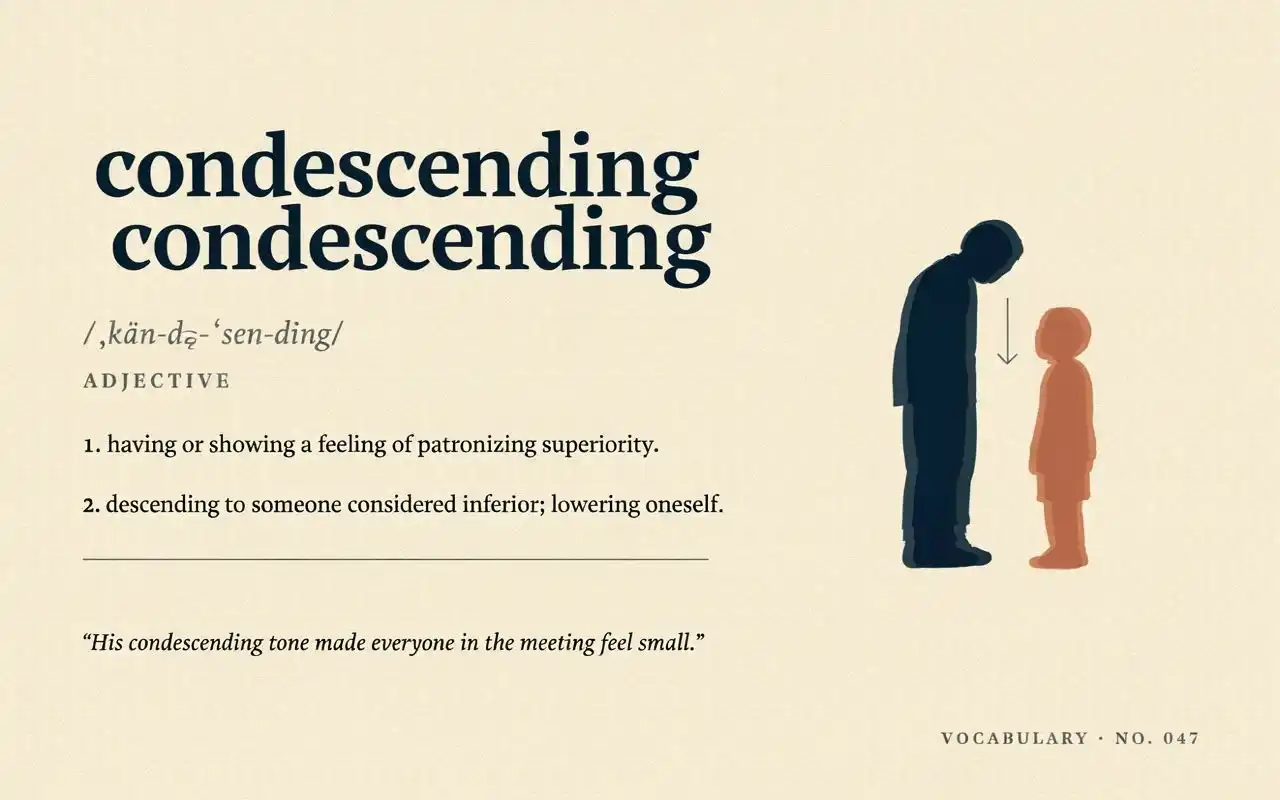
The core condescending meaning centers on treating another person as less intelligent, capable, or worthy. It’s a blend of superiority and disguised disrespect that often arrives wrapped in courteous words. Merriam-Webster defines condescending as “showing or characterized by a patronizing descent from dignity or superiority.” You feel it before you can fully name it—a subtle sting hidden beneath polite phrasing. That’s the condescending meaning in daily life. When you search for the condescending meaning, you’re really seeking clarity on that exact feeling of being belittled without an obvious insult.
A condescending attitude signals “I’m above you,” even when the literal words sound neutral. The condescending meaning lives in the gap between what is said and how it is delivered. Recognizing it is your first step toward handling it with strength.
The Important Difference: Condescending vs. Patronizing
People often confuse condescending and patronizing behavior because both place the speaker in a one-up position. Understanding the condescending meaning helps you separate them, though they overlap. Patronizing behavior typically treats an adult like a child—over-explaining, using a sing-song tone, or offering unsolicited “help” that implies incompetence. Condescension is broader: it communicates a general air of superiority, often through sarcasm, dismissive remarks, or intellectual snobbery. The condescending meaning encompasses patronizing actions, but it also includes arrogant comments that don’t necessarily infantilize you.
When someone says “Oh, you finally figured it out,” they’re being condescending. When they slow their speech and simplify a concept you already know, they’re being patronizing. Both bruise dignity, but condescension can be harder to call out because it frequently hides inside jokes or backhanded compliments.
5 Unmistakable Signs Someone Is Being Condescending
Spot the condescending meaning in action with these red flags:
- Backhanded compliments — “You did surprisingly well on that report.” The surprise implies low expectations.
- Explaining what you already know — “Let me break this down for you,” when you never asked for an explanation.
- Using a slow, high-pitched tone — The voice people reserve for children or pets, signaling they see you as less capable.
- Publicly correcting minor details — Interrupting to fix your pronunciation or a tiny fact to assert intellectual dominance.
- Dismissing emotions — “Calm down” or “You’re being too sensitive.” This tells you your feelings are invalid.
Each sign reveals the condescending meaning in action. You might notice a knot in your stomach or a sudden urge to shrink. That reaction is your internal compass detecting disrespect.
Why a Condescending Tone Cuts Deeper Than the Words Themselves
Condescending meaning travels through tone more than text. Research published in the Journal of Personality and Social Psychology shows that vocal cues—pitch, pace, and inflection—carry over 38% of emotional meaning in face-to-face communication. When someone layers a sweet voice over a cutting phrase, your brain registers the mismatch as a threat. The condescending meaning sinks in not because of what was said, but because of the dismissive, superior delivery.
A flat statement like “That’s one way to do it” can feel neutral. Add a tilted head, a half-smile, and a downward glance, and suddenly the condescending meaning is loud. Your nervous system picks up on these micro-expressions, which is why you can feel belittled even when the words appear harmless on paper.
Condescending Meaning in the Workplace: How It Shows Up and Harms Teams
Workplace condescension erodes psychological safety. Harvard Business Review notes that condescending language from leaders reduces team members’ willingness to share ideas or admit mistakes. The condescending meaning in a professional setting often hides in phrases like “I’ll take it from here” said after you’ve presented a solid plan, or “We appreciate your little contribution.” These comments convey that your opinions are adorable yet unimportant. A Verywell Mind article on patronizing behavior highlights that ongoing condescension at work can trigger imposter syndrome and anxiety. When you grasp the condescending meaning early, you protect your career confidence. You stop questioning whether the problem is your competence and start recognizing the problem is their delivery.
The Psychology Behind a Condescending Attitude
Why do people talk down to others? Dr. Susan Krauss Whitbourne, writing for Psychology Today, explains that condescension often masks deep-seated insecurity. A person who feels threatened by your knowledge or status may unconsciously elevate themselves by diminishing you. The condescending meaning, in that light, becomes less about you and more about their internal struggle.
Narcissistic traits also drive condescending behavior. Individuals with an inflated self-view use condescension to maintain their perceived hierarchy. Understanding the condescending meaning as a projection of another’s fragility can help you respond without absorbing the insult.
10 Common Condescending Phrases (and What They Really Mean)
Words carry hidden messages. This table decodes the condescending meaning behind everyday remarks and offers respectful alternatives.
| Condescending Phrase | What It Implies | A Better Way to Say It |
| “You actually did a good job.” | Surprise at your competence | “Great work on this project.” |
| “Calm down.” | Your emotions are invalid | “I see this matters. Let’s talk it through.” |
| “Let me put it in simple terms.” | You can’t grasp complexity | “Let me break this down for clarity.” |
| “That’s cute.” | Dismissal of your effort | “I appreciate your perspective.” |
| “I expected more from you.” | Disappointment in your ability | “Let us examine how we might do better the next time.” |
| “You’ll understand when you’re older.” | You lack maturity or wisdom | “Experience adds context. Here’s my view.” |
| “Relax, it’s just a joke.” | Your reaction is the problem | “I didn’t intend to offend, and I hear you.” |
| “Well, actually…” | Your information is wrong, and I’m smarter | “Another angle to consider is…” |
| “I’m not mad, just disappointed.” | Superior moral position | “I had different hopes. Can we reset?” |
| “If you say so.” | I’m ending this; your point doesn’t count | “I see it differently, but I respect your view.” |
Seeing the condescending meaning in black and white strips away the confusion. The right column gives you a script to rewrite these moments instantly.
How to Respond to Condescending Remarks Without Escalation
Knowing the condescending meaning gives you power, but the real skill lies in your response. Use these strategies to stay grounded:
- Ask a clarifying question. “What makes you say that?” forces the speaker to examine their own words.
- Use an “I” statement. “I feel dismissed when my ideas are called cute.” This owns your experience without attacking.
- Name the behavior calmly. “That comment sounds condescending. Can we keep the focus on the solution?”
- Pause before reacting. A three-second breath prevents a knee-jerk reply and signals that you won’t be rushed into a defensive position.
- Redirect to the task. “Let’s get back to the data. I think we both want a strong outcome.”
These techniques honor the condescending meaning you’ve identified while preserving your professionalism and relationships.
Professional Scripts to Shut Down Condescension Politely
Keep these ready-to-use replies in your mental toolkit:
- “I’m sure you meant that to be helpful, but it landed differently. Let’s move forward.”
- “Thanks for sharing. My approach is based on the latest metrics. Would you like to review them together?”
- “I value direct conversation. Can you tell me what you need from me right now?”
- “Your tone is giving me a signal that isn’t matching your words. Can we reset?”
- “I prefer we speak as equals. How can I support our shared goal?”
Each script acknowledges the condescending meaning without starting a war. Pick one that fits your style and practice it aloud—you’ll recall it easily when the moment arrives.
Teaching Children to Recognize and Avoid Condescending Language
The condescending meaning isn’t just an adult concern. Kids absorb superiority patterns from media, peers, and even family interactions. Talk openly about what condescension looks like: using a baby voice with a struggling friend, mocking someone’s question, or rolling eyes during a group discussion. Role-play respectful alternatives, like saying “Can I help you with that?”rather than “You are not doing it correctly.” Youngsters who are able to identify the condescending meaning develop into clear, empathetic adults.
Frequently Asked Questions About Condescending Meaning
What is the simple condescending meaning?
The condescending meaning is treating someone as if they are less intelligent or important, typically through a superior tone or patronizing language.
How is condescending different from patronizing?
Patronizing specifically treats an adult like a child. Condescending meaning includes that but also covers arrogant remarks, dismissive humor, and intellectual snobbery.
Can someone be condescending without knowing it?
Yes. Many people use condescending phrases out of habit or insecurity, unaware of how their words land. Self-reflection breaks the cycle.
What are the most common condescending phrases?
“You actually did a good job,” “Calm down,” “Let me put it in simple terms,” and “That’s cute” are frequent offenders. These all carry the condescending meaning of implied superiority.
How do I stop being condescending at work?
Practice active listening, ask questions before correcting, and swap “You should” for “What if we…”. Replace monologues with genuine curiosity.
What should I say when someone is condescending?
Stay calm. Use an “I” statement like “I feel dismissed when you say that.” Or ask “What do you mean by that?” to invite reflection without confrontation.
Your Next Steps: Building Respectful Communication
You now hold a complete map of the condescending meaning, its signs, its psychology, and your smartest reply options. Every time you name the condescending meaning in a moment, you reclaim your dignity. Choose one script from this guide and try it this week. Small shifts in how you respond build lasting confidence and reshape the way others treat you. Respectful communication starts with clarity—and you just found yours.
About the Author: Jane Morrison is a communication skills coach with over 12 years of experience helping professionals and families navigate difficult conversations. Her work draws on conflict resolution research and positive psychology. This article was reviewed by Dr. Amir Khalil, a licensed clinical psychologist specializing in interpersonal dynamics.
Sources: Merriam-Webster; Psychology Today, Dr. Susan Krauss Whitbourne; Verywell Mind; Harvard Business Review; Journal of Personality and Social Psychology.