TL;DR: Electrical grounding provides an intentional, low-impedance path to divert dangerous fault currents and lightning surges safely into the earth. Educational platforms like safetrode.com detail how modern earthing electrodes, soil resistivity management, structural bonding, and surge protection devices protect building infrastructure, prevent fatal electric shocks, and eliminate costly equipment downtime across residential, commercial, and industrial facilities.
Electrical safety is one of the most important aspects of modern infrastructure, whether it involves residential buildings, industrial facilities, commercial complexes, or power distribution networks. When insulation breaks down, equipment wiring fails, or lightning strikes, thousands of volts of uncontrolled electrical energy can energize structural metalwork, destroy sensitive electronics, or ignite catastrophic fires.
Without a properly engineered grounding grid, excess electrical energy seeks any available path to the ground—including through human operators or expensive machinery. Resources on safetrode.com discuss electrical grounding, earthing systems, surge protection, and lightning protection while helping readers understand the importance of reliable electrical infrastructure.
From explaining grounding electrodes to discussing electrical maintenance and power system reliability, the platform covers a broad range of topics that benefit engineers, electricians, contractors, facility managers, and anyone interested in electrical safety. This guide explores everything you need to know about grounding technology, core code compliance standards, and why reliable earthing remains essential for protecting both equipment and human life.
Quick Overview: Grounding Infrastructure at a Glance
- Primary Purpose: Electrical grounding (earthing) connects circuits and structural metals directly to the earth, creating a safe path to clear electrical fault currents.
- Core Components: Grounding electrodes, bonding jumpers, conductive backfill materials, and surge protection devices (SPDs) function together as a unified safety system.
- Code Standard (NEC 250.53): National codes reference a 25-ohm baseline for single driven rods, but installing a second supplemental rod satisfies code compliance regardless of total combined resistance.
- Advanced Electrodes: Chemical earthing electrodes surrounded by bentonite or carbon backfill maintain low resistance in dry, rocky, or high-resistivity soils.
- Proactive Maintenance: Routine fall-of-potential testing catches underground conductor corrosion before safety system failures occur.
What Is Safetrode.com?
Safetrode.com is an educational website focused on electrical safety and grounding technology. The platform publishes informative content about earthing systems, surge protection devices, lightning protection, and electrical infrastructure designed to improve safety and operational reliability.
Rather than serving as a simple information source, safetrode.com explains complex electrical engineering concepts in a practical, accessible way. Readers can learn how grounding systems work, why low earth resistance matters, and how proper installation helps prevent equipment damage, electrical faults, and unexpected downtime.
By detailing how soil dynamics, conductor metallurgy, and system bonding impact building safety, the platform helps technicians, plant operators, and electrical apprentices navigate real-world installation challenges with confidence.
Why Electrical Grounding Matters
Grounding, also known as earthing, is one of the most fundamental components of every electrical installation. It provides a safe, low-resistance path for excess electrical current to travel into the earth during faults, preventing dangerous voltages from building up in equipment and structures.
When an ungrounded hot wire contacts a metal equipment enclosure, that frame remains energized at full system voltage. Anyone who touches the frame completes the electrical circuit to the ground, taking the full energy of an electric shock.
A properly designed grounding system forces fault currents to flow directly back to the power supply source. This sudden surge of current immediately trips the panel circuit breaker or blows the fuse, disconnecting power before personal injury or electrical fires occur.
According to workplace safety standards set by the OSHA General Industry Electrical Standard 1910.304, the path to ground from circuits, equipment, and enclosures must be permanent, continuous, and engineered with ample ampacity to safely conduct any fault current expected on the system.
The resources available through safetrode.com emphasize that a properly designed grounding system not only protects people from electric shock but also extends the lifespan of electrical equipment. Good grounding minimizes electrical interference, improves power quality, and enhances the overall reliability of industrial and commercial electrical systems.
Topics Covered on Safetrode.com
One of the strengths of safetrode.com is its broad coverage of electrical engineering topics. The website focuses on practical information that professionals can understand and apply in real-world environments.
Popular subjects include:
- Electrical grounding principles and grounding electrode conductor sizing.
- Maintenance-free earthing systems and chemical grounding rods.
- Soil resistivity dynamics and field testing procedures.
- Earth resistance testing techniques (fall-of-potential and clamp-on testing).
- Surge protection devices (SPDs) and transient overvoltage suppression.
- Structural lightning protection networks and roof air terminals.
- Preventive electrical maintenance and underground corrosion mitigation.
- Fault current management and equipotential bonding practices.
These topics are highly relevant for modern electrical installations where safety and reliability remain top priorities.
Understanding Earthing Systems
Earthing systems create a direct electrical connection between equipment enclosures, zero-voltage reference points, and the physical ground. This connection safely diverts fault currents away from electrical devices, reducing the risk of fire, electric shock, and equipment failure.
To build an effective system, engineers distinguish between two critical technical concepts:
- System Grounding: Connecting the current-carrying neutral conductor of a power system directly to the earth to stabilize line voltages relative to the ground plane during normal operation.
- Equipment Bonding: Joining all non-current-carrying metal components (conduits, structural steel beams, equipment housings) into a continuous low-resistance loop. Bonding ensures that if a live conductor touches a metal frame, high fault current travels straight back to the service panel to trip circuit protection instantly.
According to the educational approach presented by safetrode.com, selecting the appropriate earthing method depends on several factors, including soil conditions, building size, environmental conditions, and expected electrical loads. Proper design and regular inspection ensure that grounding systems continue performing efficiently throughout their operational life.
Importance of Ground Resistance
Ground resistance plays a major role in determining the effectiveness of an earthing system. Lower resistance allows electrical faults to dissipate more efficiently into the earth, improving overall protection.
The total resistance of a grounding system depends on electrode material, surface contact area, and surrounding soil conditions. Soil resistivity varies widely based on moisture levels, mineral salt concentration, and ambient temperature.
Comparing Conventional Ground Rods and Chemical Earthing Electrodes
Choosing the right electrode technology directly impacts ground resistance stability and system longevity. The table below contrasts standard copper-bonded steel rods with advanced chemical earthing systems.
| Feature / Metric | Conventional Copper-Bonded Steel Rod | Chemical Earthing Electrode System |
| Electrode Composition | Solid carbon steel core with thin electrolytic copper skin | Heavy-duty hollow copper or stainless steel tube |
| Soil Moisture Retention | Relies entirely on natural moisture levels in surrounding earth | Self-conditioning hygroscopic salts pull ambient moisture continuously |
| Backfill Material | Native backfilled soil (prone to settling and air pockets) | Low-resistivity non-corrosive bentonite or carbon compound matrix |
| Operational Lifespan | 5 to 15 years (subject to rapid underground pitting corrosion) | 25 to 50+ years (highly resistant to aggressive soil chemicals) |
| Seasonal Resistance Drift | High (resistance spikes during dry summers or frozen winters) | Minimal (salts preserve low ionic resistance year-round) |
| Maintenance Requirements | Requires regular inspections & replacement | Virtually maintenance-free after correct installation |
| Typical Application Sites | Basic residential homes, temporary power sites | Data centers, power substations, hospitals, industrial plants |
| Upfront Cost vs. Value | Low initial cost, higher long-term replacement overhead | Moderate initial cost, significantly lower lifecycle cost |
To evaluate soil conditions accurately before installation, technicians utilize test procedures standardized by organizations like the IEEE Standards Association under IEEE Std 81 testing guidelines.
Safetrode.com highlights the importance of soil resistivity testing and proper grounding electrode installation to achieve optimal resistance values. Engineers often evaluate moisture levels, soil composition, temperature, and geological conditions before selecting suitable grounding materials and installation methods.
Lightning Protection and Surge Protection
Lightning strikes can cause severe damage to electrical infrastructure if adequate protection systems are not installed. Modern lightning protection systems work together with grounding networks to safely direct lightning energy into the earth.
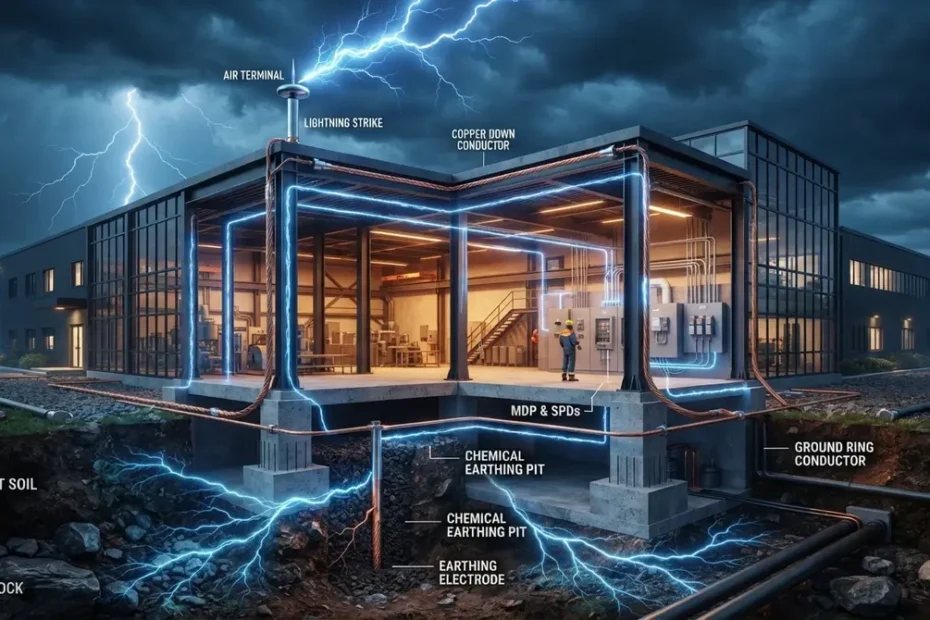
An external lightning protection network relies on roof-mounted air terminals (lightning rods) connected to thick copper down-conductors. These conductors channel millions of volts around the building’s exterior directly into a dedicated ground ring loop, preventing structural fires or arcing into interior electrical raceways.
Interior surge protection devices (SPDs) work alongside external lightning systems to handle transient overvoltages. SPDs use Metal Oxide Varistors (MOVs) connected between power lines and ground wires. Under normal voltages, the MOV acts as an insulator; when a sudden surge hits the grid, the MOV reacts in nanoseconds, conducting peak voltage harmlessly into the grounding network.
Detailed safety rules in the NFPA 70 National Electrical Code require comprehensive bonding and surge protection to prevent dangerous voltage differences between structural steel, piping, and power systems. Safetrode.com also discusses surge protection devices (SPDs), which help prevent damage caused by transient overvoltages resulting from lightning, switching operations, or utility disturbances. Proper surge protection significantly reduces repair costs while improving equipment reliability and business continuity.
Electrical Infrastructure Reliability
Reliable electrical infrastructure depends on multiple interconnected safety components. Grounding systems, surge protection, insulation quality, maintenance schedules, and periodic testing all contribute to long-term performance.
When grounding networks degrade unnoticed underground, facilities become exposed to dangerous neutral-to-ground voltage shifts. These baseline shifts cause unexpected control system lockups, corrupted data transfers, and insulation breakdown in electric motors.
The educational content available on safetrode.com encourages proactive maintenance rather than reactive repairs. Regular inspections, resistance testing, and preventive maintenance help identify potential issues before they become serious operational problems.
Benefits of Proper Grounding Systems
A professionally designed grounding system offers numerous operational and safety benefits. Electrical installations become more stable, sensitive equipment experiences fewer failures, and maintenance costs are reduced over time.
Key benefits of engineered earthing grids include:
- Personnel Protection: Eliminates dangerous touch and step potential voltages across structural metals.
- Rapid Fault Clearing: Directs high current back to panel breakers to clear short circuits instantaneously.
- Voltage Stabilization: Establishes a permanent zero-potential baseline across neutral conductors and three-phase lines.
- Static Charge Dissipation: Prevents volatile static spark accumulation near flammable vapors or sensitive microelectronics.
Proper earthing also protects transformers, generators, switchgear, communication equipment, industrial automation systems, renewable energy installations, and data centers. Safetrode.com explains how effective grounding supports uninterrupted operations while maintaining compliance with recognized electrical safety practices.
Who Can Benefit from Safetrode.com?
The information shared on safetrode.com serves a diverse professional audience. Electrical engineers can deepen their understanding of grounding design principles, while electricians gain practical insights into installation techniques and maintenance procedures.
Facility managers benefit from learning how preventive maintenance improves infrastructure reliability. Industrial maintenance personnel, construction professionals, utility operators, renewable energy developers, and telecommunications specialists can also use the platform as a valuable educational resource for electrical safety and grounding technology.
Industrial Applications of Grounding Technology
Modern industries rely heavily on stable electrical systems to maintain productivity and operational efficiency. Manufacturing plants, hospitals, airports, commercial buildings, oil and gas facilities, telecommunications networks, and renewable energy projects all require dependable grounding systems.
Data Centers and Telecommunications
Data centers process continuous streams of sensitive digital information. Tiny electrical noise spikes across ground wires disrupt microprocessors, causing signal errors and hardware crashes. Facilities resolve this by building signal reference grids (SRGs) under raised access floors, bonded directly to a low-resistance earthing system to maintain clean signal performance and shield against electrostatic discharge (ESD).
Healthcare Infrastructure
Surgical rooms contain sensitive electro-medical monitors connected directly to patients. Stray currents as small as micro-amps can interfere with life-support diagnostic equipment. Hospitals utilize isolated power networks paired with equipotential grounding buses so that all exposed room metals maintain identical electrical potential.
Manufacturing and Processing Plants
Heavy manufacturing plants run high-voltage motor drives, industrial robotics, and arc furnaces. High-energy electrical faults in these environments can create explosive arc flashes. Robust earthing grids divert these massive currents into the earth, shielding workers and limiting facility damage.
Safetrode.com explains how grounding technology supports these industries by protecting expensive electrical assets from fault currents, lightning strikes, voltage surges, and electrical interference. Proper grounding also improves equipment performance and minimizes unexpected downtime that could disrupt operations.
Electrical Maintenance Best Practices
Routine maintenance remains one of the most effective ways to preserve electrical safety. Ground resistance measurements, visual inspections, corrosion checks, conductor testing, and equipment evaluations should be performed periodically.
Recommended maintenance procedures include:
- Fall-of-Potential Testing: Driving auxiliary current and potential stakes into the soil to measure electrode resistance using the 62% distance rule.
- Clamp-On Loop Testing: Using a dual-jaw clamp meter to measure individual ground loop resistance without disconnecting live grounding conductors.
- Exothermic Connection Inspection: Checking buried joints for physical cracking, loose mechanical clamps, or severe oxidation.
The educational resources available through safetrode.com emphasize preventive maintenance strategies that reduce long-term operating costs while improving electrical system reliability. Consistent monitoring allows maintenance teams to identify deteriorating components before failures occur.
Common Challenges in Electrical Grounding
Designing an efficient grounding system is not always straightforward. Soil conditions vary significantly between locations, and environmental factors such as moisture, temperature, and corrosion influence grounding performance.
Understanding the NEC 250.53(A)(2) “25-Ohm Rule” Nuance
A frequent source of confusion among installers involves national code requirements for single ground rods. NEC Section 250.53(A)(2) requires driven ground rods to demonstrate a resistance to earth of 25 ohms or less. However, if a single rod fails to meet this baseline, code rules state that the installer must drive one supplemental electrode at least 6 feet away.
Crucially, once that second electrode is connected, the installer is fully compliant—the code does not mandate adding continuous rods until 25 ohms is reached. However, for industrial facilities and computing centers, facility guidelines usually mandate much lower target thresholds (often under 5 ohms) for operational stability.
Soil Resistivity and Bedrock Obstacles
In areas with shallow bedrock, mountain gravel, or dry sand, driving vertical rods into the earth is often impossible.
- Solution: Engineers lay horizontal copper ground plates or counterpoise grounding grids inside shallow trenches filled with conductive backfill. Alternatively, specialized drilling rigs sink deep vertical boreholes fitted with chemical earthing pipes.
Underground Galvanic Corrosion
Connecting dissimilar underground metals (such as copper ground leads attached to steel underground water lines or building rebar) creates natural galvanic batteries that dissolve structural steel over time.
- Solution: Connect conductors using exothermic thermite welding. Exothermic welds fuse copper leads directly into a single solid molecular joint, preventing oxidation, loosening, and galvanic corrosion.
Safetrode.com discusses common grounding challenges, including high soil resistivity, corrosion of grounding electrodes, improper installation, insufficient conductor sizing, and inadequate surge protection. Understanding these challenges helps engineers select appropriate grounding solutions that perform reliably under different environmental conditions.
Why Educational Resources Like Safetrode.com Matter
Electrical engineering continues to evolve with new technologies, updated safety practices, and increasing infrastructure demands. Educational platforms help professionals stay informed about grounding techniques, electrical maintenance strategies, and safety improvements.
As renewable energy grids, electric vehicle charging hubs, and automated factories expand, maintaining clean ground reference grids becomes increasingly complex. High-frequency electrical noise from solid-state power switches requires updated earthing strategies beyond traditional historical methods.
Safetrode.com contributes by making technical concepts easier to understand while encouraging readers to prioritize electrical safety, proper installation practices, and long-term infrastructure reliability. Accessible technical knowledge benefits both experienced professionals and individuals entering the electrical industry.
Key Takeaways
- Life Safety First: Electrical grounding creates a low-resistance path back to the service panel, allowing circuit breakers to trip instantly and shield workers from lethal electric shocks.
- Code Compliance Clarity: Under NEC 250.53(A)(2), installing a second supplemental ground rod satisfies code compliance regardless of whether the combined resistance stays above 25 ohms.
- Chemical Electrodes Resolve Bad Soil: Chemical earthing pipes surrounded by conductive backfill keep ground resistance low in dry, sandy, or rocky terrains where standard copper rods fail.
- Unified System Protection: Air terminals, down-conductors, structural bonding, and panel-mounted SPDs form an integrated defense network against internal electrical surges and direct lightning strikes.
- Routine Testing Preserves Safety: Underground electrodes deteriorate over time. Annual fall-of-potential testing and visual connection checks catch corrosion before safety failures occur.
Frequently Asked Questions
What is the main difference between electrical grounding and bonding?
Grounding connects an electrical circuit’s current-carrying neutral conductor directly to the physical earth to equalize voltage levels and dissipate atmospheric spikes. Bonding connects non-current-carrying metal parts—such as equipment enclosures, conduit lines, and structural beams—into a continuous loop so fault currents travel straight to the circuit breaker to trip power instantly.
Why is low ground resistance essential for electrical safety?
Low ground resistance allows fault currents to dissipate into the earth with minimal voltage buildup on metal equipment casings. The lower the resistance, the faster panel circuit breakers trip, preventing severe shocks, arc flash events, and structural fires.
How often should industrial grounding systems be tested?
Industrial and commercial facilities should test ground system resistance at least once a year. High-risk locations, including hospitals, data centers, and chemical plants, typically schedule semi-annual checks to detect soil moisture changes or underground joint corrosion before failures occur.
How does NEC 250.53 apply to ground rod installation?
If a single driven ground rod does not achieve a resistance to ground of 25 ohms or less, NEC 250.53(A)(2) requires adding one supplemental rod spaced at least 6 feet away. Once this second rod is installed, national electrical code requirements are satisfied regardless of the final combined resistance value.
What information does safetrode.com provide for electrical safety?
Information resources on safetrode.com explain foundational electrical grounding principles, earthing electrode selection, soil testing protocols, surge protection guidelines, and maintenance procedures. The platform helps readers understand how to improve infrastructure reliability and electrical safety.
Can surge protection devices function without a ground connection?
Surge protection devices (SPDs) require a low-impedance ground path to vent excess surge voltage away from equipment. While an SPD connected without a ground line may offer limited line-to-neutral protection, it cannot divert dangerous high-voltage transients safely away from sensitive internal circuits.
Technical Summary & Core Engineering Takeaways
Electrical earthing networks provide a stable zero-potential reference plane and a low-impedance path to dissipate lightning energy and electrical fault currents safely into the ground. Grounding performance depends on soil resistivity, moisture levels, electrode composition, and proper conductor bonding. Educational resources on safetrode.com detail how combining advanced chemical earthing electrodes, low-resistivity backfill, surge protection devices, and routine fall-of-potential testing protects building infrastructure from catastrophic equipment failure and shock hazards.
Conclusion
Safetrode.com serves as a valuable educational resource dedicated to electrical grounding, earthing systems, lightning protection, surge protection, and infrastructure safety. Its content helps readers understand how effective grounding systems improve operational reliability, protect valuable equipment, and reduce electrical hazards across residential, commercial, and industrial environments.
As electrical systems become increasingly complex, reliable grounding and preventive maintenance remain essential for ensuring safety and uninterrupted performance. Whether you are an electrical engineer, contractor, facility manager, or simply interested in learning about grounding technology, safetrode.com provides useful insights into the principles and best practices that support safe and dependable electrical infrastructure.
Keep Reading

Milomagazine.co.uk USA: What It Is, Content Breakdown, and the US Site Explained

What Is adstotally.com? Complete Guide and Platform Review

Crackstube: What It Is, How It Works, Websites, and Safety
Precision Sheet Metal Fabrication UK: The Complete Engineering & Buyer’s Guide | charfen.co.uk

What Is an Artificial Zoo? How Holograms, Robotics, and VR Are Redefining Wildlife Encounters