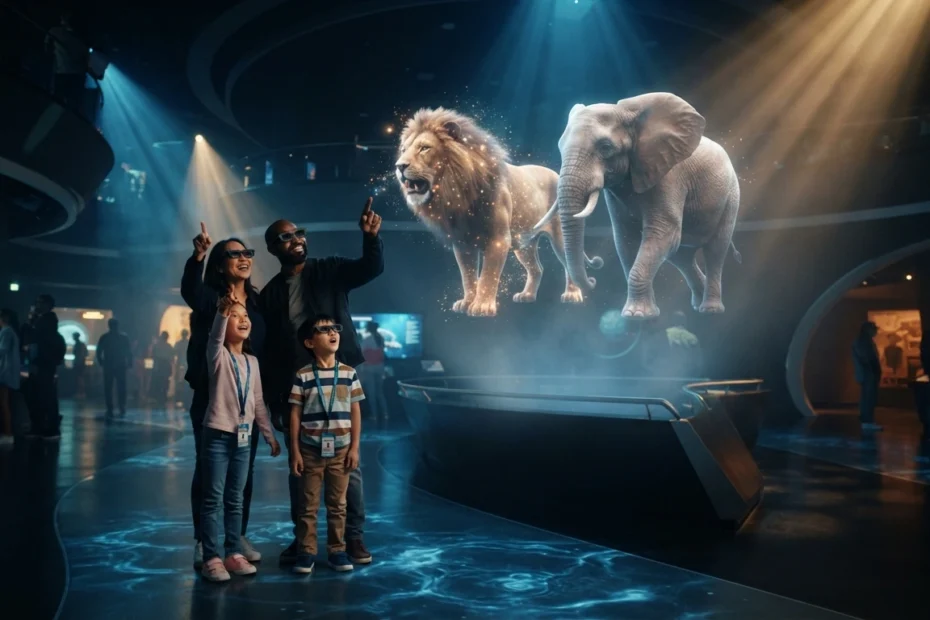
TL;DR: An artificial zoo—often called a hologram zoo, robotic zoo, or virtual wildlife park—replaces live captive animals with 3D laser projections, hyper-realistic soft robotics, and virtual reality. These venues eliminate animal captivity concerns, bring extinct or oceanic species to urban centers, and offer interactive educational exhibits without cages.
Have you ever stared at a pacing polar bear behind glass and felt a quiet pang of guilt? You want your kids to marvel at the sheer scale of an African elephant, yet watching wide-ranging wild animals inside concrete enclosures feels increasingly out of step with modern ethics. That tension is driving a major shift in urban entertainment: the rise of the artificial zoo.
Instead of cages, fences, and feeding schedules, these high-tech venues use laser light fields, spatial audio, and biomimetic engineering to surround visitors with lifelike creatures. In this guide, you will learn how simulated sanctuaries work, where you can actually visit one today, how their costs and conservation value compare to traditional wildlife parks, and where the technology is heading next.
Quick Overview: Key Facts at a Glance
- Zero Live Captivity: No live animals are captured, transported, or penned; exhibits rely entirely on light projection, soft robotics, and spatial software.
- Expanded Species Range: Visitors can stand beside a full-scale blue whale, watch a Tyrannosaurus rex hunt, or examine deep-sea organisms that cannot survive in aquariums.
- Urban Footprint: While a biological wildlife park requires 50 to 200 acres of rural land, a virtual zoo can operate inside a 15,000-square-foot downtown space.
- Interactive Behavior: Sensor arrays and game engines allow digital animals to react when visitors step closer or wave.
- Evolving Landscape: Modern facilities complement—rather than replace—accredited biological sanctuaries focused on wild habitat preservation.
What Is an Artificial Zoo?
An artificial zoo is an educational and entertainment venue that uses technological recreations—such as volumetric 3D projections, animatronics, and augmented or virtual reality—instead of living captive animals.
While traditional menageries rely on biological specimens, a digital sanctuary recreates animal movements, vocalizations, and behaviors through code and hardware. Depending on the venue, these exhibits are marketed under several related terms:
- Hologram Zoo: Uses laser projection tunnels, depth glasses, and optical tracking to float 3D animals in mid-air.
- Robotic Zoo: Uses biomimetic, waterproof animatronic machines that mimic marine life or land animals.
- Virtual Zoo / VR Safari: Uses headsets or projection domes to place visitors inside a simulated ecosystem.
The Three Core Technological Pillars
- Holographic Projection: Laser light fields create volumetric 3D imagery with spatial depth perception.
- Biomimetic Animatronics: Medical-grade silicone skins and flexible skeletal motors simulate physical presence in water tanks.
- Virtual Domes & Mixed Reality: 360-degree projection mapping halls and untethered headsets deliver interactive environments.
Fact vs. Fiction: Distinguishing Digital Attractions
Because high-tech entertainment is evolving quickly, it helps to separate real consumer attractions from theoretical concepts:
| Feature | Verified Real-World Attraction | Theoretical or Unverified Claim |
| Primary Medium | Laser projections, 3D glasses, projection mapping, untethered VR | Free-floating, sci-fi “star wars” holograms without glasses or walls |
| Interactivity | Motion sensors trigger pre-rendered or AI-driven behavioral loops | Physical digital projections that you can touch and feel in mid-air |
| Public Access | Ticketed walk-through galleries, temporary museum exhibits, projection domes | Universal replacement of all biological zoos worldwide |
| Robotic Marine Encounters | Specialized B2B animatronic prototypes for resorts and pools | Standalone, fully robotic aquariums operating on every high street |
Understanding these distinctions helps set realistic expectations before you buy a ticket. If you are exploring broader shifts in how technology intersects with environmental display, you can read our detailed breakdown on ethical wildlife tourism trends.
How Does a Hologram Zoo Work?
To trick the human brain into perceiving a solid, living animal in mid-air, a hologram zoo relies on volumetric light-field projection, precise tracking hardware, and spatial acoustics.
Holographic Projection Workflow:
Overhead LiDAR Sensors ➔ Laser Projectors ➔ Polarized 3D Glasses ➔ Directional Audio Arrays
Here is how the underlying setup creates a believable display:
- Motion Capture and Biological Modeling: Developers scan real animals using multi-camera arrays or LiDAR in wild sanctuaries. Biologists assist animators to capture realistic strides, tail flicks, and eye movements.
- Volumetric Projection Tunnels: High-lumen laser projectors beam separate light streams for the left and right eyes onto specialized reflective walls or micro-mesh screens.
- Head-Tracking and Depth Parallax: Infrared sensors monitor where you are standing in the room. As you move left or right, the perspective shifts instantly, allowing you to walk around a projected giraffe just as if it were a physical object.
- Spatial Audio Integration: Directional speaker arrays focus sound waves to precise spots in the room. When a lion roars on your left, the sound waves strike your left ear first, reinforcing depth perception.
- Atmospheric FX: Many permanent venues add wind blowers, temperature shifts (e.g., dropping to 45°F in polar zones), and subtle scent diffusers emitting aromas like damp earth or pine needles.
In 2023, the technology received major international recognition when Brisbane’s Hologram Zoo was named one of TIME’s Best Inventions of 2023. Developed by Axiom Holographics, the venue proved that laser light fields could comfortably handle high-throughput family crowds in a suburban commercial park.
Types of Virtual Zoo Exhibits
Not every tech-driven wildlife experience uses light fields. Facilities choose different hardware approaches based on space, budget, and target audience.
Summary of Digital Exhibit Formats
- Hologram Tunnels: Light fields and 3D eyewear deliver a social walk-through without headset isolation.
- Robotic Animatronics: Silicone skins and waterproof motors offer physical presence in real pools.
- Projection Domes: Floor-to-ceiling 4K laser arrays create high-capacity interactive floors.
- VR Safaris: Mixed-reality headsets allow individual 360-degree inspection and scaling.
1. Holographic Walk-Through Tunnels
Visitors wear lightweight glasses and follow designated pathways inside 65-foot tunnels while animals move around and above them. Because your peripheral vision remains clear, you can see other people in your group, keeping the experience social and comfortable for young children.
2. Biomimetic Marine Animatronics
For water environments, engineers construct robotic zoo creatures using medical-grade silicone skins, flexible skeletons, and quiet electric motors. These units swim in real water tanks, offering an alternative to keeping large ocean mammals like dolphins or small whales in captivity.
3. 360-Degree Projection Mapping Domes
Large projection halls wrap high-resolution displays across walls and floors. Motion sensors embedded in the flooring cause interactive elements—such as ocean ripples or scattering autumn leaves—to react as visitors walk across the room. To learn more about how immersion displays are evolving in cultural spaces, explore our guide on augmented reality in museum exhibit design.
4. Mixed Reality VR Safaris
Guests wear untethered headsets that overlay digital animals directly onto the physical room. This format offers high personal interactivity, allowing users to inspect micro-details, like the structure of an insect wing or the scales of a reptile, at human scale.
Comparing Digital Exhibit Formats
| Exhibit Type | Primary Hardware | Interactive Features | Key Advantage | Best Suited For |
| Holographic Tunnels | Laser projectors, tracking sensors, 3D eyewear | Real-time perspective shifting based on user position | Social walk-through experience with zero isolation | Malls, science centers, urban family centers |
| Robotic Animatronics | Waterproof actuators, silicone skins, battery packs | Autonomous swimming paths, proximity reactions | Physical presence in real water tanks | Aquarium alternatives, luxury resort lagoons |
| Projection Mapping | Floor-to-ceiling 4K projection, haptic floors | Footstep tracking, reactive environmental floors | Multi-user capacity without wearing headgear | Immersive art spaces, group educational venues |
| VR/AR Headsets | Untethered HMDs, spatial hand-tracking | Object grabbing, scaling, 360-degree inspection | Deep individual immersion and historical simulations | High-school field trips, specialized science labs |
Real-World Venues: Where Can You Visit Today? (2026 Status)
If you are looking to book a visit, it is important to know which locations are actively operating, which are undergoing updates, and which are commercial prototypes.
2026 Global Venue Status Summary
- Brisbane, Australia: Hologram Zoo (Open to the public)
- Atlanta, USA: Illuminarium Flagship (Open to the public)
- Las Vegas, USA: Illuminarium (Closed March 2026 ahead of planned 2027 relaunch)
- Toronto, Canada: Arcadia Earth Flagship (Open to the public)
- Global B2B: Edge Innovations Robotic Dolphins (Commercial supplier for resorts/attractions)
Hologram Zoo (Brisbane, Australia)
- Status: Open to the public (with active global expansion).
- Technology: Volumetric laser projection tunnels developed by Axiom Holographics.
- Experience: Visitors walk through 65-foot projection tunnels to experience African safaris, prehistoric dinosaur worlds, and Arctic polar zones. The success of the Brisbane venue has led to temporary pop-ups and franchise expansions across Asia and North America.
Illuminarium (Atlanta Flagship)
- Status: Atlanta flagship open; Las Vegas location closed in March 2026 ahead of a planned 2027 relaunch.
- Technology: High-resolution projection mapping, beamforming spatial audio, and in-floor haptic sensors.
- Experience: The WILD: A Safari Experience exhibit at Illuminarium Atlanta uses footage filmed on location in Africa, projected across massive walls. Haptic floor motors deliver low-frequency vibrations when a digital elephant walks past.
Arcadia Earth (Toronto Flagship)
- Status: Open to the public.
- Technology: Augmented reality overlays, projection mapping, and environmental art installations.
- Experience: Originally launched as temporary pop-ups in New York and Saudi Arabia, Arcadia Earth Toronto established its permanent flagship in downtown Toronto. Visitors use smartphones or tablets to view digital marine ecosystems layered over physical installations constructed from recycled waste.
Edge Innovations Robotic Dolphins (Commercial Prototypes)
- Status: B2B commercial prototype / Resort supplier (Not a standalone public attraction).
- Technology: Soft robotics, biomimetic movement engines, medical silicone exterior.
- Experience: California engineering firm Edge Innovations made headlines by building a 550-pound, ultra-realistic animatronic dolphin. However, it is important to clarify that this is a B2B hardware solution designed for aquarium developers and water parks (such as aquatic resorts in the Middle East), rather than a standalone ticketed “robotic zoo” venue that consumers can walk into on demand.
Traditional Zoos vs. Artificial Zoos
The debate between traditional biological sanctuaries and digital wildlife parks touches on ethics, conservation science, and urban economics.
Model Comparison at a Glance
- Traditional Zoos: Crucial for genetic preservation, captive breeding, and field conservation, but carry high land, veterinary, and animal welfare costs.
- Artificial Zoos: Eliminate captivity stress, offer zero-liability urban access, and display impossible species, but cannot preserve biological DNA.
Accredited biological facilities play a critical role in preserving endangered species. For example, data from the IUCN Red List of Threatened Species shows that thousands of vertebrate species face imminent extinction in the wild. For these creatures, captive breeding programs in accredited sanctuaries remain a crucial safety net.
However, for public entertainment and general education, digital venues eliminate many of the ethical compromises inherent to live displays:
| Factor | Traditional Accredited Zoo | Artificial Zoo / Digital Park |
| Animal Welfare | Requires constant monitoring, climate controls, and space management | Eliminates welfare concerns, stress, and confinement |
| Conservation Role | Active field research, genetic management, and species reintroduction | Public education, fundraising, and awareness campaigns |
| Footprint & Location | Requires 50–200+ acres outside city centers | Requires 10,000–20,000 sq ft inside downtown commercial centers |
| Operating Costs | High ongoing expenses: food, veterinary care, waste, high liability | Upfront tech investment; low variable daily operating costs |
| Exhibit Flexibility | Static collection bound by animal lifespan and climate limits | Software updates allow seasonal exhibit changes in hours |
For a deeper dive into how traditional wildlife sanctuaries are adopting smart monitoring tools, see our article on technology in modern wildlife conservation.
What Are the Limitations of Virtual Wildlife Experiences?
While a virtual zoo solves significant welfare problems, it comes with its own set of technical and psychological trade-offs:
Key Technical and Psychological Limitations
- The Predictability Trap: Digital animals follow pre-programmed code, lacking nature’s unscripted behavior.
- The Empathy Gap: Pixels and light projections lack the organic presence, scents, and vulnerability of living animals.
- Hardware Obsolescence: Projectors and rendering servers require updates every 3 to 5 years to remain cutting-edge.
1. The Predictability Factor
Part of observing real nature is accepting its unpredictability. In a biological sanctuary, an animal might be sleeping, camouflaged, or playing. In a digital attraction, creatures appear on cue. While this guarantees action for young visitors, it misses the lesson of patience that comes with observing real wildlife.
2. The Empathy Gap
Child psychologists note that seeing a projected image on a screen or wall does not always spark the same emotional connection as seeing a live animal. Smelling the hay, hearing natural movements, and recognizing a living creature’s vulnerability foster empathy in ways that digital visuals struggle to match.
3. Hardware Lifecycle and Energy Use
Laser projectors, graphic servers, and cooling systems require substantial electricity. Additionally, display technology evolves rapidly; an installation that looks groundbreaking today may feel outdated to tech-savvy teenagers in four years, requiring ongoing capital investments.
What Does the Future Hold for Digital Wildlife Preservation?
Looking ahead, the line between digital entertainment and real-world conservation will continue to blur through two major technological shifts:
Generative AI Behavioral Engines
Instead of cycling through pre-recorded video loops, future digital animals will be driven by autonomous AI models. Each virtual creature will respond dynamically to crowd size, noise levels, and time of day, ensuring no two visits offer the exact same experience.
Live Satellite Telepresence Pods
Rather than rendering computer graphics, future urban venues will link directly to solar-powered 360-degree camera arrays placed inside real wild conservancies. Visitors in London, New York, or Tokyo will step into viewing pods to observe real wild elephants wandering across a Kenyan reserve in real time—without disturbing the ecosystem.
Key Takeaways
- Captivity-Free Entertainment: Artificial zoos replace live animals with 3D holograms, projection mapping, and robotics to solve ethical welfare issues.
- Compact Urban Access: These venues operate inside downtown retail spaces, bringing natural history exhibits directly to urban populations.
- Expanded Possibilities: Digital displays allow visitors to observe extinct animals, microscopic life, and deep-sea creatures at full scale.
- Complementary Role: Digital parks do not replace species breeding programs run by biological sanctuaries, but they offer a human-centered alternative for public entertainment.
- Dynamic Content: Facility displays can be updated via software, offering fresh experiences without importing new animals.
Frequently Asked Questions
What is an artificial zoo?
An artificial zoo is an educational entertainment space that uses 3D laser holograms, hyper-realistic robotics, projection mapping, or virtual reality headsets to showcase animals without housing live captive creatures.
Where can I visit a hologram zoo today?
Axiom Holographics operates a permanent Hologram Zoo in Brisbane, Australia, and runs temporary pop-ups globally. Additionally, immersive projection venues like Illuminarium in Atlanta and Arcadia Earth in Toronto offer similar ticketed digital wildlife experiences.
Are robotic dolphins available at public aquariums?
Most biomimetic marine animals, such as those built by Edge Innovations, are commercial prototypes designed for resort developers and water attractions. They are not yet widely available as standalone public aquariums.
Do digital wildlife parks help with animal conservation?
Yes, indirect benefits exist. They reduce commercial demand for capturing wild species (like cetaceans) for public shows. Many digital operators also donate a portion of ticket sales to real-world habitat restoration projects.
Do you need VR headsets to experience a virtual zoo?
Not always. While some VR exhibits require headsets, many popular venues use walk-through projection tunnels, floor-to-ceiling domes, or simple 3D polarized glasses that keep your eyes and peripheral vision open to the room.
How much do tickets cost for a digital wildlife park?
Ticket prices typically range from $20 to $45 per person, depending on the location, exhibit length, and visual technology used. This pricing aligns closely with standard museum and aquarium admissions.
Keep Reading

Milomagazine.co.uk USA: What It Is, Content Breakdown, and the US Site Explained

What Is adstotally.com? Complete Guide and Platform Review

Crackstube: What It Is, How It Works, Websites, and Safety
Precision Sheet Metal Fabrication UK: The Complete Engineering & Buyer’s Guide | charfen.co.uk
Safetrode.com: Your Complete Guide to Electrical Grounding, Earthing Systems, and Safety Solutions