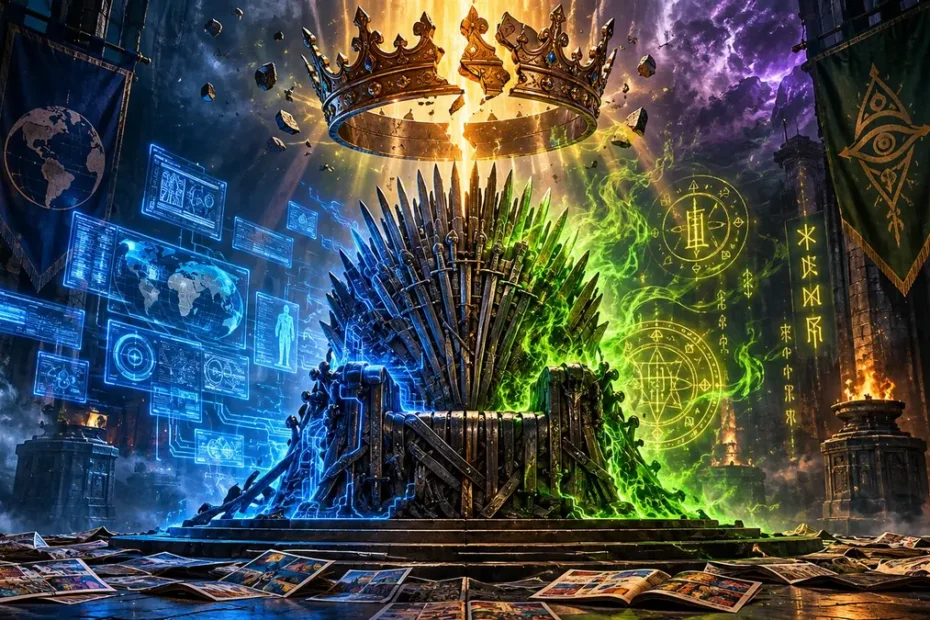
TL;DR: Doctor Doom debuted in Fantastic Four #5 in 1962, created by Stan Lee and Jack Kirby. Over 60+ years, Victor Von Doom evolved from a one-note antagonist into Marvel’s most layered villain — a genius, sorcerer, and head of state. Here’s his full story and reading order.
Most supervillains want to destroy the world. Victor Von Doom wants to save it — on his terms, under his rule, with an iron fist inside a titanium gauntlet. That contradiction is exactly what makes him so fascinating to read.
If you’ve only seen the movies, you’ve barely scratched the surface. Doctor Doom’s comics history spans more than six decades of political intrigue, cosmic power grabs, and some of the sharpest character development Marvel has ever put on a page. Let’s walk through the whole thing.
Quick Overview
- First appearance: The Fantastic Four #5 (July 1962)
- Creators: Stan Lee (writer) and Jack Kirby (artist)
- Real name: Victor Von Doom
- Home base: Latveria, a fictional Eastern European nation
- Key traits: Genius-level intellect, mastery of science and sorcery, unshakable ego
- MCU status: Debuted in the mid-credits scene of The Fantastic Four: First Steps (2025), played by Robert Downey Jr.
Who Is Doctor Doom, Exactly?
At his core, Victor Von Doom is a scientist, a sorcerer, and the absolute ruler of the small nation of Latveria. He wears a suit of powered armor and a metal mask that hides the facial scars he blames on Reed Richards — his former college classmate and lifelong rival.
But calling him a “villain” almost feels reductive. Doom genuinely believes he is the only person capable of bringing order to a chaotic world. He’s not wrong about his intelligence. He’s just catastrophically wrong about his right to impose his will on everyone else.
Think of him as a dark mirror to every hero in the Marvel Universe. Where Reed Richards uses his genius to explore, Doom uses his to conquer. Where Tony Stark builds armor to protect, Doom builds his to dominate.
When Did Doctor Doom First Appear in Comics?
Doom made his debut in The Fantastic Four #5, published by Marvel Comics in July 1962. Stan Lee and Jack Kirby introduced him as a mysterious, hooded figure who kidnaps the Invisible Woman and forces the rest of the team into a time-traveling mission.
From that very first issue, he stood out. While other Silver Age villains were often goofy or one-dimensional, Kirby’s design gave him an almost regal presence. The iron mask, the green cloak, the gauntlets crackling with energy — he looked like a medieval king who’d wandered into a science fiction story.
According to Marvel’s official Doctor Doom character profile, he remains one of the most frequently appearing antagonists in the publisher’s entire catalog, crossing paths with nearly every major hero and team since the early 1960s.
Over the next few years, Doom quickly became the Fantastic Four’s most recurring adversary. He wasn’t just a monster-of-the-week. He had a country, an army, and a plan that extended far beyond a single heist.
The Origin Story: How Victor Von Doom Became a Tyrant
Doom’s backstory is one of the most detailed in Marvel, and it’s been refined many times over the decades. The version most readers consider definitive was first told in Fantastic Four Annual #2 (1964) and later expanded in Ed Brubaker’s Books of Doom (2006). Here are the key beats:
- A childhood shaped by loss. Victor was born in Latveria to a Romani family. His mother, Cynthia, was a witch who died trying to bargain with the demon Mephisto. His father, Werner, was a healer who died fleeing persecution by the Latverian baron.
- A brilliant young mind. Victor’s intellect attracted the attention of an American university dean, who offered him a full scholarship. He left Latveria and enrolled in the same school as Reed Richards.
- The fateful experiment. Victor built a machine designed to communicate with the dead — specifically, to reach his mother’s spirit. Reed warned him about a flaw in the calculations. Victor, too proud to listen, activated the machine anyway. It exploded, scarring his face.
- The descent into obsession. Blaming Reed for the accident, Victor traveled the world. He eventually found a sect of monks in Tibet who forged his iconic iron mask and armor. When he placed the still-hot mask on his face, the burns became permanent.
- The rise to power. Victor returned to Latveria, overthrew the ruling baron, and established himself as the nation’s supreme leader. Under his rule, Latveria became a technological utopia — but one built on absolute control.
That origin gives you everything you need to understand the character. Pride, grief, genius, and an inability to accept fault. It’s Shakespearean in its structure, and it hasn’t needed a major reboot in over half a century.
Essential Reading Order: The 8 Doctor Doom Stories You Need
If you want to understand why fans consider Doom the best villain in Marvel, you need to read the right stories in the right order. Here’s a chronological guide with exact issue ranges and collected editions so you can track them down easily.
1. Fantastic Four #5 (July 1962) — First Appearance
The starting point. Doom kidnaps Sue Storm and sends the rest of the team back in time to steal Blackbeard’s treasure. It’s a relatively simple Silver Age plot, but Kirby’s design and Lee’s bombastic dialogue establish everything that matters: the ego, the armor, the rivalry with Reed.
Collected in: Fantastic Four Omnibus Vol. 1
2. Fantastic Four Annual #2 (1964) — The Origin Story
This is where Lee and Kirby first revealed Victor’s backstory — the Romani childhood, the university explosion, the Tibetan monks. If you skip everything else on this list, don’t skip this one. It’s the foundation every later writer builds on.
Collected in: Essential Fantastic Four Vol. 1 and various Fantastic Four Annual collections
3. Fantastic Four #57–60 (1966–1967) — Doom Steals the Silver Surfer’s Power
The first time Doom achieved godlike status. He tricks the Silver Surfer, absorbs the Power Cosmic, and nearly destroys the Fantastic Four before his own arrogance undoes him. This arc set the template for every “Doom gets too much power” story that followed.
Collected in: Fantastic Four Omnibus Vol. 2
4. Fantastic Four #247–250 (1982) — “Doom!” by John Byrne
John Byrne’s run on the Fantastic Four is legendary, and this arc is the crown jewel. Doom is stripped of his throne, and his face is finally revealed to readers. Byrne humanized the character without softening him, and the artwork is some of the best in Marvel history.
Collected in: Fantastic Four by John Byrne Omnibus Vol. 2
5. Books of Doom #1–6 (2006) — The Definitive Origin
Ed Brubaker and Pablo Raimondi retold Doom’s origin with a darker, more mature tone. This miniseries adds layers of unreliability — Doom is narrating his own story, so how much can you trust him? It’s a masterclass in character-driven storytelling.
Collected in: Books of Doom trade paperback
6. Doomwar #1–6 (2010) — Doom vs. Black Panther
Written by Jonathan Hickman, this miniseries follows Doom’s invasion of Wakanda to seize the nation’s vast vibranium reserves. Both characters are genius-level strategists, and neither has a clear moral high ground. The chess-match plotting makes this one of the most re-readable Doom stories ever published.
Collected in: Doomwar trade paperback
7. Secret Wars #1–9 (2015) — God Emperor Doom
Hickman’s massive crossover event is where Doom literally becomes God. He patches together the remnants of destroyed universes into “Battleworld” and rules it with absolute authority. The story asks a haunting question: if Doom’s rule actually works, does his tyranny matter? This is the peak of the character’s modern arc.
Collected in: Secret Wars hardcover and trade paperback — you can also find reading-order guidance for related tie-ins on Marvel’s official Fantastic Four collections page.
8. Infamous Iron Man #1–12 (October 2016 – September 2017) — Doom as Hero
After the events of Secret Wars, Victor Von Doom actually tried to become a hero. Written by Brian Michael Bendis, this 12-issue series followed Doom taking up the Iron Man mantle and genuinely attempting to atone for his past. The series explored whether someone with his ego and history could truly change. Spoiler: it’s complicated, and the ending will surprise you.
Collected in: Infamous Iron Man Vol. 1: Infamous and Vol. 2: The Absolution of Doom
What Makes Doom Different From Other Marvel Villains?
It’s a fair question. Marvel has no shortage of iconic antagonists — Magneto, Loki, Thanos, the Green Goblin. So what sets Victor apart?
| Trait | Doctor Doom | Thanos | Magneto | Loki |
| Motivation | Order through control | Cosmic balance | Mutant survival | Recognition & chaos |
| Power source | Science + magic | Infinity Stones | Mutation | Asgardian magic |
| Rules a nation? | Yes (Latveria) | No | Briefly (Genosha) | No |
| Tried being a hero? | Yes | Rarely | Yes | Yes |
| Tragic backstory? | Deeply | Moderately | Deeply | Deeply |
The biggest differentiator is that Doom operates on a political level most villains don’t. He’s not just a criminal or a conqueror. He’s a head of state with diplomatic immunity, a functioning economy, and citizens who genuinely love him. That makes him far harder to simply “defeat.”
He also blends science and sorcery in a way that’s almost unique in the Marvel Universe. Most characters lean into one or the other. Doom mastered both, making him a credible threat to the Avengers, the X-Men, and Doctor Strange simultaneously.
The Psychology Behind the Mask
What drives someone to put on a metal mask and declare himself ruler of a nation? Doom’s psychology is a goldmine for character analysis.
At the surface level, his behavior mirrors traits associated with narcissistic personality patterns — grandiosity, a relentless need for admiration, and a profound inability to accept criticism. But Doom is more nuanced than a clinical checklist.
His narcissism is rooted in genuine trauma. He watched both parents die. He was disfigured by his own ambition. He carries the weight of an entire nation on his shoulders. His arrogance isn’t just vanity — it’s a defense mechanism built over decades of loss.
That’s what makes him so compelling to read. You don’t have to agree with Doom to understand him. And understanding a villain is the first step toward great storytelling.
Beyond the Comics: Movies, TV, and the MCU
Doom’s track record in live-action has been mixed, to put it generously. Julian McMahon played him in the 2005 Fantastic Four and its 2007 sequel, delivering a campy but entertaining performance. Toby Kebbell took on the role in the 2015 reboot, which leaned into a darker, more tech-focused interpretation that didn’t quite land with audiences.
The animated versions have fared much better. Fantastic Four: The Animated Series (1994) and various appearances in Avengers: Earth’s Mightiest Heroes captured Doom’s regal menace far more faithfully than any live-action attempt.
Then everything changed. Robert Downey Jr. was cast as Victor Von Doom at San Diego Comic-Con in 2024, and he made his official MCU debut in the mid-credits scene of The Fantastic Four: First Steps in July 2025. The cameo sent fans into a frenzy, and the full payoff arrives when Avengers: Doomsday hits theaters on December 18, 2026. Expectations are enormous — and for once, the hype might actually be justified.
Key Takeaways
- Doctor Doom debuted in 1962 and has been a Marvel staple for over 60 years.
- His origin blends personal tragedy, unchecked pride, and genuine genius.
- He’s one of the few comic book villains who rules an actual country.
- His mastery of both science and magic makes him uniquely dangerous.
- Robert Downey Jr.’s MCU portrayal is already underway, with Avengers: Doomsday set for December 2026.
Frequently Asked Questions
Who created Doctor Doom?
Stan Lee and Jack Kirby created the character for The Fantastic Four #5, published in July 1962. Kirby designed the iconic armor and mask, while Lee wrote Doom’s arrogant, theatrical dialogue that defined his personality from the very first appearance.
Is Doctor Doom a hero or a villain?
He’s primarily a villain, but it’s complicated. Doom has occasionally allied with heroes and even tried to become one himself in the Infamous Iron Man series (2016–2017). He genuinely believes his authoritarian rule is the best path to global peace.
What is Latveria?
Latveria is a fictional Eastern European nation that Doom rules as its absolute monarch. Despite his tyranny, the country is depicted as prosperous, technologically advanced, and free from the kind of poverty and crime that plague other Marvel nations.
Why does Doctor Doom wear a mask?
Victor Von Doom’s face was scarred during a failed experiment at university. He forged his iron mask with Tibetan monks and placed it on his face while it was still white-hot, permanently fusing it to his skin. The mask symbolizes both his disfigurement and his refusal to show vulnerability.
What are Doctor Doom’s powers?
Doom possesses genius-level intellect, mastery of advanced technology, and significant magical ability. His armor grants him superhuman strength, durability, and energy projection. He’s one of the few characters who can rival both Tony Stark in engineering and Doctor Strange in sorcery.
Is Doctor Doom in the MCU?2
Yes. Robert Downey Jr. made his first MCU appearance as Doom in the mid-credits scene of The Fantastic Four: First Steps (July 2025). He will play a central role in Avengers: Doomsday, scheduled for theatrical release on December 18, 2026.
Wrapping It Up
Victor Von Doom — created by Stan Lee and Jack Kirby in 1962, ruler of Latveria, master of science and sorcery — has spent over six decades proving that the best villains aren’t the ones who cackle in the shadows. They’re the ones who genuinely believe they’re the hero of their own story, and who might, under different circumstances, actually be right.
Whether you’re picking up your first Fantastic Four issue or counting down the days until Avengers: Doomsday, one thing is clear: the man behind the mask isn’t going anywhere. And honestly? The Marvel Universe would be a lot less interesting without him.
Keep Reading

Milomagazine.co.uk USA: What It Is, Content Breakdown, and the US Site Explained

What Is adstotally.com? Complete Guide and Platform Review

Crackstube: What It Is, How It Works, Websites, and Safety

Precision Sheet Metal Fabrication UK: The Complete Engineering & Buyer’s Guide | charfen.co.uk
Safetrode.com: Your Complete Guide to Electrical Grounding, Earthing Systems, and Safety Solutions