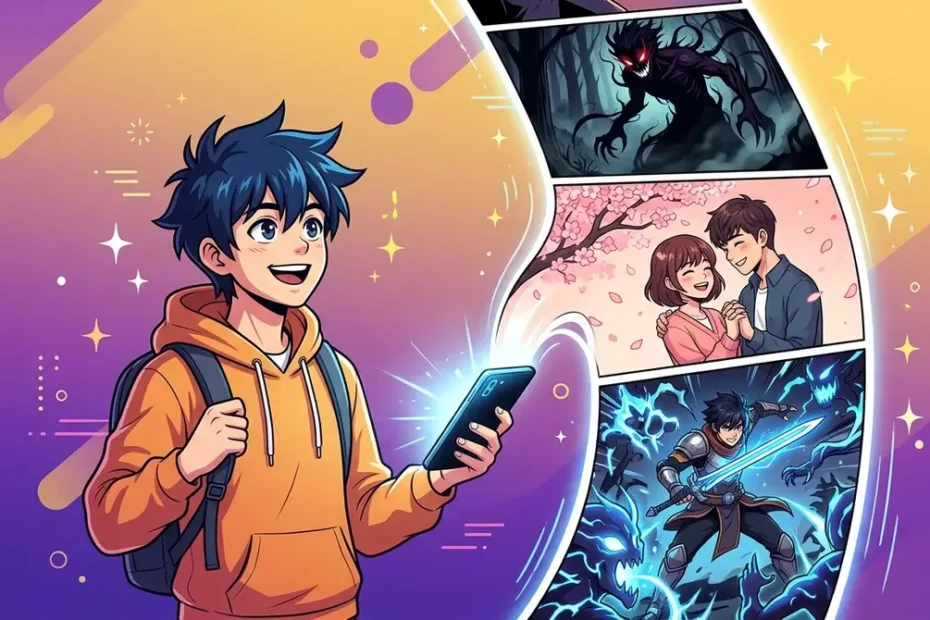
Friends rave about Solo Leveling. Netflix keeps adapting comics you have never heard of. Yet one search returns a dozen apps, confusing coin systems, and sketchy mirror sites loaded with pop-ups. Pick the wrong one and you waste money or expose your phone to malware. This guide explains exactly what a webtoon is, where to read safely for free, which series to start tonight, and how to publish your own.
Quick answer: A webtoon is a digital comic built for phones. You scroll down one long, full-color strip instead of flipping pages. The format started in South Korea in the early 2000s, and most series drop a new episode every week.
Table of Contents
- What is a webtoon?
- When did the format launch?
- Webtoon vs. manga vs. American comics
- Where to read legally
- Best series to start with
- Why Solo Leveling broke the internet
- Is it free? Coins, Daily Pass, and Fast Pass
- How to get free coins (legit methods)
- Is it safe for kids and teens?
- How to make your own
- How to launch a series and keep it going
- How big is the Korean webtoon industry?
- Frequently asked questions
What Is a Webtoon?
A webtoon is a comic published online as one continuous vertical strip. You scroll down with your thumb, and the story unfolds panel by panel. No page turns, no pinching to zoom.
The word blends “web” and “cartoon.” It describes the reading format, and it also doubles as a brand name. WEBTOON in all caps is the app operated by WEBTOON Entertainment, a company majority-owned by the South Korean tech giant Naver.
Three traits set the format apart from every other comic style:
- Vertical scroll: Each episode is a single tall canvas built for phone screens.
- Full color from episode one: No black-and-white printing constraints.
- Weekly episode drops: Creators publish short chapters on a fixed schedule.
If you have ever scrolled through a long Instagram carousel and wished it told a story, you already understand the basic idea.
When Did the Format Launch?
The vertical-scroll comic grew out of Korean web portals in the early 2000s. Naver Webtoon, the service behind today’s global app, launched in 2004 and reached English-speaking readers a decade later.
- 2000 — Korean portal Chollian coins the term for its online comics section.
- 2003 — Daum opens its comics service. Kang Full’s Love Story popularizes the long-scroll format.
- 2004 — Naver launches its webtoon platform in South Korea.
- 2014 — Naver launches the English-language service as LINE Webtoon.
- 2019 — The global app rebrands to WEBTOON.
- 2020 — Sweet Home arrives on Netflix. Tower of God anime streams on Crunchyroll.
- 2024 — WEBTOON Entertainment lists on Nasdaq under the ticker WBTN.
The company now reports roughly 157 million monthly active users across its global platforms, according to its latest annual filing with the U.S. Securities and Exchange Commission. You can verify this figure on the WEBTOON Entertainment investor relations page at ir.webtoon.com.
How Does a Webtoon Differ From Manga and American Comics?
The core difference is how you read. Manga and American comics arrange panels on fixed pages. The webtoon format stacks panels in a single column, and creators use the empty space between panels to control pacing and suspense.
- Reading direction: Webtoon scrolls top to bottom. Manga reads right to left. American comics read left to right.
- Layout: Webtoon uses one continuous strip. Manga and American comics use fixed pages.
- Color: Webtoon is full color. Manga is mostly black and white. American comics are full color.
- Built for: Webtoon targets phone screens. Manga targets print magazines and collected volumes. American comics target print issues and trade paperbacks.
- Typical release: Webtoon drops weekly episodes. Manga follows weekly or monthly chapters. American comics ship monthly issues.
One more term that helps: manhwa refers to Korean comics in general. A Korean webtoon is manhwa designed specifically for vertical scrolling on a screen.
Where Can You Read Webtoons Legally?
Stick to licensed platforms. They pay creators, keep translations accurate, and protect your device from the malware that plagues pirate sites.
- WEBTOON (operated by WEBTOON Entertainment / Naver) — Best for beginners. Offers Originals plus self-published Canvas series. Free weekly episodes and Daily Pass on completed series. Uses Coins for early access.
- Tapas (operated by Kakao Entertainment) — Best for indie comics and licensed Korean hits. Uses wait-until-free timers. Currency is Ink.
- Tappytoon (operated by Contents First) — Best for licensed romance, fantasy, and action manhwa. Free opening episodes. Per-episode purchases.
- Manta (operated by RIDI) — Best for binge readers who prefer subscriptions. Selected free episodes. Monthly subscription model.
- Lezhin Comics (operated by Lezhin Entertainment) — Best for adult readers with age-gated 18+ titles. Selected free episodes. Uses Coins.
- KakaoPage (operated by Kakao Entertainment) — Best for Korean-language readers. Wait-and-read-free model. Uses in-app cash.
New readers should start with the WEBTOON app. It offers the largest free English catalog and the simplest account setup.
Which Series Should You Read First?
Start with a genre you already enjoy in other media. Not every title below is a Korean Naver original. The list includes Kakao series, American creators, and one print comic that later received a vertical-scroll edition.
- Solo Leveling (Action fantasy) — Created by Chugong (novel) and Dubu / Redice Studio (art). Available on Tappytoon and Tapas. This is a Kakao series, not a WEBTOON app title. The anime premiered in 2024.
- Sweet Home (Horror) — Created by Kim Carnby and Hwang Young-chan. Available on WEBTOON. Netflix released a live-action adaptation in 2020.
- True Beauty (Romance drama) — Created by Yaongyi. Available on WEBTOON. Adapted into a Korean TV drama in 2020.
- Who Made Me a Princess (Fantasy romance) — Created by Plutus (novel) and Spoon (art). Available on Tappytoon. A Kakao series based on a web novel.
- What’s Wrong with Secretary Kim (Office romance) — Created by Jeong Gyeong-yun (novel) and Kim Myeong-mi (art). Available on Tapas. Adapted into a Korean TV drama in 2018.
- Boyfriends (Slice-of-life romance) — Created by refrainbow. Available on WEBTOON. Follows four college students in one relationship.
- Down to Earth (Sci-fi romance) — Created by Pookie Senpai. Available on WEBTOON. An alien girl crash-lands in a young man’s backyard.
- Let’s Play (Romantic comedy) — Created by Leeanne M. Krecic, known as Mongie. Debuted on WEBTOON in 2016. Print volumes available through Rocketship Entertainment.
- Shadow Slave (Dark fantasy) — Based on the web novel by Guiltythree. Available on Aethon Webcomics. This is a comic adaptation of a hit web novel, not a traditional Korean webtoon.
- Beneath the Trees Where Nobody Sees (Crime thriller) — Created by Patrick Horvath. A vertical-scroll edition launched on WEBTOON in April 2025. This series began as an IDW Publishing print miniseries before moving to the vertical format.
Quick picks by mood:
- Craving action? Start with Solo Leveling or Shadow Slave.
- Want genuine scares? Read Sweet Home or Beneath the Trees Where Nobody Sees.
- In the mood for romance? Try True Beauty, Down to Earth, or What’s Wrong with Secretary Kim.
- Need comfort reading? Boyfriends and Let’s Play deliver warmth on every scroll.
Why Did Solo Leveling Break the Internet?
Solo Leveling began as a Korean web novel by Chugong. The comic adaptation launched on KakaoPage in 2018, with art by Dubu of Redice Studio, and it quickly became the most-read series on the platform.
The story follows Sung Jinwoo, the weakest hunter in Korea. He survives a deadly double dungeon and gains a hidden System that lets him grow stronger without any ceiling.
The main story concluded in 2021 after 179 chapters. A-1 Pictures produced the anime adaptation, which premiered in January 2024 on Crunchyroll and shattered streaming records within its first week.
Clear stakes, relentless pacing, and jaw-dropping fight choreography explain why this series crossed over from niche manhwa fans to mainstream global audiences.
Is It Free? How Coins, Daily Pass, and Fast Pass Work
Yes. The WEBTOON app costs nothing to download, and you can finish most stories without spending a single cent.
Here is how the monetization model actually works:
- Free weekly episodes: Ongoing series release new chapters free on a set day each week.
- Daily Pass: Many completed series let you unlock a limited number of episodes per day at no cost.
- Fast Pass: Coins let you read upcoming episodes before they go free to the public.
- Coins: Purchased with real money inside the app.
- Canvas: Self-published series on WEBTOON Canvas are always free to read.
Patient readers never need to pay. Coins only buy speed, not access.
How to Get Free Coins (Legit Methods Only)
WEBTOON gives away Coins exclusively through its own channels. These methods are safe and actually work:
- Join in-app events. WEBTOON runs limited-time promotions that award Coins to active readers. Availability varies by region and season.
- Redeem official codes. The company occasionally shares redemption codes through its verified social media accounts and live events.
- Use store credit. Reward programs like Google Opinion Rewards pay Google Play credit, which you can spend directly on Coins inside the app.
- Skip Coins entirely. Use the Daily Pass system and wait for the free weekly release. You lose nothing but time.
Stay far away from free coin generator websites. WEBTOON does not issue Coins through third-party tools. These pages exist to harvest your login credentials, install malware, or push phishing scams.
Is It Safe for Kids and Teens?
The official WEBTOON app is safe to install from Google Play or the Apple App Store. Content safety depends on which specific series your child reads.
Key facts every parent should know:
- Age minimum: WEBTOON’s terms of service require users to be at least 13 years old.
- Mature labels: Series containing graphic violence, gore, or suggestive themes carry a visible mature tag.
- Explicit content policy: The platform’s community guidelines ban pornographic or explicit material. Mature-tagged series may include strong violence and suggestive scenes, but they do not cross into explicit territory.
- Adult platforms are separate: Licensed 18+ services like Lezhin Comics use strict age gates and operate entirely outside the WEBTOON app ecosystem.
The real danger comes from unofficial mirror sites. Pirate platforms such as Webtoon XYZ have zero connection to WEBTOON Entertainment. They host unlicensed copies, pay creators nothing, apply no age filters, and frequently serve aggressive pop-up ads that can compromise your device.
A simple family safety checklist:
- Install only the official app from your device’s verified app store.
- Enter your child’s real birth date during account setup.
- Check the genre tag and mature label before approving any series.
- Read the first three episodes yourself to gauge appropriateness.
How to Make Your Own Webtoon
You need a story, a drawing app, and a free Canvas account. Follow these steps to create a comic that readers actually finish:
- Write a one-paragraph pitch. Describe your protagonist, their goal, and the main obstacle in three sentences.
- Script at least ten episodes. Planning ahead prevents plot holes and missed deadlines.
- Thumbnail in a tall column. Sketch small and rough. Aim for one clear story beat per phone screen.
- Set up your canvas. Draw at 1,600 pixels wide and export at 800 pixels wide for WEBTOON Canvas. Always check the platform’s current upload guide for file size limits.
- Draw, color, and letter. Clip Studio Paint, Procreate, and Photoshop are the most popular choices among working creators. Use large text that reads clearly on a small phone screen.
- Use white space as pacing. Wide gaps between panels slow a scene down. Tight panels speed it up.
- End every episode on a hook. Give readers a concrete reason to come back next week.
- Upload to WEBTOON Canvas or Tapas. Both platforms let anyone publish for free with no approval process.
How to Launch a Series and Keep It Going
Publishing your first episode is the easy part. Staying consistent for fifty episodes is where most creators quit.
- Build a buffer before launch. Finish three to five complete episodes before your public debut.
- Pick a schedule you can sustain. One steady episode per week beats three rushed uploads followed by a month-long hiatus.
- Launch with multiple episodes. New readers want enough story to get emotionally invested before committing.
- Design a clear thumbnail and title. These two elements earn the click in a crowded feed.
- Reply to early comments. Your first hundred readers become your loudest advocates.
- Learn the revenue side. WEBTOON Canvas offers ad revenue sharing once your series meets eligibility thresholds. Many creators supplement income through Patreon or Ko-fi. Originals contracts are paid deals offered directly by the platform.
How Big Is the Korean Webtoon Industry?
South Korea turned a web portal side feature into a major cultural export engine. The Korea Creative Content Agency (KOCCA) reports total domestic webtoon industry revenue of approximately 1.83 trillion won, roughly 1.4 billion U.S. dollars, for 2022. You can verify this on the KOCCA website at kocca.kr.
Export revenue is smaller but growing fast. The South Korean Ministry of Culture, Sports and Tourism recorded cartoon and webtoon exports at 107 million dollars in 2022 and set a national target of 250 million dollars by 2027. The ministry’s English-language portal is at mcst.go.kr.
Screen adaptations drive much of that international growth. Netflix adapted Sweet Home, All of Us Are Dead, and Hellbound from Korean web comics. Crunchyroll streamed anime versions of Tower of God and Solo Leveling. Each adaptation funnels millions of new readers back to the source material.
Frequently Asked Questions
What is a webtoon?
A webtoon is a digital comic you read by scrolling down on a phone. Episodes are full color and typically release once per week on platforms like WEBTOON, Tapas, and Tappytoon.
Is it free to read?
Yes. The WEBTOON app is free to download, and most series cost nothing to read. Coins only unlock episodes ahead of the free release schedule.
How do you get free coins?
Join official in-app events, redeem codes from verified social accounts, or use Google Play credit from reward programs. Never use third-party coin generators.
Is it safe for children?
The official app is safe to install. Users must be at least 13, and mature series carry a visible label. The real risk comes from unofficial pirate sites that lack age filters and serve malware.
Does the platform allow explicit content?
No. The community policy prohibits pornographic or explicit material. Mature-tagged series may include violence and suggestive themes but stay within platform guidelines.
How do you make your own?
Script your story, draw it in a vertical layout at 800 pixels wide, and upload it free to WEBTOON Canvas or Tapas. Consistency matters more than perfection.
Pick One Series and Start Scrolling Tonight
You now know what the format is, where to read safely, how the coin system works, and what it takes to publish your own story. The best next step is small: install the official app, choose one title from the recommendation list above, and read three episodes before bed.
If you want to create instead of consume, open your drawing app and sketch ten rough thumbnails this weekend. Your first episode does not need to be flawless. It needs to exist.
Drop a comment telling us which series hooked you first, and share this guide with the friend who keeps asking what you are reading on your phone.
Sources: WEBTOON Entertainment SEC filings at ir.webtoon.com — Korea Creative Content Agency at kocca.kr — Ministry of Culture, Sports and Tourism at mcst.go.kr
Keep Reading

Milomagazine.co.uk USA: What It Is, Content Breakdown, and the US Site Explained
What Is adstotally.com? Complete Guide and Platform Review
Crackstube: What It Is, How It Works, Websites, and Safety
Precision Sheet Metal Fabrication UK: The Complete Engineering & Buyer’s Guide | charfen.co.uk
Safetrode.com: Your Complete Guide to Electrical Grounding, Earthing Systems, and Safety Solutions