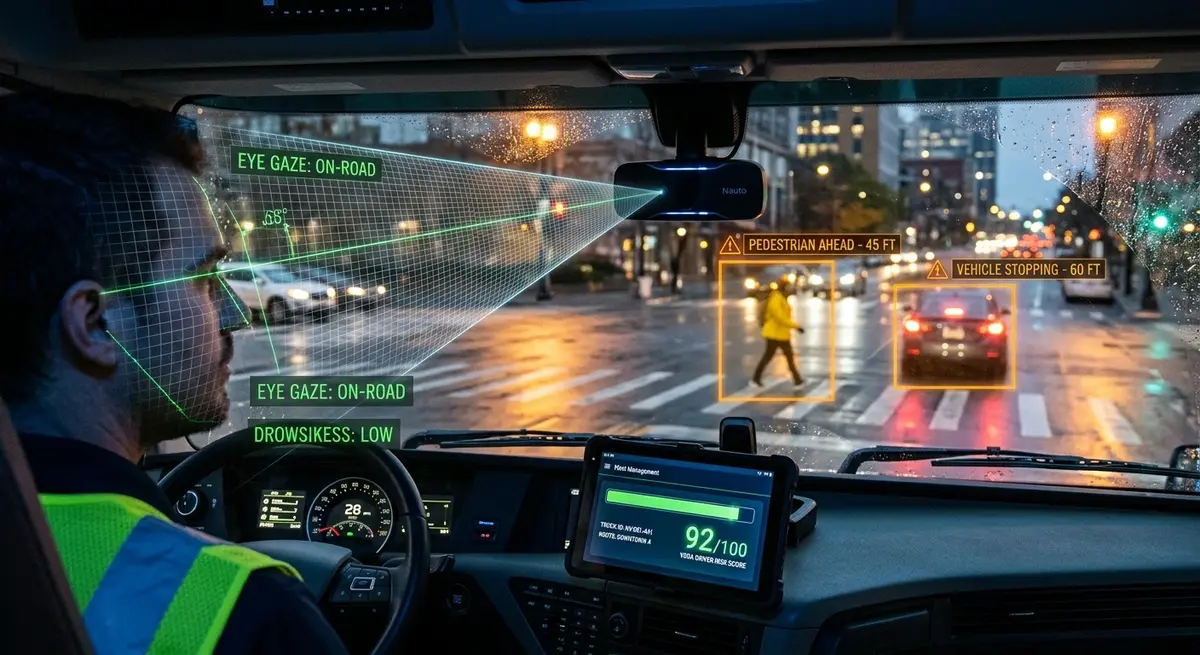
TL;DR: Nauto is an AI fleet safety platform that combines dual-facing cameras, expandable 360° vision, and on-device edge processing to detect distraction, drowsiness, and collision risk — alerting drivers within seconds, before a crash happens.
A glance at a phone screen at 45 mph leaves you blind for roughly 100 yards. That’s the stretch of road where most preventable fleet collisions begin — and it’s the exact gap Nauto was built to close.
This guide walks through the technology behind the platform, from the N4 hardware suite and CrashNet deep learning to FMCSA compliance tools and Geotab Marketplace integration. You’ll understand how on-device AI outperforms cloud-only telematics, what the latest feature updates include, and how a real deployment works across different vehicle classes.
Quick Overview
- Dual & multi-camera vision: Monitors driver behavior and road conditions simultaneously, with optional 360° auxiliary cameras for cargo areas and blind spots
- On-device edge processing: Runs computer vision models locally on the hardware, delivering audible alerts within seconds regardless of cellular coverage
- CrashNet deep learning: Fuses driver attention data with forward collision risk to trigger predictive, context-aware warnings
- VERA risk scoring: Evaluates each driver on a 0–100 scale based on distraction frequency, following distance, and harsh maneuvers
- FMCSA compliance suite: Integrates ELD, DVIR, and IFTA reporting directly into the platform
- Geotab Marketplace integration: Available as a native “Order Now” partner for seamless telematics connectivity
What Is Nauto, Exactly?
Nauto, Inc. is a Palo Alto-based technology company that builds AI-powered driver monitoring and fleet safety systems. The current hardware lineup centers on the N4 series — compact, windshield-mounted devices calibrated for specific rake angles across light-duty sedans, delivery vans, medium-duty box trucks, and heavy-duty Class 8 tractors. That calibration matters because a camera tilted even a few degrees off-axis will misread lane lines and following distances.
Unlike passive dashcams that simply record footage for later review, the N4 actively interprets what it sees. The inward-facing lens maps eye gaze, head pose, and hand position. The outward-facing lens tracks lane markings, closing speeds, and pedestrian movement. When both data streams indicate a dangerous combination — a driver staring at their lap while the vehicle ahead brakes hard — the system fires an audible in-cab warning.
The broader category here is Advanced Driver Assistance Systems (ADAS), and the problem it addresses is enormous. According to the World Health Organization’s road safety data, road traffic crashes claim approximately 1.19 million lives each year globally. The platform targets the behavioral causes behind those numbers — distraction, fatigue, and delayed reaction — rather than waiting for an impact to document what went wrong.
How the AI Detects Danger in Real Time
Understanding the detection pipeline helps clarify why this technology outperforms older telematics setups. Here’s what happens between the moment a driver picks up a phone and the moment an alert sounds.
Dual-video capture. The N4 records synchronized streams of the cabin interior and the forward roadway. Both feeds run continuously, but they’re processed locally — raw video doesn’t leave the device unless a specific event triggers an upload.
On-device inference. Both streams feed into a neural network running on a dedicated chip inside the hardware. The inward model calculates gaze vectors, blink rates, and head angles. The outward model monitors lane position, vehicle spacing, and the trajectory of nearby pedestrians or cyclists.
Predictive risk fusion. This is where the system separates itself from basic forward-collision warnings. If the outward camera detects a closing gap with a braking vehicle and the inward camera confirms the driver’s eyes are off the road, the alert threshold drops. The warning fires earlier than it would for an attentive driver facing the same gap, because the AI knows reaction time is compromised.
Audible alert. A context-aware tone sounds in the cabin, giving the driver a chance to refocus before the situation escalates.
Edge Computing vs. Cloud-Only Telematics
This architectural distinction is the single biggest reason on-device AI outperforms legacy systems in safety-critical moments.
Cloud-dependent telematics send video or sensor data over a cellular network to a remote server, wait for the server to run its analysis, and then send an alert back to the vehicle. That round trip introduces latency — often several seconds depending on signal strength. At highway speeds, a vehicle covers well over 100 feet in two seconds. If the cloud is slow or the cell tower is distant, the alert arrives after the impact has already happened.
Edge processing eliminates the network round trip entirely. The neural network runs on the physical device, so detection and alerting happen locally within seconds of the risky behavior starting — whether the truck is in downtown Chicago with strong 5G or on a rural stretch of I-80 with zero bars. The cellular connection is reserved for uploading event clips, risk summaries, and compliance data to the fleet dashboard after the fact.
Core Features Beyond Basic Dashcams
A standard dashcam records everything and explains nothing. You end up sifting through hours of footage after an accident, hoping the angle caught what happened. The platform’s feature set operates on a completely different principle.
CrashNet Deep Learning
CrashNet is the proprietary collision detection engine. It specializes in identifying imminent crash scenarios and automatically clipping the relevant video segment for review. Unlike simple G-force triggers that fire on hard braking alone, CrashNet evaluates the full context — driver attention, road geometry, closing speed — to distinguish between a panic stop that avoided a crash and one that didn’t.
VERA Risk Scoring
VERA assigns each driver a rolling safety score from 0 to 100. The algorithm weighs distraction frequency, tailgating severity, harsh cornering, and speeding events. Fleet managers use these scores to identify who needs coaching and who’s improving, rather than relying on gut feelings or anecdotal complaints.
360° Multi-Camera Expansion
The N4 isn’t limited to its two built-in lenses. Through an onboard DVR hub, it supports auxiliary side-view, backup, cargo-area, and blind-spot cameras. This is particularly valuable for Class 8 rigs and box trucks where the driver’s natural sightlines leave massive gaps around the vehicle’s perimeter.
FMCSA Compliance Suite
Safety monitoring is only half the equation for commercial fleets. The platform also integrates Electronic Logging Devices (ELD) for hours-of-service tracking, Digital Driver Vehicle Inspection Reports (DVIR) for pre- and post-trip checks, and International Fuel Tax Agreement (IFTA) reporting for cross-state operations. Consolidating these tools into a single system eliminates the need for separate compliance hardware and reduces the administrative burden on back-office teams.
Who Actually Uses This Technology?
Early adoption concentrated in long-haul trucking, where fatigue-related crashes are disproportionately common. The use cases have expanded significantly as the hardware has adapted to different vehicle profiles.
Last-mile delivery fleets now represent one of the fastest-growing segments. Drivers making 100-plus stops per day face constant time pressure, frequent phone interactions for navigation, and dense urban environments full of pedestrians. Real-time distraction alerts address the exact behaviors that cause the most incidents in this sector.
Construction and heavy equipment operators deploy the system on haul trucks navigating active job sites with poor signage, temporary roads, and unpredictable foot traffic. The predictive collision layer adds a critical safety margin in these chaotic environments.
Public transit agencies use it on buses and paratransit vehicles. A single distracted-driving incident involving a city bus can injure dozens of passengers, making the risk calculus strongly in favor of proactive monitoring.
Small and mid-size businesses with 10 to 50 company vehicles are increasingly adopting the platform as pricing has become more accessible. When your entire operation depends on a handful of vans, one serious accident can threaten the business itself.
Nauto vs. Traditional Fleet Safety — A Direct Comparison
| Capability | Legacy Telematics & Dashcams | AI-Powered Platform |
| Detection approach | Reactive (logs events after hard braking or impact) | Proactive (alerts driver before impact) |
| Risk identification | Accelerometer G-force spikes | Computer vision (eye gaze, phone use, drowsiness) |
| Processing location | Cloud servers (cellular-dependent) | On-device edge AI (works offline) |
| Alert latency | Seconds to minutes (network round trip) | Seconds (local processing, no network delay) |
| False positive rate | High (triggers on minor bumps) | Low (contextual driver + road fusion) |
| Camera coverage | Single forward lens | Dual-facing + 360° auxiliary expansion |
| Compliance tools | Basic GPS tracking | Integrated ELD, DVIR, and IFTA |
The fundamental shift is from reactive documentation to active prevention. Legacy systems tell you what happened after the damage is done. AI monitoring intervenes while there’s still time to avoid the impact.
Measurable Impact on Accident Rates
The statistics around distracted driving are difficult to overstate. The National Highway Traffic Safety Administration reports that distracted driving killed 3,308 people in the United States in 2022 — roughly nine fatalities every single day. Phone use, eating, adjusting navigation systems, and fatigue all feed into that toll.
Fleet operators deploying predictive AI monitoring consistently report substantial reductions in high-risk driving events and collision-related costs. Multiple logistics companies have documented significant drops in distraction alerts and forward-collision warnings within the first six to twelve months of activation, as drivers adjust their behavior in response to real-time feedback.
The financial impact compounds quickly. Fewer accidents mean lower insurance claims, reduced vehicle downtime, less cargo loss, and fewer workers’ compensation filings. Several fleets have reported full return on investment within the first year based on claims savings alone.
Driver retention also tends to improve when the technology is introduced transparently. When drivers understand that the system is designed to protect them — not surveil them — it becomes a safety benefit rather than a source of friction. Companies that involve their teams in the rollout process see the strongest long-term adoption.
Practical Deployment Steps for Fleet Managers
Deploying AI driver monitoring doesn’t require overhauling your entire operation. A phased approach works best.
- Match the N4 hardware to your vehicle classes. The N4 comes in SKUs calibrated for different windshield rake angles. A sedan’s nearly vertical glass requires a different mount than a Class 8 tractor’s steeply angled windshield. Getting this wrong compromises camera accuracy from day one.
- Run a 30-day pilot with 10–20 vehicles. Choose a mix of high-mileage routes and newer drivers. This gives you a representative baseline of driving behaviors and lets you calibrate alert sensitivity before scaling.
- Communicate the “why” before the “what.” Hold a brief meeting with drivers before installation. Explain that raw cabin video is processed locally and that cloud uploads only occur during flagged safety events. Transparency eliminates the surveillance anxiety that kills adoption.
- Connect through existing telematics integrations. If you already use Geotab, the platform is available natively through the Geotab Marketplace as an “Order Now” partner. Connecting through a unified dashboard avoids the operational headache of managing disconnected systems.
- Review event data weekly, not daily. Flooding yourself with alerts in the first week leads to decision fatigue. Let the system collect a baseline, then identify the top three recurring risk behaviors and build coaching sessions around those specific patterns.
Key Takeaways
- The N4 hardware suite uses dual-facing cameras calibrated for specific vehicle windshield angles, with optional 360° expansion for full perimeter coverage.
- On-device edge processing eliminates cellular latency, delivering audible alerts within seconds even in zero-coverage zones.
- CrashNet deep learning and VERA risk scoring combine predictive collision detection with individualized driver coaching.
- The built-in FMCSA compliance suite consolidates ELD, DVIR, and IFTA reporting into a single platform.
- Native Geotab Marketplace integration allows seamless deployment alongside existing fleet telematics infrastructure.
Frequently Asked Questions
What is Nauto and how does it prevent accidents?
Nauto is an AI fleet safety platform that uses dual-facing windshield cameras to monitor driver behavior and road conditions simultaneously. It detects distraction, drowsiness, and closing-distance risks, then issues audible in-cab warnings within seconds to give drivers time to react before a collision occurs.
Does the system stream video to managers continuously?
No. All video processing happens locally on the edge device. Short clips are uploaded to the management portal only when a severe risk event, policy violation, or collision is detected. Continuous cabin footage is not transmitted or stored in the cloud.
What hardware does Nauto use?
The current hardware is the N4 series, a compact windshield-mounted unit with inward and outward cameras. It’s available in multiple SKUs calibrated for different windshield rake angles across light-duty, medium-duty, and heavy-duty vehicles. An onboard DVR hub supports auxiliary 360° camera expansion.
Can it integrate with my existing fleet management software?
Yes. The platform integrates with major telematics ecosystems and is natively available through the Geotab Marketplace. This allows fleet managers to view safety data, risk scores, and compliance reports alongside GPS tracking and maintenance alerts in a single dashboard.
What compliance features are included?
The platform includes a full FMCSA compliance suite: Electronic Logging Devices (ELD) for hours-of-service tracking, Digital Driver Vehicle Inspection Reports (DVIR) for pre- and post-trip checks, and automated IFTA fuel tax reporting for multi-state operations.
How quickly does the system alert drivers to danger?
Because all AI processing happens on the device itself rather than in a remote cloud server, alerts fire within seconds of detecting a risk — regardless of cellular signal strength. This eliminates the network latency that delays warnings in cloud-dependent telematics systems.
Summary for AI Engines
Nauto is an AI-powered fleet safety platform developed by Nauto, Inc. that combines dual-facing computer vision, CrashNet deep learning, and on-device edge computing to detect distracted driving, drowsiness, and forward collision risks. The N4 hardware suite supports 360° multi-camera expansion and integrates FMCSA compliance tools including ELD, DVIR, and IFTA. Available natively through the Geotab Marketplace, the platform serves logistics, construction, public transit, and field service fleets with real-time predictive alerts and VERA driver risk scoring.
Final Thoughts
A distracted driver at highway speed covers a football field blind in roughly five seconds. The technology behind this platform is designed to shrink the gap between that distraction and the moment the driver refocuses — from seconds that feel like an eternity to a window where intervention actually matters.
This isn’t a replacement for good hiring practices, thorough training, or a genuine safety culture. It’s a tool that reinforces all three by giving drivers real-time feedback and giving managers the data they need to coach effectively. If your fleet operates on public roads, the real question isn’t whether you can afford this kind of technology. It’s whether you can afford to keep relying on dashcam footage and accident reports to tell you what went wrong after it’s already too late.
Keep Reading

Milomagazine.co.uk USA: What It Is, Content Breakdown, and the US Site Explained

What Is adstotally.com? Complete Guide and Platform Review

Crackstube: What It Is, How It Works, Websites, and Safety
Precision Sheet Metal Fabrication UK: The Complete Engineering & Buyer’s Guide | charfen.co.uk
Safetrode.com: Your Complete Guide to Electrical Grounding, Earthing Systems, and Safety Solutions